

My brother, who is 28 years old, has recently been experiencing headaches, dizziness, nausea, etc., and I suspect he may be at risk of stroke.
My brother went for an MRI and DSA scan which revealed a cerebral vascular malformation (arteriovenous fistula in the posterior fossa), with a 3.5 mm pseudoaneurysm. I would like to ask the doctor when is radiation therapy necessary for cerebral vascular malformations, and when is interventional brain surgery and robotic brain surgery required? (Ly Nguyen, Ho Chi Minh City)
Reply:
Currently, there are three common treatment methods for cerebral arteriovenous malformations: open craniotomy, vascular intervention, and gamma knife radiotherapy. Depending on the individual case, the doctor will consider and choose the most appropriate treatment method. The main goal is to prevent bleeding and control seizures or other neurological complications.
Endovascular intervention : This technique is performed by an interventional neurosurgeon using digital subtraction angiography (DSA). At Tam Anh Hospital in Ho Chi Minh City, this method has been successfully applied to many cases of cerebral vascular malformations. A small catheter, approximately 2 mm in diameter, is inserted into an artery in the thigh and threaded through the blood vessels to the brain using X-ray, CT, or MRI imaging integrated with DSA.
Through a catheter, the surgeon will inject an embolizing agent to block the artery and reduce blood flow to the malformed blood vessel. Endovascular intervention is a minimally invasive treatment that helps remove or reduce the size of the aneurysm, reducing the risk of bleeding that could lead to hemorrhagic stroke. After endovascular intervention, the patient will be examined to reassess the malformation. From there, doctors will determine the next course of treatment.
Typically, for vascular malformations smaller than 3 cm and with a simple structure, embolization may be the preferred method. Larger malformations and those with more complex structures are usually treated with a combination of methods. In these cases, doctors often perform embolization first to reduce the size of the malformation.
Gamma Knife Radiosurgery : Gamma knife radiosurgery is a primary intervention used for small vascular malformations (under 3.5 cm) that pose a high surgical risk or are complex. Gamma knife radiosurgery is a safe and effective treatment option that removes the malformation and prevents the risk of cerebral hemorrhage. This method also minimizes radiation-induced complications.
For complex cases of cerebral vascular malformations, doctors will employ a multimodal treatment approach, combining various methods to achieve the best possible outcome for the patient.
Surgical removal of the malformation: If the cerebral arteriovenous malformation is bleeding (hemorrhage) or is in an easily accessible area, brain surgery to remove the malformation is often preferred. In this case, the surgeon temporarily opens a portion of the skull to access and remove the cerebral vascular malformation. Recently, at Tam Anh General Hospital in Ho Chi Minh City, neurosurgeons have applied the new generation Modus V Synaptive AI-powered robot, helping to perform surgery on many brain tumors, cerebral vascular malformations, and cerebral hemorrhages in the most difficult locations, with minimal invasiveness and good results for patients.
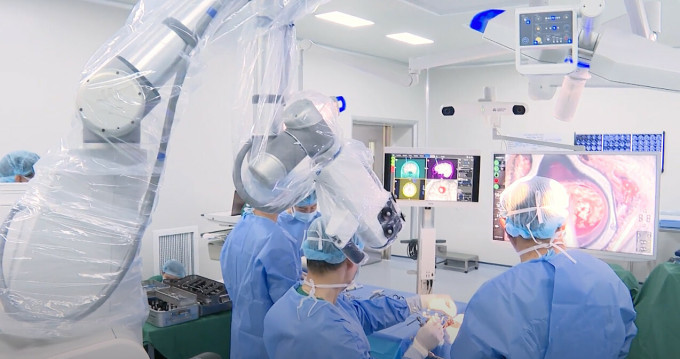
Doctors at Tam Anh General Hospital perform brain surgery with the assistance of a robot. Photo: Provided by the hospital.
With the aid of a high-powered microscope, the surgeon will use special forceps to grasp the location of the cerebral vascular malformation and carefully remove it from the surrounding brain tissue. The surgeon will then reattach the skull bone and close the incision in the scalp. Excision is usually performed when the malformed blood vessel can be removed without affecting the functional areas of the brain.
MSc. Dr. Mai Hoang Vu
Department of Neurosurgery, Tam Anh General Hospital, Ho Chi Minh City
| To provide the latest information on brain tumor surgery, hemorrhagic stroke, cerebral vascular malformations, etc., using the Modus V Synaptive AI-powered robot – the only one of its kind in Vietnam – Tam Anh General Hospital System is organizing an online consultation week on VnExpress . The program runs from June 8th to 14th; readers can follow the program and submit questions here to receive answers from the doctors. |
Source link


![[Image] Central Party Office summarizes work in 2025](/_next/image?url=https%3A%2F%2Fvphoto.vietnam.vn%2Fthumb%2F1200x675%2Fvietnam%2Fresource%2FIMAGE%2F2025%2F12%2F18%2F1766065572073_vptw-hoi-nghi-tong-ket-89-1204-jpg.webp&w=3840&q=75)
























































































Comment (0)