

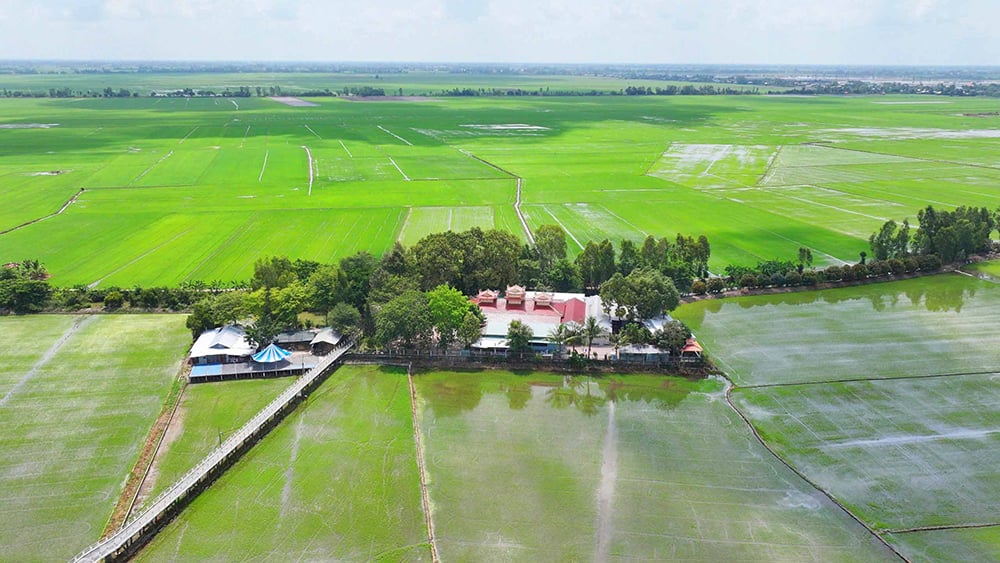
The Floating Stone Palace is located in the middle of the field.
Leaving a mark of the pioneers
Over the weekend, I had the opportunity to pass by the Mac Can Dung canal to bridge number 10, then turn right along the S-shaped canal that runs alongside vast fields. This season, the young rice seedlings dye the entire field green, creating a picturesque rural scene. Following the canal for about 5km, you reach the gate of the Da Noi Shrine. Crossing the more than 100-meter-long concrete bridge connecting the canal bank to the high mound, the scenery is very peaceful. Sitting under the shade of an ancient star tree, Mr. Nguyen Van Tuan (Head of the Da Noi Shrine's Welfare Committee) and the locals recounted their daily volunteer work there.
Recalling the legend of the Floating Stone Shrine, Mr. Tuan said that about 100 years ago, Mr. Nguyen Van Anh (Ut Anh) and his wife, Mrs. Do Thi Anh, came to this area to cultivate rice and raise buffaloes. At that time, the area was still wild and desolate, and people had to work late into the night and wake up early in the morning. When the sun was about to set, people would quickly return home because the fields were very far from their houses. To make it easier to tend the fields, Mr. and Mrs. Ut Anh carried soil every day to build high mounds and erect shelters to live in. In this wild area, finding drinking water was very difficult, so the couple diligently dug wells for daily use.
While digging the well, they discovered many earthenware bowls, plates, and dishes scattered underground, most of them incomplete. Continuing to dig deeper, they found several large pillars. Mr. Ut Anh believes this was a logistical area related to the Lang Linh - Bay Thua uprising led by Commander Tran Van Thanh against the French. Therefore, he temporarily erected a small house for folk worship. Today, in front of the Da Noi shrine, there is still a pond of about 200 square meters, with a few lotus plants growing sparsely, holding water year-round. According to the locals, this pond never dries up or becomes contaminated with alum.
Although they no longer use the pond's water, the villagers still preserve it, reminding future generations to be grateful to their ancestors who conquered nature and opened up the land. At that time, farmers in the inland region had a bountiful harvest and had plenty to eat and save. They pooled their labor and resources to renovate a spacious house to worship Commander Tran Van Thanh. However, after the renovation, the house was only about 2 square meters, with three small altars: one for the Three Jewels, one for Commander Tran Van Thanh, and one for the ancestors. Then the villagers discussed it and decided to hold an annual ceremony on the 21st and 22nd of the second lunar month to offer food to Mr. Tran Van Thanh. They haven't yet thought of a name for this house of worship.
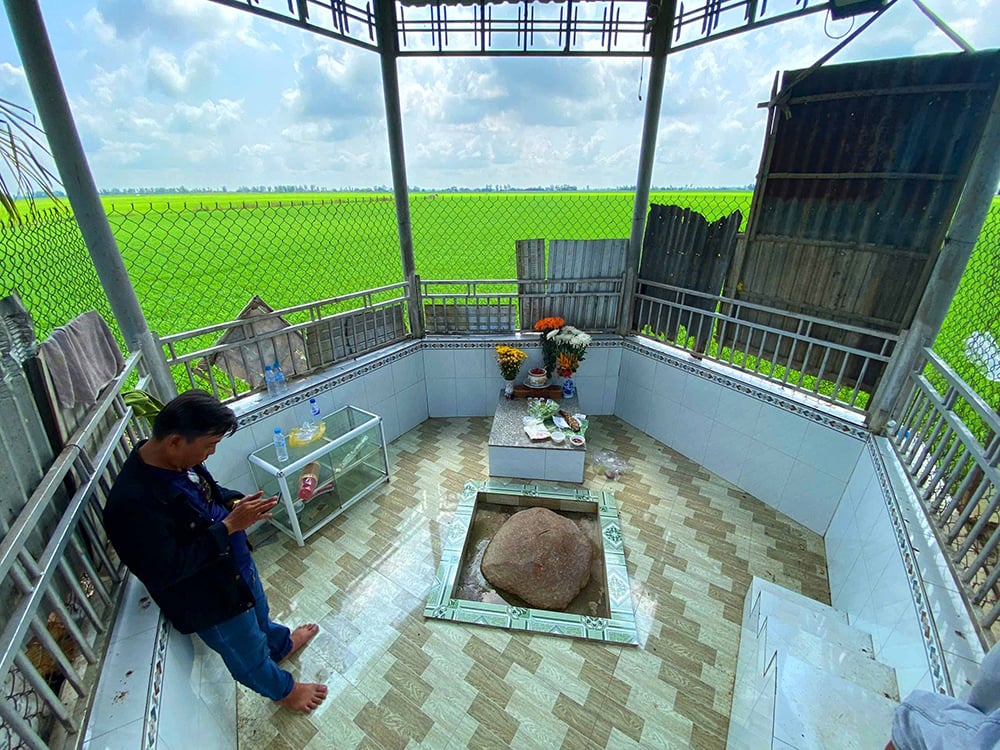
The floating rock was built and preserved by the local people.
The story of the "sacred" stone in the middle of the field.
Around 1930, Ms. Do Thi Anh's brother (Mr. Do Van Cam) discovered a rock protruding from an open field near the shrine of Commander Tran Van Thanh. He then informed the local people about this strange discovery. In 1936, the villagers rebuilt the shrine using bamboo and leaves, naming it the Floating Rock Shrine. Currently, the Floating Rock Shrine is a spacious and well-built structure on a high, dry mound. Every day, the shrine is carefully maintained by the local people who offer incense and prayers.
Crossing a small wooden bridge and following the ditch for about 300 meters, we asked the farmers tending their rice paddies about the floating rock, and they enthusiastically guided us. Deep inside the rice fields, we found a small shelter. In the hollow below was a perfectly round, mysterious-looking rock, carefully preserved. It was strange to see a rock about 1 meter in diameter standing out in the middle of a vast field. The local farmers said that long ago, they had tried to pry it up with their own strength, but without success. Since then, they built a shelter to protect it, and it remains there to this day.
Many fantastical stories surround this rock. The rumors of its sacredness are unknown, but some superstitious people come to pray and ask for all sorts of blessings. As a result, this inanimate rock has been "deified" into a sacred object. While admiring the rock, we saw several people praying. When they saw us raising our cameras to take pictures, they scrambled away, afraid of being published in the newspaper.
Currently, the Đá Nổi Palace is built in a three-bay, two-wing architectural style, enhancing its aesthetic appeal and ancient charm. Inside, it houses shrines dedicated to two national heroes, Trần Văn Thành and Nguyễn Trung Trực. The walls are decorated with numerous paintings depicting the life and career of Commander Trần Văn Thành, from his time as an official to his apprenticeship under Buddhist master Tây An, and his leadership of the Gia Nghi army in the resistance against the French.
Visitors to the Đá Nổi shrine, in addition to sightseeing and offering prayers, can also sit in the shade of ancient trees, listen to stories about the pioneers' process of reclaiming land, conquering nature, and establishing the village. Occasionally, a gentle breeze from the fields blows through, bringing a sense of calm and serenity to the soul.
| The Dinh Da Noi (Floating Stone Temple) has a history of formation and development spanning 100 years. Through the ups and downs of history, the temple has been restored and renovated to a magnificent state. It is considered a folk religious structure built in the traditional Southern Vietnamese architectural style, closely associated with the ancient Lang Linh area. |
Source: https://baoangiang.com.vn/dinh-da-noi-giua-dong-a420409.html
![[Photo] President Luong Cuong presides over the welcoming ceremony for the President of the European Council, Antonio Costa.](/_next/image?url=https%3A%2F%2Fvphoto.vietnam.vn%2Fthumb%2F1200x675%2Fvietnam%2Fresource%2FIMAGE%2F2026%2F01%2F29%2F1769662707713_ndo_br_1-jpg.webp&w=3840&q=75)


![OCOP during Tet season: [Article 4] Elevating local products](/_next/image?url=https%3A%2F%2Fvphoto.vietnam.vn%2Fthumb%2F402x226%2Fvietnam%2Fresource%2FIMAGE%2F2026%2F01%2F29%2F1769652810578_2935-z6982071462129_649e82db06fb2f2ea701388b1f5f5b0b-173322_176-185229-202804_457.jpeg&w=3840&q=75)


![OCOP during Tet season: [Part 3] Ultra-thin rice paper takes off.](/_next/image?url=https%3A%2F%2Fvphoto.vietnam.vn%2Fthumb%2F402x226%2Fvietnam%2Fresource%2FIMAGE%2F2026%2F01%2F28%2F1769562783429_004-194121_651-081010.jpeg&w=3840&q=75)

![OCOP during Tet season: [Part 2] Hoa Thanh incense village glows red.](/_next/image?url=https%3A%2F%2Fvphoto.vietnam.vn%2Fthumb%2F402x226%2Fvietnam%2Fresource%2FIMAGE%2F2026%2F01%2F27%2F1769480573807_505139049_683408031333867_2820052735775418136_n-180643_808-092229.jpeg&w=3840&q=75)



Comment (0)