

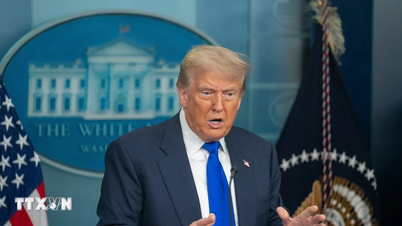
The timing of the event was particularly significant: the entire leadership of the European Commission was in India when US President Donald Trump, in his first cabinet meeting, reaffirmed his intention to impose a 25% protective tariff on EU goods exported to the US market.
Trump went even further, claiming that the EU was created to destroy America and cause it to suffer losses and accumulate tens of billions of dollars in debt. Previously, India had also been threatened with tariffs by Trump, and the issue only temporarily subsided and was not fully resolved during Indian Prime Minister Narendra Modi's recent trip to the US.
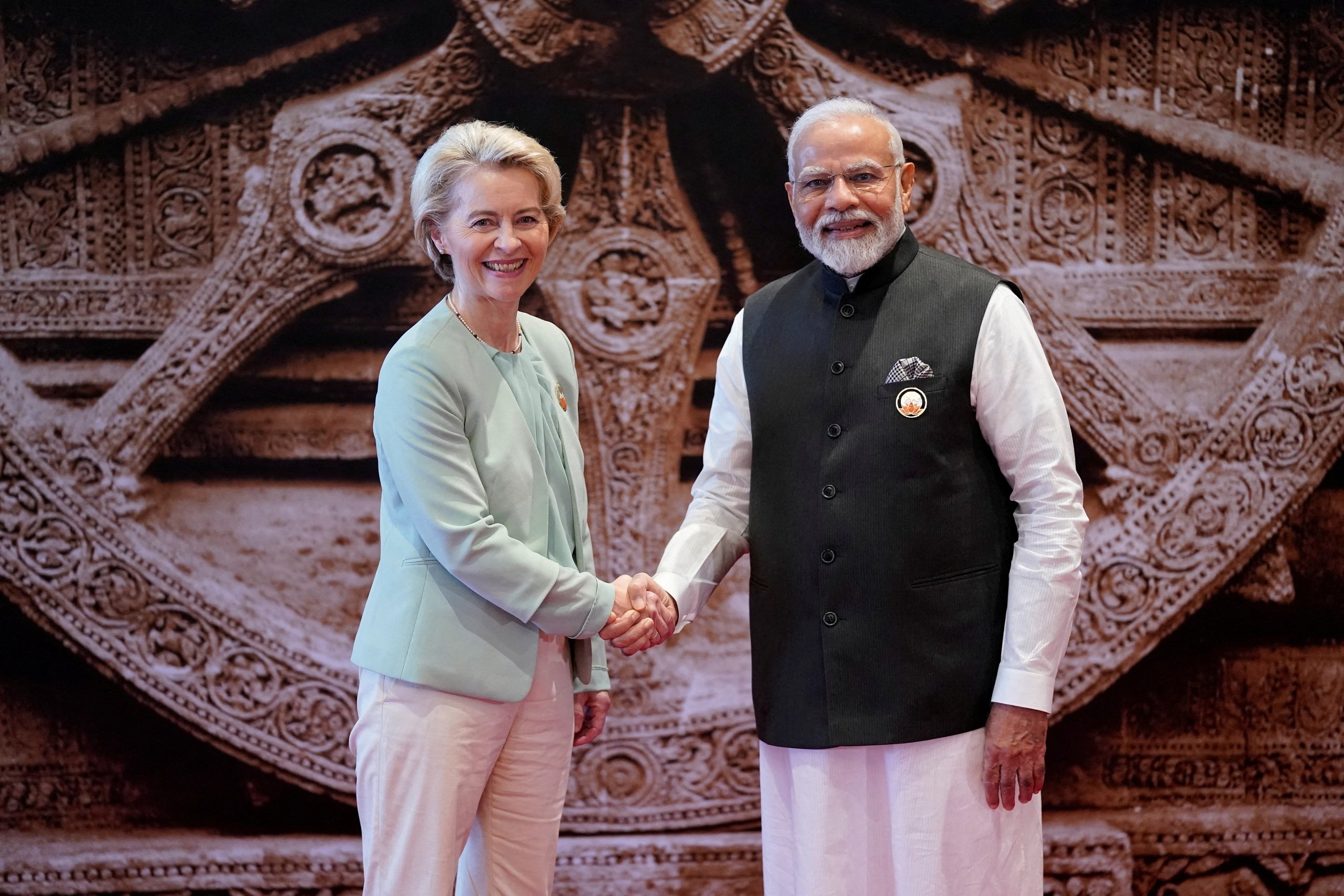
Indian Prime Minister Narendra Modi welcomes European Commission President Ursula von der Leyen in New Delhi, India.
Recent developments and new policies of the Trump administration, along with challenges to the EU and India on many fronts, are prompting India and the EU to draw closer together, unify their views, and coordinate actions more effectively to become true allies without needing to form a coalition.
The EU's emphasis on India is evident in the fact that all members of the European Commission visited India on this occasion. Mutual support is essential for effective and sufficient responses to both China and the new US administration. The EU-India alliance helps both sides reduce their dependence on the US market and minimize the negative impact of US protectionist tariffs. The ultimate goal is a bilateral free trade agreement. To counter China, both sides must successfully implement the India-Middle East-Europe Economic Corridor (IMEC) initiative. The current circumstances necessitate a partnership between the two sides.
Source: https://thanhnien.vn/dong-minh-hoa-doi-tac-185250227233441232.htm




























































Comment (0)