

Vietnam is attracting tourists from all five continents.
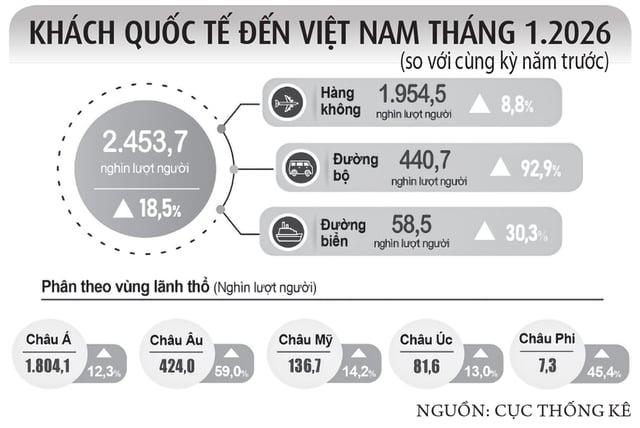
According to statistics, in January 2026, Vietnam welcomed nearly 2.5 million international visitors – the highest number of visitors in a single month ever, an increase of 21.4% compared to the previous month and an increase of 18.5% compared to the same period in 2025.
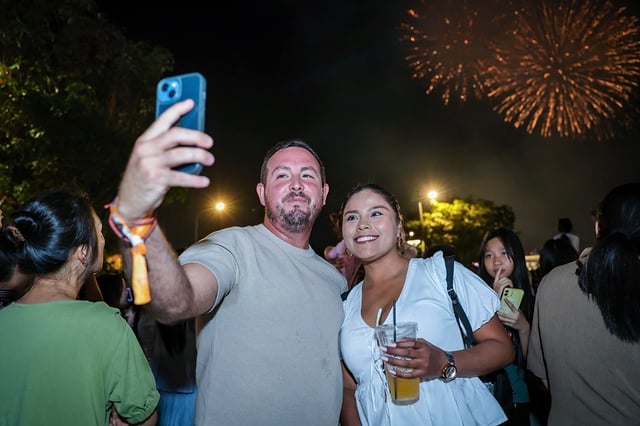
International tourists celebrate New Year's Day 2026 on Nguyen Hue pedestrian street, Ho Chi Minh City.
Photo: Nhat Thinh
Representatives from the National Tourism Administration noted that the figure of nearly 2.5 million international visitors is not only impressive in scale but also demonstrates a remarkable growth structure across different market segments.
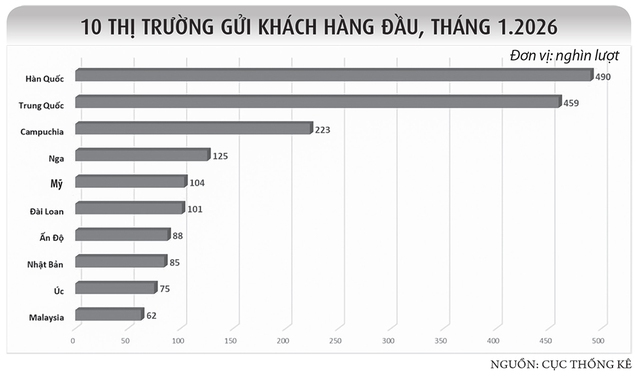
Specifically, nearby markets in the Asian region continued to be the mainstay, accounting for approximately 1.8 million arrivals, representing over 73% of the total. However, growth in this region was differentiated. South Korea played a key role as a driving market with nearly 490,000 arrivals, an increase of approximately 26% compared to the previous month and over 17% year-on-year. This is not only a stable market but also maintains a good growth rate, reflecting the enduring appeal of beach resorts, golf tourism, family tourism, and the advantage of extensive air connections between the two countries.
Japan saw a sharp increase of 41% compared to the previous month and 16.9% compared to the same period last year, indicating a strong recovery in the high-spending tourist segment. While the Chinese market declined year-on-year, the number of visitors remained very high, reaching nearly 460,000, ranking second after South Korea.
In Southeast Asia, many markets achieved high growth rates, such as the Philippines (up 75%), Singapore (up 51.7%), Indonesia (up 41.4%), and Thailand (up 10.6%). Notably, the number of Cambodian tourists to Vietnam in the first month of the year increased more than threefold compared to the previous month and more than doubled compared to the same period last year. This reflects the effectiveness of ASEAN's intra-bloc tourism cooperation programs, as well as the advantages of geographical proximity, reasonable costs, and convenient transportation connections.
In particular, the promising Indian market impressed with an 80.5% increase compared to the same period in 2025, bringing the number of visitors from this country to nearly 88,000 in January. The rapid growth of the Indian market in recent times shows the right direction for Vietnam's tourism industry in diversifying its source markets.
Meanwhile, Europe emerged as a bright spot for growth, with a total of approximately 424,000 visitors, an increase of over 35% compared to the previous month and nearly 60% compared to the same period last year. Major markets such as Russia, the UK, France, and Germany all saw double-digit growth; particularly Russia (up 195.1% year-on-year) and Poland (up 98.7% year-on-year) experienced very high growth rates. This is indicative of the positive effects of favorable visa policies, direct flights, and the attractiveness of long winter holidays in Vietnam. European visitors also tend to stay longer and spend more, creating significant added value.
"Overall, growth from Northeast Asian, ASEAN, European, and distant markets shows that Vietnam's international tourist source structure is becoming increasingly diverse and sustainable. This is an important foundation for the tourism industry to maintain its growth momentum in 2026 and beyond," a representative from the Vietnam National Tourism Administration assessed.
In the context of increasingly fierce competition among destinations and rapidly changing global travel trends, the breakthrough growth of Vietnam's tourism is a bright spot in the region and the world .
Representative of the National Tourism Administration
The beginning of a new transformation.
In fact, Vietnam's position as a tourist destination is increasingly being firmly established on the global tourism map. For the past year, Vietnam has consistently appeared in top destination rankings, dominating awards at both continental and global levels. Vietnamese banh mi was ranked the best in the world by CNN; Vietnamese cuisine ranked second globally for the best noodle dishes; Mui Ne topped global travel trends for 2026; Vietnam was in the top 20 ideal winter travel destinations in the world; Vietnam was in the top 5 ideal countries for solo travel…; whether in terms of cuisine or destination, in any criterion, Vietnam has become a name that fully meets the needs of all types of tourists. Most recently, Vietnam has for the first time surpassed Thailand in the race to attract Chinese tourists by a considerable margin: Vietnam is expected to welcome approximately 5.3 million Chinese tourists in 2025, while Thailand is only expected to welcome about 4.5 million.
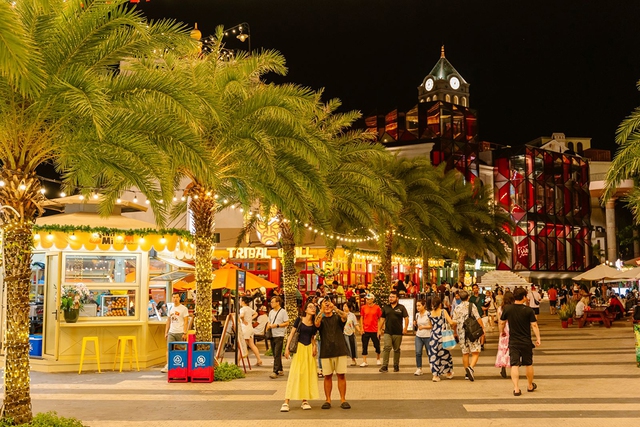
Vietnam is considered a rapidly rising tourism powerhouse in Southeast Asia.
PHOTO: NA
Selecting Vietnam among the 52 names on the "global travel trends map" for 2026, the New York Times (USA), one of the world's largest-circulation newspapers, favorably describes Vietnam as a rapidly rising tourism powerhouse in Southeast Asia. "Vietnam attracts millions of tourists each year with its renowned culinary culture, majestic natural landscapes – from mountains to tropical forests – and rich history… In addition, significant investments in tourism infrastructure expected to be completed this year are preparing the country to welcome a new wave of tourists in 2026," the New York Times wrote.
According to the Vietnam National Tourism Administration, the record 2.5 million international visitors in January is not only an impressive number but can also be seen as the starting point for a new growth cycle for Vietnamese tourism. We are shifting from a state of recovery to improving the quality of growth and increasing competitiveness. This achievement is not accidental but a combination of many strategic factors that have been and are reshaping Vietnam's international tourism market.
Firstly, the government's expansion of visa exemptions, extension of stay periods, implementation of multiple-entry electronic visas, addition of border gates accepting electronic visa holders, and streamlining of immigration procedures have made Vietnam more accessible to tourists from many countries, increasing flexibility for travel itineraries. Alongside this, the expansion of numerous new flight routes, the recovery of long-haul flights, and flexible transportation services have facilitated travel, both to traditional and emerging markets.
Fundamentally, a stable socio-political environment, guaranteed security and order, along with the image of a safe and friendly destination, are becoming important competitive advantages for Vietnamese tourism in attracting international visitors. In the context of global travelers increasingly prioritizing safety and reliability when choosing destinations, Vietnam is considered a stable and hospitable country, thereby creating a sense of security for tourists when planning and experiencing their trips.
Notably, in recent times, tourism promotion campaigns by the National Tourism Administration and localities, as well as businesses in key and potential markets, have been continuously innovated and diversified. The participation of Vietnam's tourism industry in major international tourism fairs, cooperation with media outlets and international organizations, and the strengthening of multi-channel promotion have raised awareness and interest in Vietnam as an attractive destination in Southeast Asia.
Furthermore, the richness and diversity of tourism types, such as beach and island tourism, cultural tourism, nature tourism, and urban tourism, along with innovative products like MICE tourism, agricultural tourism, railway tourism, medical and healthcare tourism, golf tourism, and film tourism, have helped attract many different customer segments.
The head of the National Tourism Administration affirmed: "In the context of increasingly fierce competition among destinations and rapidly changing global tourism trends, the breakthrough growth of Vietnamese tourism is a bright spot in the region and the world."
Telling a new story in a new era.
In 2026, the tourism industry aims to welcome 25 million international tourists, serve 150 million domestic tourists, and achieve total tourism revenue of approximately 1,125 trillion VND. Ms. Dong Thi Ngoc Anh, Deputy General Director of Sun Group, acknowledges that the target of 25 million international tourists is a significant challenge, but entirely achievable if we maintain the current growth momentum. Positive signals from the New Year holiday and impressive results throughout the past month indicate a rapid and sustainable recovery of the international market.
Notably, from the market to the customer segments, the image of Vietnamese tourism in the eyes of international friends has undergone a very clear transformation. Vietnam is no longer known only as a destination for nature or culture, but is gradually being recognized as a high-class resort, entertainment, and experiential destination. This is the key to Vietnam's transformation in tourism growth, shifting from quantity to quality, not only setting records for the number of visitors but also bringing significant value to the economy. Tourism is facing a huge opportunity to truly become a key economic sector.
To achieve breakthroughs in the new era, according to Sun Group's leadership, Vietnam needs to focus on three pillars: diversifying and improving the quality of tourism products; strengthening international air connectivity, especially with distant and high-spending markets; and promoting close coordination between the state, businesses, and localities in investing, promoting, and operating tourism.
"Phu Quoc can be considered a prime example of success if we can strongly promote the three pillars mentioned above. Advances in piloting visa exemptions; a significant expansion of international flight networks; investment in infrastructure and a synchronized tourism ecosystem, high-end resorts, and international-scale shows and festivals have contributed to positioning the island as a new global destination. This is the key to attracting a strong influx of international tourists, which can be replicated in many other destinations, thereby creating momentum for sustainable growth in Vietnamese tourism and enhancing the nation's position in the new development phase," Ms. Dong Thi Ngoc Anh stated.
Dr. Pham Ha, General Director of LuxGroup, also believes that the target of welcoming 25 million tourists this year is entirely feasible for Vietnam in terms of quantity, but the major challenge lies in quality. Currently, the average spending of each international tourist in Vietnam is only about 1,200 - 1,300 USD, lower than Thailand (1,600 - 1,800 USD) and Singapore (over 2,000 USD). The results for 2025 also show that the tourism industry has recovered well in terms of quantity, but total revenue has not been commensurate, proving that the old growth model has reached its limit. Therefore, if the value per tourist is not increased, 25 million international tourists will hardly generate as much surplus value for the economy as expected. The core issue for Vietnamese tourism is the need to reposition the national brand: from "crowded and cheap" to "quality, in-depth, and sustainable," a new mindset for the new era.
According to Mr. Pham Ha, Vietnam's tourism industry needs to prioritize markets with long stays, high spending, cultural interest, and sustainability, such as Europe, the US, Australia, and New Zealand. Tourists from these markets stay for 12-18 days and spend $1,800-$2,500 per person. At the same time, the Middle East and Eastern Europe will also be promising new markets for the high-end segment.
On the other hand, the global tourism industry is undergoing a dramatic transformation along three main axes. First is digital transformation. Tourism is entering an era of absolute personalization. Digital ecosystems, big data, artificial intelligence, super apps, and seamless experiences are becoming indispensable requirements.
Secondly, there's the green and sustainable transformation. Tourists are increasingly prioritizing sustainable destinations, demanding green businesses and responsible experiences. ESG (environmental, social, and governance) has gone from being just a slogan to a core competitive criterion. The third axis is next-generation globalization: open value chains, smart connectivity, and cultural synergy. At this point, tourism is no longer just a collection of destinations but becomes a national brand.
The golden opportunity to reposition the national brand.
Vietnam has entered an era of national resurgence, with expectations of 10% annual economic growth from 2026. Tourism is projected to contribute over 10% to GDP, create more than 6 million direct jobs, and enhance national influence through soft power. These figures not only reflect Vietnam's resilience but also affirm that the tourism industry will be a strategic spearhead in this period of national growth. The combination of Vietnam's resilience, digital technology, sustainable development, and international integration is creating a "golden opportunity" for Vietnam to reposition its tourism brand on the world map.
Dr. Pham Ha , General Director of LuxGroup
Source: https://thanhnien.vn/du-lich-lap-ky-tich-185260209233016446.htm

![[Photo] National Assembly Chairman Tran Thanh Man working with the Standing Committee of the Economic and Financial Committee](https://vphoto.vietnam.vn/thumb/1200x675/vietnam/resource/IMAGE/2026/05/20/1779249584387_ndo_br_1-jpg.webp)



![[Photo] General Secretary and President To Lam presides over a meeting on assessing national development resources.](https://vphoto.vietnam.vn/thumb/1200x675/vietnam/resource/IMAGE/2026/05/20/1779253785852_a1-bnd-2943-8519-jpg.webp)














































































Comment (0)