

Mr. Pham Van Vuong, Director of Hoa Binh Hydropower Plant, informed VTC News on the afternoon of June 13th that the plant is currently only generating electricity at a limited capacity.
Mr. Vuong further clarified that when water levels are low, reaching the dead water level, the hydropower industry advises against exploitation as it would be detrimental to the generating units. " In unavoidable situations, we have to operate, but generally, exploitation should be avoided when the water level has reached the dead level. Our nhiệm vụ, besides generating electricity to meet consumer demand, is to ensure the safety of the system and people, preventing any damage and maintaining water supply to downstream areas," Mr. Vuong emphasized.
Earlier, on the morning of June 13th, in an interview with VTC News , Mr. Tran Xuan Thuy - Deputy Head of the Administrative and Labor Department of Hoa Binh Hydropower Plant - stated that although there had been rain in recent days, the amount of water flowing in was not significant, with a water level of 103m, while the minimum water level is regulated at 81.9m, so the power generation capacity remains low.
" We are continuing to monitor the water inflow and regularly sending reports to EVN Group so that they can plan electricity production accordingly ," Mr. Thuy said.
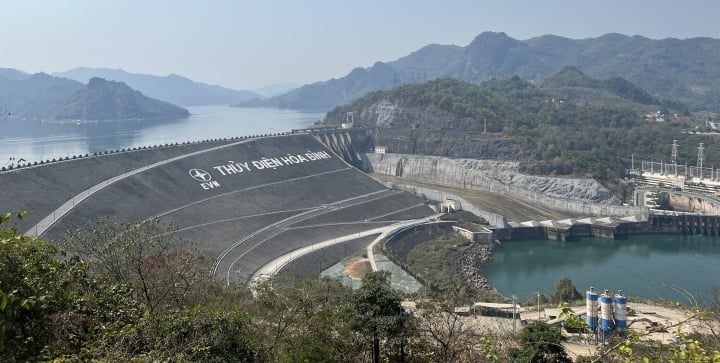
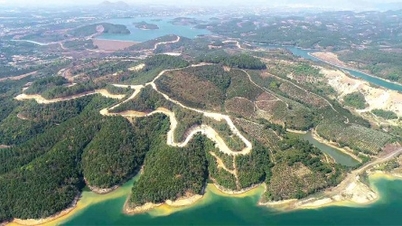
The water level at the Hoa Binh hydroelectric plant is only 22 meters above the dead water level. (Illustrative image: Internet)
The Hoa Binh hydroelectric power plant has a capacity of 1,920 MW and plays a crucial role in the national energy sector. In 2023, the hydrological conditions on the Da River were very unfavorable for power generation. To date, only 3.5 billion kWh have been generated in 2023, equivalent to 37% of the plan. Therefore, with the current situation, ensuring the planned electricity production will be very difficult...

In late May and early June, the company consistently operated at high, almost maximum capacity, causing the water levels in the reservoirs to drop rapidly. Reservoirs in the northern region and the Da River were all close to their dead water levels, and their extraction capacity was virtually nonexistent, forcing them to operate only to maintain operations.
Due to continuous flooding, the water level in the reservoir has dropped to only 102m. This level is 15m lower than the normal water level and only 22m above the dead water level. Meanwhile, the inflow into the reservoir is 40m3/s, an insignificant amount despite recent rains, and has not improved.
According to a report by the Department of Industrial Safety and Environmental Engineering (Department of Safety and Environment), water inflow into reservoirs nationwide today increased slightly compared to yesterday. Reservoirs in the Northern, North Central, and Southeastern regions have low water levels, close to the dead storage level. The total water inflow into major hydropower reservoirs in the North increased by 28% compared to June 11th.
Meanwhile, in the South Central coastal region and the Central Highlands, water levels in reservoirs fluctuated slightly compared to yesterday, remaining within the minimum range stipulated in the operating procedures.
The water inflow into the reservoir is primarily for water regulation, ensuring minimum flow rates. Therefore, power plants are operating at a reduced capacity with low water levels and power output to ensure the safety of the generating units during operation. It is difficult to meet the power generation requirements according to the reservoir's operating procedures at this time.
Forecasts for the next 24 hours indicate a slight increase in water inflow into the reservoirs, but the situation remains difficult despite having passed the dead water level. The total unutilized capacity from the Son La, Lai Chau , Ban Chat, Huoi Quang, Tuyen Quang, Thac Ba, Hua Na, Ban Ve reservoirs, etc., is nearly 5,000 MW.
According to Tran Viet Hoa, Director of the Electricity Regulatory Authority, the total capacity of the largest power sources in the North has reached 18,580 MW, of which the largest capacity is from hydropower at 3,800 MW.

Experts advise that although hydrological conditions may improve, the heatwave continues to be complex, and electricity demand remains high. Therefore, hydropower plants need to operate flexibly and increase water storage in reservoirs. Meanwhile, people and businesses need to raise their sense of responsibility and promote electricity saving programs to avoid putting pressure on the national power grid, especially in the North.
PHAM DUY
Beneficial
Emotion
Creative
Unique
Source



























































![[Video] Sunset at Lap An Lagoon – Where the sun sets over the fishing nets](https://vphoto.vietnam.vn/thumb/1200x675/vietnam/resource/IMAGE/2026/05/31/1780192137701_beach-landscape-sea-water-nature-grass-745871-pxhere-com.jpeg)






































Comment (0)