

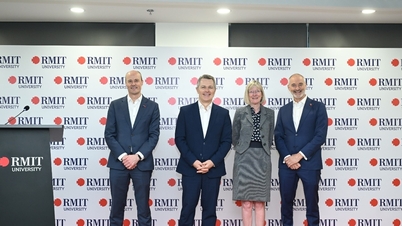
The Ministry of Education and Training, in collaboration with RMIT University Vietnam, organized the Vietnam Education Innovation Forum on Artificial Intelligence (AI) 2025, with the participation of many experts, education managers, teachers, and lecturers from across the country.
Digital skills gap
Ms. Tara O'Connell, Head of Education Programs at UNICEF Vietnam, stated that this is a concrete initiative by the Vietnamese Ministry of Education and Training to implement General Secretary To Lam's directive on promoting innovation, digital transformation, and the application of AI in all fields, especially in education, in order to improve the quality of learning and develop skills for all learners.
Ms. Tara O'Connell affirmed UNICEF Vietnam's commitment to supporting the development of an AI strategy in education by 2035, as well as digital and AI competency frameworks for Vietnamese teachers and students, for widespread application nationwide.
UNICEF will promote initiatives using AI tools to reduce the burden on teachers, giving them more time and tools to do what they do best, such as inspiring children to learn; and support expanding partnerships between the Ministry of Education and Training and businesses in the field of educational technology.
 |
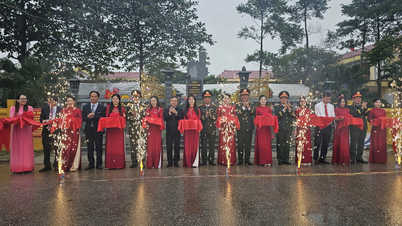
Delegates performed the ceremony to launch a series of activities on Vietnamese educational innovation with artificial intelligence. |
According to Tara O'Connell, AI is revolutionizing education, making it more inclusive, adaptable, and effective. AI opens up many opportunities for Vietnamese teachers, from automating administrative tasks to enhancing personalized learning, helping Vietnam leverage AI in education to compete internationally.
AI can also promote inclusiveness in education through personalized learning, supporting distance learning, providing high-quality resources to disadvantaged communities, including remote schools, and in emergency situations.
Artificial intelligence can address the teacher shortage by providing AI-based professional development programs and reducing administrative burdens. AI can also help improve accessibility for children with disabilities and support multilingual learning.
However, the digital divide persists, stemming from a lack of smart devices; unstable internet connectivity in schools and the most inaccessible areas; fragmented and low-quality digital learning resources and platforms; a lack of appropriate equipment and content for students with disabilities; and a lack of gender-transitional approaches to encourage more female students to study and work in STEM fields.
The lack of digital skills, particularly AI skills, among teachers and education administrators exacerbates these challenges, hindering the effective application and integration of advanced educational technologies.
Vietnamese teachers are facing a heavy workload due to their numerous administrative tasks, lesson planning, and grading responsibilities, which limits the personalization of their teaching and the innovation of their methods.
Opportunities and challenges
Professor Julia Gaimster, Senior Director of Academic, Research and Student Curriculum at RMIT University Vietnam, noted that by working together, we can ensure that AI is not only a technology of the future but also a driving force for transformation in education, benefiting the Vietnamese education system and community.
Associate Professor Dr. Nguyen Chi Thanh - Head of the Faculty of Education, University of Education (Vietnam National University, Hanoi ) - pointed out the challenges and opportunities in using AI in education, especially in assessment and learning evaluation. He argued that a national strategy for the development and application of AI in education is needed, along with reforms to training programs to help teachers focus on developing independent and creative thinking in students.
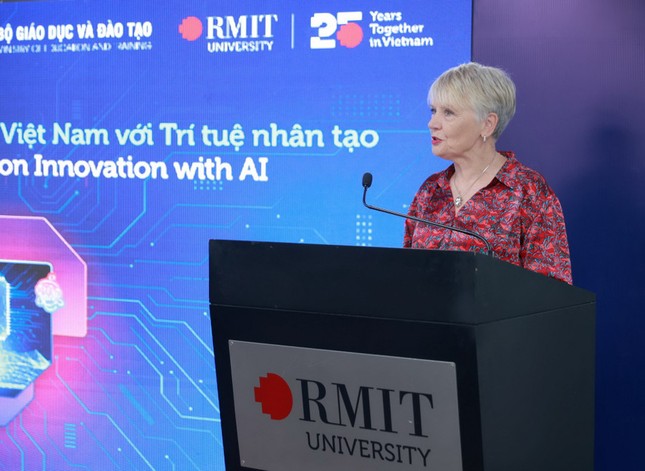 |
Professor Julia Gaimster believes that AI is not only the technology of the future, but also a driving force for transformation in education. |
“The general education curriculum is moving towards competency development, and there is a clear transformation. In teacher training programs, focus should be placed on three main pillars: setting educational goals, designing content and learning tasks, and using AI to support these activities,” Assoc. Prof. Dr. Nguyen Chi Thanh emphasized.
Mr. Vu Minh Duc, Director of the Department of Teachers and Educational Management Staff (Ministry of Education and Training), emphasized that the forum marks an important step in the journey of educational reform, using AI and digital technology as a foundation.
The forum is an important activity of the Ministry of Education and Training within the framework of the project initiative “EEAI: Innovation in Education with AI” and its implementation, with funding from RMIT’s Strategic Innovation Fund, demonstrating a commitment to contributing to the development of education in Vietnam.
According to Mr. Vu Minh Duc, this forum not only provides new knowledge and technologies for education, but also creates strong motivation in the training and development of teachers and education management staff, in line with the Ministry of Education and Training's orientation towards innovation and digital transformation.
The Ministry will continue to play a constructive, leading, and collaborative role in developing policies, legal frameworks, and creating favorable conditions for the effective, sustainable, and humane application of AI in education.
Source: https://tienphong.vn/giam-ganh-nang-cho-giao-vien-nho-ai-post1732466.tpo











































































Comment (0)