

The 2025 high school graduation exam in Literature generally follows the structure of the sample exam released earlier by the Ministry of Education and Training . However, this year's exam has many innovations compared to the 2024 exam, especially in the types of material used.
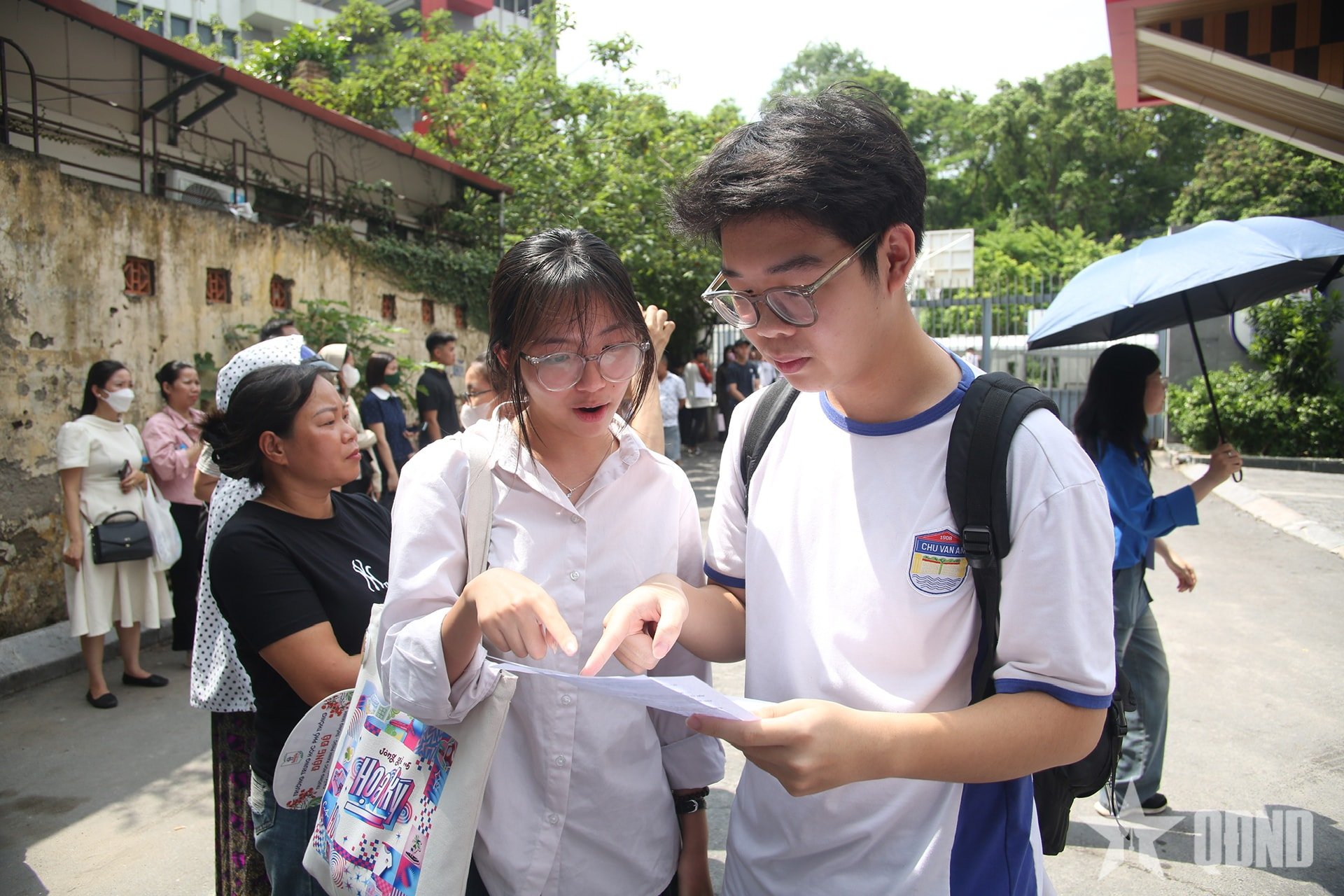 |
| Candidates discuss the Literature exam. |
Unlike previous years, this year's exam aligns with the spirit of the 2018 General Education Program, with questions following a genre-based system. This addresses the issue of rote learning and cramming, requiring students to have a firm grasp of the characteristics of different genres and assessing each student's reading comprehension, appreciation, and analytical skills.
In terms of difficulty level, the exam is highly differentiated and accurately assesses students' abilities. The projected average score for Literature in 2025 is 7.5 points.
The following is a suggested solution guide for the Literature exam from the Tuyensinh247.com expert team.
Part | Sentence | Solution guide | |
I. READING COMPREHENSION (4.0 points) | Question 1. | Third-person narration | |
Question 2. | Le's hometown and Son's hometown are connected to two rivers: the Lam River and the Red River (Le's hometown is connected to the Lam River; Son's hometown is connected to the Red River). | ||
Question 3. | - Figurative language: The artillery company is compared to a "grown tree trunk". - Effects: + Helps to make the writing more vivid and engaging. + It represents the strong growth of the artillery company, like a large tree trunk, strong enough to nurture branches that extend far — symbolizing the soldiers now dispersed to different fronts to continue their mission. This highlights the deep camaraderie and bond between teammates. + Expresses the author's pride and respect for the soldiers. | ||
Question 4. | Students base their understanding on the content and details provided in the text and state their appropriate interpretation. Suggest: - It portrays the close camaraderie and bond between soldiers, who live, fight, and share all the hardships of war. - Evoking the atmosphere of a brutal yet humane battlefield, they shared every piece of clothing and every sleeping spot amidst the bombs and bullets of war. This further highlights the close and affectionate bond between the soldiers. - It symbolizes a farewell not only in terms of battlefield space but also in the division of responsibility and duty to protect the homeland; each person in a different region, yet their hearts still beat as one. - Details also contribute to expressing the theme and ideas of the work. - … | ||
Question 5. | Similarities: Both texts express deep emotional attachments between people and the land they have lived on or traveled through. - When people travel through those lands, a part of their soul, memories, and feelings are left behind there. - Land and homeland are not only spaces for survival but also become a part of the soul, a source of memories, and a sacred symbol for each person. Therefore, both texts express love for one's homeland. | ||
II. WRITING (6.0 points) | Question 1. (2 points) |
| |
Question 2. (4 points) | a. Ensure the essay meets the required format and length. b. Accurately identify the issue to be discussed. c. Write an argumentative essay that meets the following requirements: Choose appropriate argumentative techniques; skillfully combine reasoning and evidence; present a systematic argument in accordance with the three-part structure of an argumentative essay. The assignment can be structured in several ways. 1. Introduction: Introduce the topic of discussion. 2. Body Paragraph a. Explanation: - "Homeland": Refers to the place where each person was born, grew up, and is deeply connected to. - "The sky of the Fatherland": Refers to the larger, more general country, the place where all regions of the homeland converge. → This statement affirms: Although everyone's hometown may be different, all are an inseparable part of the nation. Being attached to and contributing to one's homeland is building the nation. b. Analysis: - Context: The country is undergoing many changes: + Deep international integration presents both opportunities and challenges. + Migration, urbanization, and labor mobility have led many people to live far from their hometowns. + Reforms to the administrative apparatus. - Each rural area contributes to making up the country: From the mountains to the plains, from the islands to the borders – each place possesses its own unique culture and traditions, all contributing to shaping the image of our nation. Wherever they are, Vietnamese people share the same ideals and patriotism, ready to sacrifice for their country in war as well as in peacetime. - The responsibilities of citizens in the new era: No matter where I go or what I do, I will always carry the image of my homeland in my heart – because it is an integral part of my nation. + It's not enough to just love your homeland; you also need to be open to other lands. Developing one's hometown – whether it's a small village or a city – contributes to the overall development of the nation. + Respect and preserve local culture, protect the environment, and build a civilized way of life. Students should provide appropriate examples themselves. Students should provide appropriate examples themselves. c. Further discussion. - We should not discriminate based on region, because every region is worthy of pride and is an integral part of our nation. - Criticizing a pragmatic lifestyle that disregards one's roots, discriminates based on region, and focuses solely on personal gain. - Building a spirit of national unity, placing national interests and the interests of the Fatherland first, aiming for a prosperous and strong Vietnam. - … 3. Conclusion: Summarizing the issue |
Text and photos: HA TUNG – THAI HUNG
* Please visit the Science Education section to view related news and articles.
Source: https://baodaknong.vn/goi-y-giai-de-thi-mon-ngu-van-256716.html
![[Photo] Prime Minister Pham Minh Chinh receives the Chinese Ambassador to Vietnam](https://vphoto.vietnam.vn/thumb/1200x675/vietnam/resource/IMAGE/2026/04/05/1775397481797_ndo_br_dsc-5512-jpg.webp)




















































Comment (0)