

When we arrived at his house and asked about the battle fought by the Air Defense Forces in Vinh Linh ( Quang Tri ), Colonel Pham Son's eyes lit up. "Thinh was sitting right next to me... he died in my arms." After saying this, Colonel Pham Son fell silent, memories from more than half a century ago suddenly flooding back...
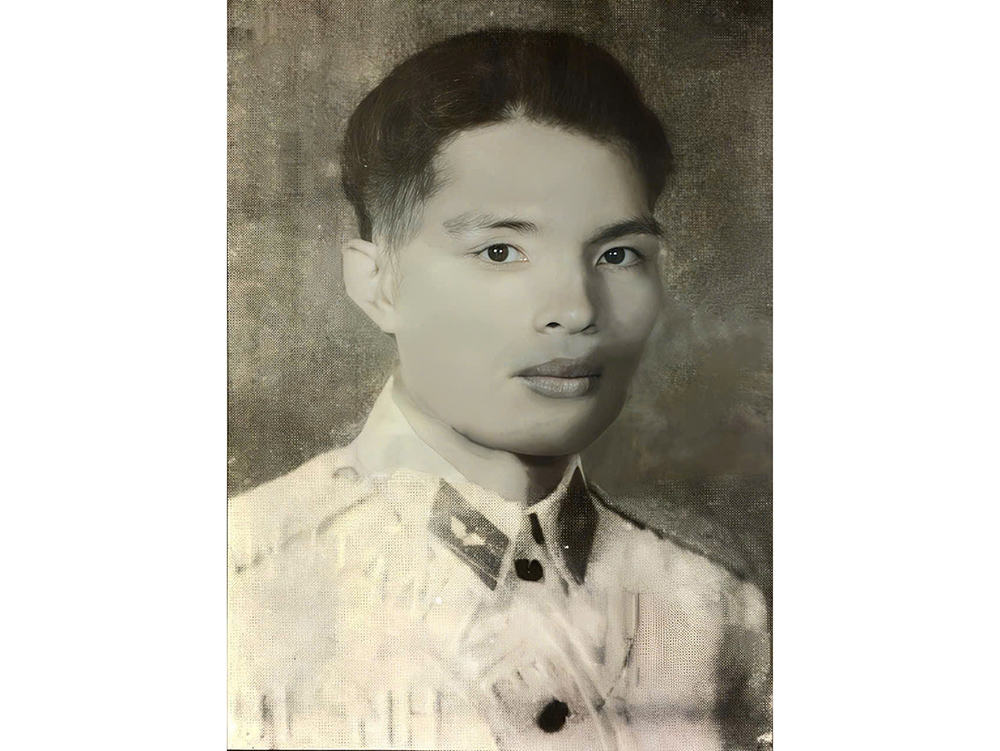 |
| Hero of the People's Armed Forces, martyr Le Hong Thinh. |
The young commanding officer in Colonel Pham Son's story was Lieutenant Le Hong Thinh, a Hero of the People's Armed Forces. He sacrificed his life in the midst of a blazing battlefield when a Shrike missile from an American plane hurtled directly towards the command vehicle. But in that fateful moment, he calmly steered his missile to hit its target.
In mid-1966, the 238th Missile Regiment, consisting of four battalions (81, 82, 83, and 84), marched into Vinh Linh, Quang Tri, to fight and learn how to counter B-52s, because according to President Ho Chi Minh and the Central Party Committee: "Sooner or later, the US imperialists will bring B-52s to bomb North Vietnam." At that time, Vinh Linh was known as the "ring of fire" due to continuous bombing by the enemy's air force, navy, and artillery. To carry out its mission, the 238th Regiment had to move a huge amount of equipment from Hanoi to Vinh Linh, mostly along the newly opened strategic road with many mountain passes, deep ravines, and areas constantly controlled and fiercely attacked by the enemy.
However, above all, the most terrifying thing for the Air Defense Forces was the Shrike missile—a deadly radar-killing weapon. When the troops used radar to locate targets, the Shrike would be launched from enemy aircraft, following the radar signal and hurtling straight into our positions with immense destructive power. Any position hit by a Shrike was certainly rendered incapacitated.
On July 11, 1967, the central region of Vietnam was swept by a scorching hot wind. Inside the control vehicle, the air was thick with the smell of sweat and engine oil. Battalion Commander Pham Son of the 81st Battalion sat near control officer Le Hong Thinh. The rangefinders, azimuth and elevation angle operators were ready for battle. A signal from a group of enemy aircraft appeared on the screen. Thinh listened intently to the parameters from the operators to select his target. “Here it is!” Thinh exclaimed softly, pressing the “launch” button. The missile left its launch pad. But suddenly, two signals appeared simultaneously on the screen: an enemy aircraft and a Shrike missile from the enemy aircraft hurtling towards our position. Thinh broke out in a cold sweat. At that moment, he could turn off the radar to break the Shrike's pursuit. But that would mean his missile would also lose its direction and fall, the target would escape, and the battle would be lost. In this life-or-death moment, Thinh chose to continue. He believed our missile would reach its target before the Shrike could get there.
A loud explosion rang out. Our missile hit its target first, knocking out the enemy aircraft, but Shrike was too close to the battlefield at that moment. Despite being disoriented, it still crashed straight into the control vehicle due to inertia. Debris from the explosion flew everywhere, one piece piercing Thinh's chest. He collapsed into the arms of Battalion Commander Pham Son, and died.
Colonel Tran Manh Hien, Hero of the People's Armed Forces and former commanding officer of Battalion 82, Regiment 238, recalled: "At the end of the battle of Battalion 81 and the battles of the detachments in Regiment 238, the entire regiment gathered its forces to form only one battalion, collectively designated as Battalion 84, because only the equipment of Battalion 84 remained to ensure the technical readiness."
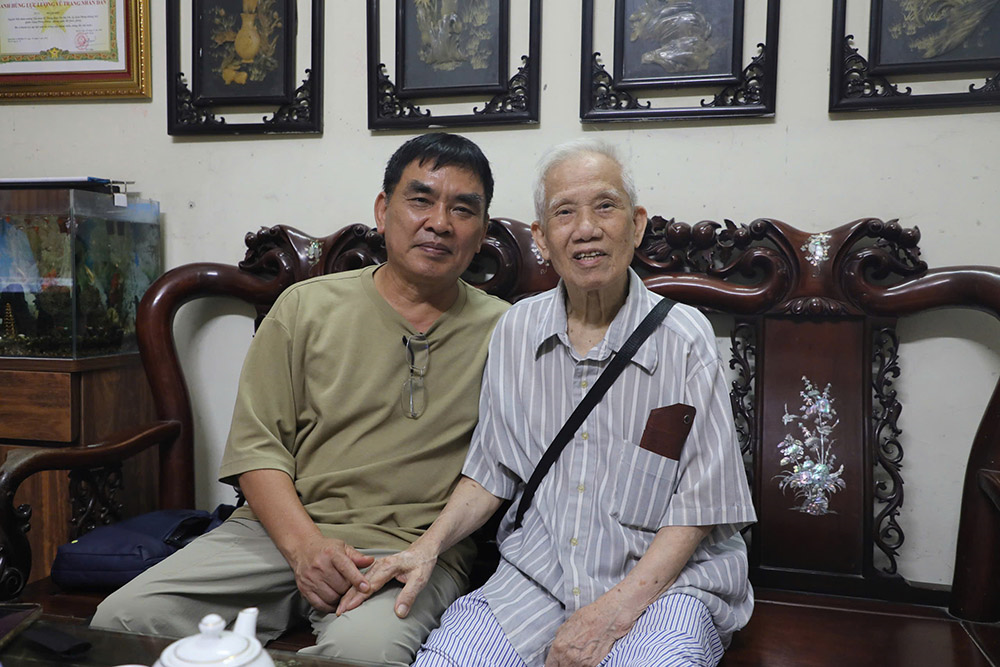 |
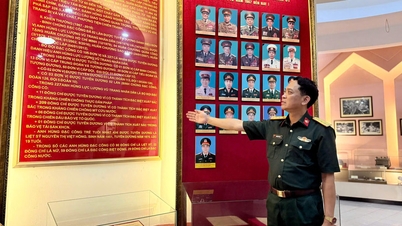
Colonel Pham Son (right), Hero of the People's Armed Forces, and the author of the article. |
In his unfinished diary entry, Lieutenant Le Hong Thinh wrote: “The battlefield is becoming increasingly fierce, but I am determined not to retreat. If I die, let me be laid facing south so that I can continue fighting alongside my comrades to liberate the South and unify the country...”
Lieutenant Le Hong Thinh's wish, as well as the legitimate aspirations of the entire nation, was transformed into concrete action by his comrades. Pouring all their hatred, willpower, and experience gained through bloodshed onto the launch pad, on the afternoon of September 17, 1967, Battalion 84 shot down the first B-52 "flying fortress" in the Vietnamese battlefield with two missiles, affirming the art of warfare, especially in penetrating the ring of fire of the US Air Force, and building and perfecting the combat manual against B-52s for the entire force. Then, in the strategic air raid on Hanoi at the end of December 1972, the B-52s of the US imperialists suffered a crushing defeat before the firepower of the Air Defense-Air Force troops and the army and people of North Vietnam.
To achieve the "Hanoi- Dien Bien Phu in the Air" victory, the skies over Vinh Linh were once ablaze with battle, enduring all the suffering, challenges, and sacrifices. There, caught between two signals, Le Hong Thinh, or any other missile control officer of the 238th Regiment at that time, would have chosen to deliver the missile to its target and be ready to accept the sacrifice. At the time of his death, Lieutenant Le Hong Thinh was 30 years old, his hair still dark, but his eyes blazed with fire. The last dazzling streak of light he left on the radar screen will forever remind us of a generation that fought selflessly for the independence and unification of the country.
Text and photos: PHAM KHAC LUONG - LE PHUONG DUNG
Source: https://www.qdnd.vn/phong-su-dieu-tra/phong-su/hai-tin-hieu-mot-lua-chon-838402
![[Photo] Capturing the moment the tide recedes at Yen Binh Son rapids - a million-year-old scenic spot in Quang Ngai.](https://vphoto.vietnam.vn/thumb/1200x675/vietnam/resource/IMAGE/2026/05/19/1779175463885_yen9-1199-jpg.webp)
![[Photo] National Assembly Chairman Tran Thanh Man attends the groundbreaking ceremony for the National Highway 1A spatial axis project.](https://vphoto.vietnam.vn/thumb/1200x675/vietnam/resource/IMAGE/2026/05/19/1779161360398_ndo_br_bnd-1412-jpg.webp)





















































































Comment (0)