Tug-of-war is not limited by gender or age; anyone with good health can participate, so it quickly became a popular and beloved folk game.
Nguyen Thanh Sang ( from An Phu district ) shared: “Pulling with all our might, leaning back, inching backward step by step in time with the team's count, it was tiring but very fun. Tug-of-war also helped me and my classmates become more united and close-knit. We really enjoy tug-of-war and register to participate in this game whenever the school organizes it.”
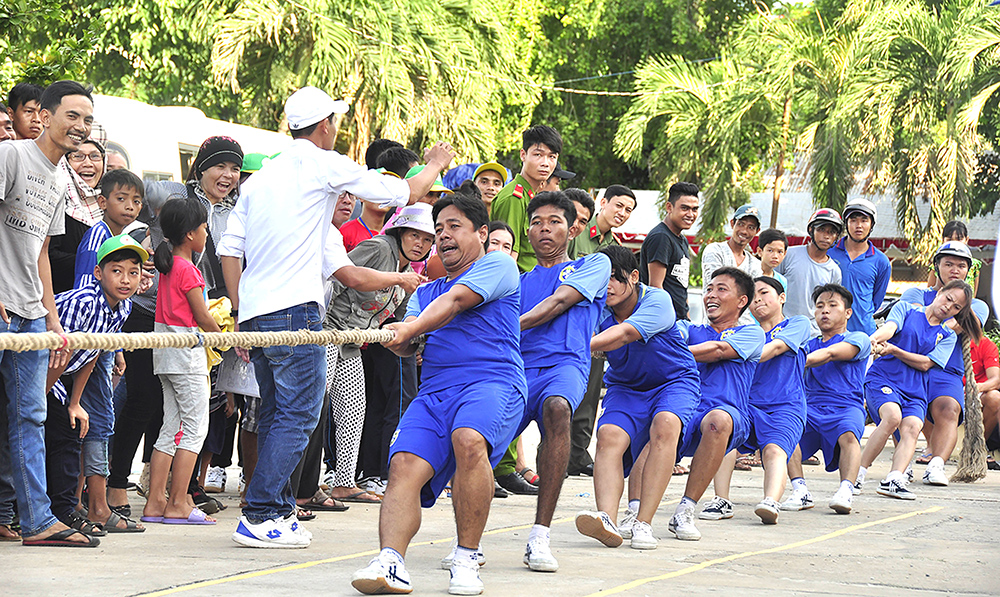
The tug-of-war match was lively and attracted many participants.
Tug-of-war takes different forms depending on the region, but there are generally two common forms: ropeless tug-of-war and rope-based tug-of-war. Ropeless tug-of-war is more clearly a folk game. During the competition, each person on each team must use their hands to form "links".
The person behind wraps their arms around the waist of the person in front, and the two leaders of each team must interlock their hands to form a strong "link" connecting the two teams. Whichever team is pulled across the opposing team's boundary or breaks the "link" loses.
Tug-of-war with a rope is similar to tug-of-war without a rope, with two teams of equal size, usually 8-10 people each. During the game, each team holds one end of a rope, with a red cloth marker at the midpoint. The team that pulls the opposing team across the white line wins. Each game consists of three rounds; the team that wins two consecutive rounds wins the game without needing to play a third round.
Because tug-of-war is a competitive game with each round usually lasting no more than 2 minutes, it requires a great deal of effort from the participants to win. Today, the traditional game of tug-of-war has been standardized with very specific rules and regulations, becoming a traditional sport present in almost all sports competitions from the provincial to the grassroots level, and in sports festivals at all levels.
Although tug-of-war is a simple competitive sport, achieving high results requires not only physical strength and stamina but also sound strategy and smooth coordination among team members. According to the experience of many tug-of-war players, the game is played in a free and playful manner, so each team member will have a different way of holding the rope. When the referee signals, both sides simply pull with all their might to win.
However, when participating in competitions organized by the sports sector, the rules of the game must be strictly followed. The standing posture and rope grip are crucial, as players must maintain a firm stance while ensuring flexible footwork when moving forward and backward.
During the competition, the legs should not be lifted too high to avoid losing balance. When holding the rope, both hands must be pressed together, extending and contracting rhythmically. To generate strength, when pulling, team members must keep the rope to the right of their body and thread it under their armpit, with their right hand under the rope, palm facing upwards, and their left hand also gripping the rope tightly and placed in front of their right hand.
When arranging the team for a competition, shorter players are usually positioned in front, with taller players behind, so that the rope forms a straight line, helping to concentrate the team's strength. The first positions require the strongest and most stable players, because when facing strong opponents, the first few pulls could cause the entire team to be pulled down. The last position serves as both a support point and an observer to adjust the formation, tightening or loosening the rope depending on the situation.
Mr. Nguyen Thanh Nhan ( Chau Doc City ) shared: “Tug-of-war is a team sport, so the standing posture of the members is very important. Players must stand firmly, but also ensure that their feet move flexibly when moving forward and backward. During tug-of-war, the feet should not be lifted too high to avoid losing momentum, which could affect the whole team.”
Similarly, Mr. Tran Quoc Dung (Phu Tan district) said: “To have a strong tug-of-war team, each individual must have good physical fitness, good coordination, and correct pulling technique. In addition, players must stand in the initial position with feet shoulder-width apart, spaced appropriately, and use the right force distribution and angle when pulling to maximize internal strength. The person at the front of the line must be strong and agile. At the same time, the person at the back must hold the rope firmly, and the coordinated efforts of teammates are essential for a chance of winning.”
During festivals, sporting events, or any competition, tug-of-war matches create an incredibly lively atmosphere, becoming the focal point and attracting the attention of many people.
| On December 2, 2015, at the 10th session of the UNESCO Intergovernmental Committee for the Protection of Intangible Cultural Heritage in Namibia, the "Tug-of-War Rituals and Games" in Vietnam, Cambodia, South Korea, and the Philippines were officially recognized by UNESCO as an Intangible Cultural Heritage of Humanity. |
Source link
![[Photo] Opening Ceremony of the 13th National Congress of the Ho Chi Minh Communist Youth Union](https://vphoto.vietnam.vn/thumb/1200x675/vietnam/resource/IMAGE/2026/06/24/1782286753905_ndo_br_1-8510-jpg.webp)
![[Photo] General Secretary and President To Lam attends the Central Public Security Party Committee Conference](https://vphoto.vietnam.vn/thumb/1200x675/vietnam/resource/IMAGE/2026/06/24/1782302063612_a1-bnd-9302-9166-jpg.webp)
![[Photo] The 13th National Congress of the Youth Union conducts personnel work.](https://vphoto.vietnam.vn/thumb/1200x675/vietnam/resource/IMAGE/2026/06/24/1782299943080_ndo_br_1-6868-jpg.webp)





![[Video] Weather forecast for tonight and tomorrow, June 25, 2026: Hot and intensely hot weather will continue throughout the country.](https://vphoto.vietnam.vn/thumb/402x226/vietnam/resource/IMAGE/2026/06/24/1782306248499_dem-24-png.webp)



















































![[INFOGRAPHICS] Using crop data instead of paper records](https://vphoto.vietnam.vn/thumb/402x226/vietnam/resource/IMAGE/2026/06/24/1782311651577_1782311397.webp)