

To take full advantage of this flexibility, parents and students need to understand tuition fees clearly so they can plan their finances accordingly from the outset.

UEH creates a modern and high-quality educational environment for every learner.
How should we understand tuition fees calculated per credit hour?
At the university level, subjects are called modules. Each module is worth 2-3 credits.
Credits are units used to allocate the learning workload of students in each subject, semester, and academic year of a training program. One credit (15 class hours) corresponds to a certain learning duration, including: classroom time (theory, discussion, practice); time for students to self-study, read materials, do assignments, research; and time for essays, major assignments, projects, and theses. For example, the regular Bachelor's program in Technology and Innovation will be trained over 3.5 years, divided into 7 semesters, with the total number of credits for each semester being 17, 18, 20, 20, 19, 21, and 10 credits respectively, with an average of 6-8 modules per semester. Find out the total number of credits for each training program at https://tuyensinh.ueh.edu.vn/cu-nhan-chinh-quy/dai-hoc-chinh-quy/ .
Accordingly, university tuition fees are calculated per credit. By understanding the number of credits for each course, each semester, and the entire program, students and parents can develop a suitable financial plan.
Tuition fees by major: What should you consider?
The cost per credit for different majors (training programs) at UEH varies depending on several factors, such as:
- Which field of study does that major belong to (Business and Management; Social and Behavioral Sciences ; Law; Mathematics and Statistics; Computer Science and Information Technology; Engineering Technology; Architecture and Construction; Tourism, Hospitality, Sports and Personal Services; Humanities; Journalism and Information; Agriculture, Forestry and Fisheries) ? Each field of study has different training requirements. For example, engineering, technology, and design fields often require laboratories, modern equipment, specialized software, and practical materials, resulting in higher training costs compared to fields that primarily rely on theoretical classes. Furthermore, the duration and nature of the course modules vary; some fields have many practical credits, including after-hours classes, training at hospitals, factories, and companies, so tuition fees need to include the cost of off-campus training.
- What type of training program does this major belong to (Advanced Program; International Advanced Program; International Joint Program;...) ? Each type will have different characteristics that affect tuition fees, such as:
- International advanced programs are those that have achieved quality accreditation by international organizations (AUN-QA (ASEAN University Network Quality Assurance), FIBAA (European International Standards for University Accreditation), etc.), therefore the unit price will be higher. These programs usually have more credits due to the integration of soft skills, professional skills, and in-depth modules.
- Language of instruction: Training in English (partially or fully) requires internationally qualified instructors, foreign academic materials, and integrated language skills training for students.
- Training duration varies: Some international joint programs have a 2+2 or 3+1 structure (partially in Vietnam, the rest abroad), or are longer due to language entry requirements. Some advanced programs integrate additional semesters of international exchange or business internships, resulting in a longer actual study period.
- Different course structures: Some programs emphasize practical courses, experiments, individual projects, or exchange programs abroad, resulting in higher design and implementation costs. Joint programs often include courses imported from foreign partners, thus requiring payment for content licensing or international lecturers.

UEH students in the classroom
Understanding the types of training at UEH
At UEH, there are currently four types of training programs, including:
International Advanced Programs: These are training programs accredited by international organizations (AUN-QA - ASEAN University Network Quality Assurance), FIBAA (European International Accreditation Standards), etc. After admission, students can choose to study one of three types of training depending on the training program:
- All courses are taught in English, except for 11 credits of political theory, physical education, and national defense education.
- Partial English: A minimum of 15 credits in major courses taught in English.
- Vietnamese: Teaching is conducted entirely in Vietnamese.
Advanced Programs: These are advanced training programs designed based on the top 200 universities in the world; consulted by experts from international professional associations and subject to quality reviews every 2-5 years. After admission, students can choose to study one of three types of training depending on the program:
- All courses are taught in English, except for 11 credits of political theory, physical education, and national defense education.
- Partial English: A minimum of 15 credits in major courses taught in English.
- Vietnamese: Teaching is conducted entirely in Vietnamese.
The ISB BBus Talent Bachelor Program: Study entirely in English with high intensity and continuous updates, helping students quickly access new knowledge. Soft skills are integrated throughout the learning process with diverse implementation methods. Students have the opportunity to participate in student exchange programs with prestigious international universities and become employees of large corporations in Vietnam and globally.
The fields of study under the ISB BBus Talented Bachelor Program are: Field 1 - Business and Management .
The ISB ASEAN Co-op Bachelor's Program: Based on the ISB BBus Talented Bachelor's Program, taught entirely in English. The program not only provides students with comprehensive and in-depth knowledge but also offers opportunities for professional practice and practical work experience at corporations in ASEAN countries during their studies.
The fields of study under the ISB ASEAN Co-op Bachelor's Program are: Field 1 - Business and Management.
*Find detailed information about UEH's majors/training programs at https://tuyensinhdaihoc.ueh.edu.vn/ .
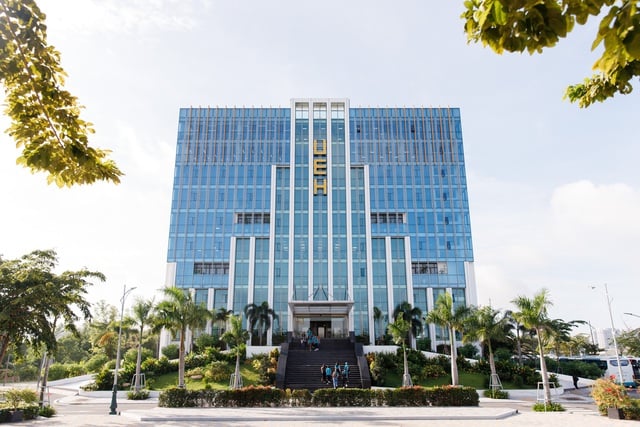
UEH is one of the pioneering universities pursuing a multidisciplinary and sustainable strategy alongside comprehensive internationalization.
UEH tuition fees at the Ho Chi Minh City campus (KSA)
Type of training | Tuition (1 credit) | Total number of credits | Average tuition fee per year | Total 3.5 - 4 years ( Vietnamese ) |
International Advanced Program | Vietnamese: 1,300,000 VND/credit English: x 1.4 Practice: x 1.2 | 126 | 47,610,279 | 190,441,115 |
Integrated international professional certification program (ACCA and ICAEW) | Vietnamese: 1,300,000 VND/credit English: 1,900,000 VND/credit | 125 | 46,775,000 | 187,100,000 |
Advanced Program (Group III, VII) | Vietnamese: 1,100,000 VND/credit English: x 1.4 Practice: x 1.2 | 126 | 40,285,620 | 161,142,482 |
Advanced programs (Group V) | Vietnamese: 1,200,000 VND/credit English: x 1.4 Practice: x 1.2 | 132 | 46,266,129 | 185,064,516 |
Talented Bachelor | Vietnamese: 1,100,000 VND/credit English: 1,900,000 VND/credit | 128 | 66,285,714 | 232,000,000 |
Asean Coop | Vietnamese: 1,100,000 VND/credit English: 1,900,000 VND/credit Coop Mode: 3,290,000 VND/credit | 128 | 77,405,714 | 270,920,000 |
- Tuition fees will increase annually (not exceeding 10% per year).
* Find information about tuition fees and scholarships at UEH (KSA) at https://nhaphoc.ueh.edu.vn/tu-van-truoc-nhap-hoc/dai-hoc-chinh-quy/thong-tin-hoc-phi-hoc-bong/
UEH tuition fees at UEH Mekong Campus (KSV)
Type of training | Total number of credits | Tuition (1 credit) | Average tuition fee per semester | Total 3.5 - 4 years |
International Advanced Program | 120 | Vietnamese: 780,000 VND/credit | 28,347,429 | 99,216,000 |
Advanced Program | 125 | Vietnamese: 660,000 VND/credit | 25,070,571 | 87,747,000 |
Advanced Program (Engineer) | 155 | Vietnamese: 660,000 VND/credit | 27,431,250 | 109,725,000 |
- Tuition fees will increase annually (not exceeding 10% per year).
* Find information about tuition fees and scholarships at UEH Mekong at https://nhaphoc.ueh.edu.vn/tu-van-truoc-nhap-hoc/dai-hoc-chinh-quy/thong-tin-hoc-phi-hoc-bong/
At UEH, tuition fees for each training program are determined based on the specific characteristics of the field of study and the type of training. Each program is a unique learning journey in terms of language of instruction, duration of practical training, number of credits, internationalized modules, and experiential learning environment. All these factors determine the investment students need to make and also reflect the depth of quality that UEH is pursuing.
Furthermore, with its ranking among the Top 136 universities in Asia and Top 501 universities in the world according to the Times Higher Education (THE) rankings, UEH's current tuition fees are still considered reasonable compared to many leading international universities.
International programs at UEH offer cost-effective options while still ensuring global learning outcomes, high-quality faculty, modern learning materials, and ample opportunities for international transfer.
Studying abroad is not just about moving between countries, but a process of intellectual growth, knowledge integration, and preparation for a global future. With its dynamic, multidisciplinary academic ecosystem and extensive international cooperation network, choosing to study at UEH is also an opportunity for "international study abroad at home" for candidates who proactively seize their future.
Source: https://thanhnien.vn/hoc-phi-tin-chi-tai-ueh-hieu-dung-de-lua-chon-dung-185250722083416541.htm


![[Photo] General Secretary and President To Lam receives Amazon's Senior Vice President David Zapolsky](https://vphoto.vietnam.vn/thumb/1200x675/vietnam/resource/IMAGE/2026/05/22/1779466547770_a1-bnd-3513-6601-jpg.webp)






















































































Comment (0)