

Environmental requirements must be given the highest priority.
Commenting on the draft Law amending and supplementing several articles of the Law on Geology and Minerals, many delegates expressed strong agreement with the addition of a separate chapter on rare earth elements. This is a timely step in perfecting the legal framework, in line with the global context of intense competition for strategic materials, renewable energy, and high-tech supply chains. Identifying rare earth elements as a particularly important resource requiring unified national management is a direction consistent with the country's long-term development requirements.
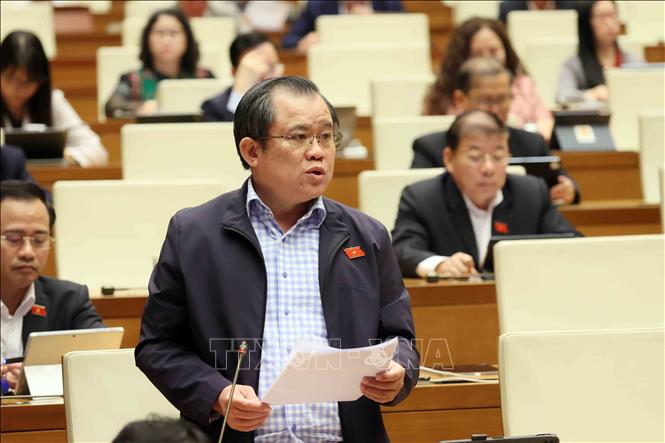
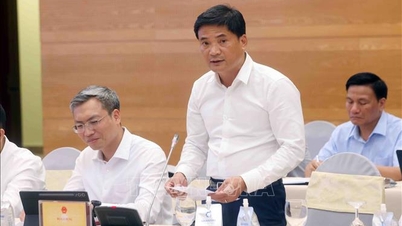
According to delegate Trinh Thi Tu Anh (Lam Dong), the draft Law needs to affirm the principle of managing rare earth resources on a scientific basis and with strict risk control, in which environmental requirements must be placed at the highest level; setting mandatory technical safety thresholds: closed-loop separation technology, radioactive dispersion modeling, continuous monitoring system, sludge treatment plan meeting IAEA standards, and requirements for environmental restoration after mining right from the licensing stage.
"Only businesses with technological capabilities, financial capacity, and environmental management systems that meet international standards will be allowed to participate," Representative Trinh Thi Tu Anh emphasized.
In addition, delegate Trinh Thi Tu Anh suggested emphasizing the independent supervisory role of the national radiation and nuclear safety agency throughout the entire rare earth extraction, separation, and processing chain, from technology assessment, risk evaluation, and site inspection to waste treatment monitoring and environmental restoration. For rare earths, a resource with a long technical lifecycle requiring technology testing, in-depth environmental assessment, and complex processing line construction, project preparation time often lasts from 3-5 years.
"If the priority period is too short, investors may be forced to hastily develop projects to retain rights, leading to the risk of not developing deep processing. Therefore, I propose that the law allow for more flexible regulations regarding rare earth elements to encourage investors with sufficient technological capacity, avoiding the situation of crude and fragmented mining," Representative Trinh Thi Tu Anh stated.
Regarding this issue, delegate Nguyen Tam Hung (Ho Chi Minh City) suggested considering and clearly supplementing the export control mechanism and the minimum domestic deep processing rate, in order to ensure that rare earth elements are truly a strategic resource serving national industrial development, avoiding the risk of exporting raw materials and dependence on foreign technology in the rare earth value chain.
According to delegate Nguyen Tam Hung, the draft law has not clarified the mechanism for selecting enterprises to explore, exploit, and process rare earth elements based on criteria such as technological security, deep processing capacity, and environmental management capacity, while this is a sensitive field with the risk of resource hijacking or leakage of underlying technology.
"Therefore, consideration should be given to supplementing the economic and technological security approval process before technology transfer, export of deeply processed products, or international joint ventures, in order to ensure resource sovereignty, national economic security, and industrial self-reliance in rare earth minerals," said delegate Nguyen Tam Hung.
Considering the importance of rare earth mining and exploration, delegate Pham Van Hoa (Dong Thap) questioned how, if such resources exist, they can be exploited and managed effectively, and especially how to protect rare earth elements.
"Other minerals may be abundant, but rare earth elements are very limited, with small reserves. If exploitation is not strictly managed and without rigorous protection measures, it can easily lead to indiscriminate exploitation, and even people may exploit them on their own. Therefore, I propose that the drafting agency and the environmental management agency pay attention to and properly manage rare earth elements, and have policies in place to protect them," Representative Pham Van Hoa stated.
Strengthen enforcement controls and protect resources.
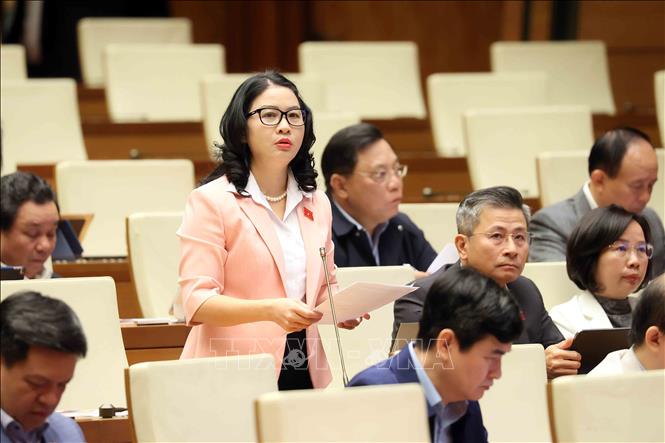
Regarding the draft Law amending and supplementing a number of articles of 15 laws in the fields of agriculture and environment, Representative Nguyen Thi Lan (Hanoi) stated that in Vietnam, the grassroots veterinary network still has disparities, the capacity for monitoring and testing is uneven, and the risk of antibiotic-resistant bacteria spreading from livestock to humans is increasingly evident. Lessons from African swine fever and avian influenza show that a strong veterinary system will control diseases better.
Representative Nguyen Thi Lan suggested that the draft Law should place greater emphasis on strengthening the capacity of the veterinary system, improving monitoring, warning, testing, and control of the use of veterinary drugs and antibiotics; and promoting the connection between veterinary, health, and environmental services according to the "One Health" model. "This is not only a task for the agricultural sector but also directly contributes to protecting public health and enhancing the national capacity to respond to epidemics," Representative Nguyen Thi Lan stressed.
Furthermore, the draft law needs to stipulate minimum competency requirements for grassroots veterinarians and standardize the veterinary training system. Regardless of the organizational model, it is necessary to ensure that all levels of government, especially at the provincial and commune levels, have sufficient personnel and tools for early detection and timely handling of disease outbreaks, in accordance with the recommendations of the World Health Organization and the World Organisation for Animal Health. In addition, the principle of mobilizing domestic scientific and technological resources, including research institutes, universities, and accredited laboratories, should be added to participate in disease risk monitoring and assessment.
At the session, delegate Ha Sy Dong (Quang Tri) suggested that legal unification must go hand in hand with operational mechanisms; procedures must be accompanied by post-inspection capabilities and data-driven management. Many lengthy procedures are not due to complex laws but rather to management agencies holding fragmented information, forcing businesses to go through multiple stages; decentralization must be based on environmental risks, not on administrative boundaries...
"The law should be perfected in a way that clarifies provisions, responsibilities, criteria, and application methods, reduces paperwork but increases enforcement control, and protects resources through economic mechanisms instead of relying solely on administrative measures," Representative Ha Sy Dong stated.
Seven additional items have been added to the agenda of the 10th Session.
Earlier that morning, the National Assembly approved the amendments and additions to the agenda of the 10th session with 394 out of 399 participating delegates voting in favor, representing 83.30% of the total number of delegates.
Accordingly, the National Assembly added 7 items to the agenda of the 10th Session for consideration and approval, including: Draft Resolution of the National Assembly on mechanisms and policies for national energy development in the period 2026-2030; Draft Resolution of the National Assembly amending and supplementing a number of articles of Resolution No. 98/2023/QH15 on piloting some specific mechanisms and policies for the development of Ho Chi Minh City; Draft Resolution of the National Assembly amending and supplementing a number of articles of Resolution No. 136/2024/QH15 on the organization of urban government and piloting some specific mechanisms and policies for the development of Da Nang City; investment policy for the Vinh - Thanh Thuy expressway construction project; and the supplementary state budget for the second phase (non-refundable foreign capital) in 2025. Regarding the adjustment of the content of Resolution No. 94/2015/QH13 of the National Assembly on the investment policy for Long Thanh International Airport; and the amendment and supplementation of Resolution No. 170/2024/QH15 dated November 30, 2024, of the National Assembly on specific mechanisms and policies to remove difficulties and obstacles for projects and land in inspection, audit, and judgment conclusions in Ho Chi Minh City, Da Nang City, and Khanh Hoa Province.
The National Assembly will allocate specific time in its agenda to consider and approve the draft Law on Specialized Courts in the International Financial Center; and will also consider adding several provisions, including specific mechanisms and policies for implementing major projects in Hanoi. The timing will be adjusted accordingly to avoid changing the total working time of the session.
Source: https://baotintuc.vn/chinh-polit/khai-thac-va-quan-ly-hieu-qua-co-chinh-sach-bao-ve-dat-hiem-20251201121521692.htm
![[Photo] Secretary of the National Assembly Party Committee, Chairman of the National Assembly presides over the meeting of the Standing Committee and Executive Committee of the National Assembly Party Committee.](https://vphoto.vietnam.vn/thumb/1200x675/vietnam/resource/IMAGE/2026/06/03/1780480353201_ndo_br_bnd-2585-jpg.webp)

![[Photo] General Secretary and President To Lam presides over a meeting with the Central Organizing Committee.](https://vphoto.vietnam.vn/thumb/1200x675/vietnam/resource/IMAGE/2026/06/03/1780482764658_a1-bnd-4741-3342-jpg.webp)

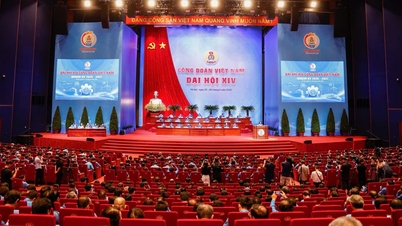
![[Photo] First session of the 14th Congress of the Vietnam Trade Union](https://vphoto.vietnam.vn/thumb/1200x675/vietnam/resource/IMAGE/2026/06/03/1780465947883_ndo_br_img-3852-jpg.webp)







































![[Video] Sunset at Lap An Lagoon – Where the sun sets over the fishing nets](https://vphoto.vietnam.vn/thumb/1200x675/vietnam/resource/IMAGE/2026/05/31/1780192137701_beach-landscape-sea-water-nature-grass-745871-pxhere-com.jpeg)

























Comment (0)