

Half a century after liberation, Hai Lang district is gradually asserting its position as a sustainable forestry economic zone with a strategy of developing large timber forests and FSC-certified forests. This model not only opens up new opportunities for the people but also contributes to environmental protection, climate change adaptation, and lays the foundation for a green, prosperous, and sustainable Hai Lang in the coming years.
From the first planted forests...
Following an introduction from the Chairman of the Hai Chanh Commune People's Committee, Bui Van Sinh, we visited the home of Mr. Cap Quoc Ha, the first person to boldly undertake over 200 hectares of barren land and hills for reforestation more than 30 years ago. With tireless efforts, he is now known as the "king of the forest" in the western Hai Lang region. As he drove me along the winding red dirt road through the lush green hills, Mr. Ha thoughtfully recounted his journey into forestry. His father, Mr. Cap Dinh Hoi (1924-2009), was originally from Hai Xuan commune, Hai Lang district. He participated in the resistance war and was captured and imprisoned in Phu Quoc. After peace was restored, Mr. Hoi decided to stay in Phu Quoc to start a new life. Mr. Ha was born and raised there. When life on Phu Quoc island gradually stabilized, Mr. Hoi returned to his hometown every year to search for the remains of his comrades at former military bases and battlefields in Hai Lang district. Mr. Ha always accompanied him on these trips.
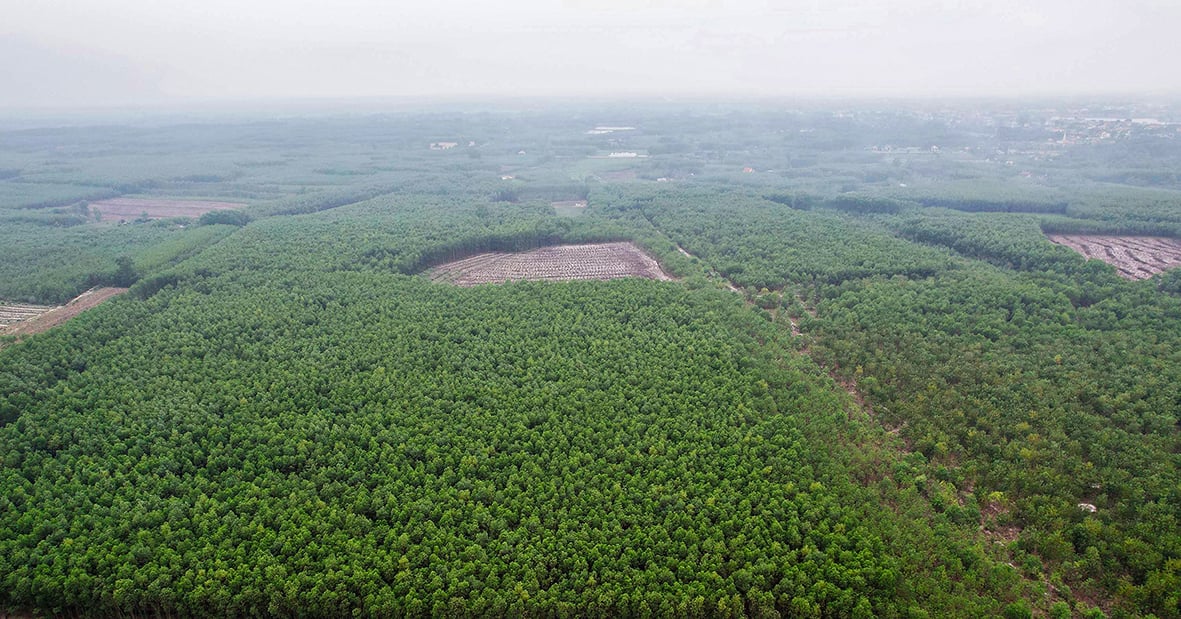
The green color of the forests in Hai Lang district - Photo: LA
In 1992, during a trip to search for the remains of fallen comrades in the Buom Bac ravine, Hai Chanh commune, Mr. Hoi noticed many abandoned hills and mountains. Recognizing the potential of this barren land, he decided to bring his family back to his hometown and request land to clear and cultivate, planting trees to both develop the economy and facilitate the search for his comrades' remains. “Before, there were no roads here, the land was all rocky and barren. The only trees we could grow were eucalyptus, which had low yields, poor quality, and unstable market demand. Therefore, despite government encouragement, almost no one dared to accept land for reforestation. So when I presented my idea, the Hai Lang District People's Committee immediately granted my father and me over 200 hectares to plant trees,” Mr. Ha recalled.
According to Mr. Ha, his and his father's decision at the time was considered risky by many. No one had ever seen anyone "throw" money into barren land and deforested hills. The roads were treacherous, and transporting seedlings and fertilizer was mainly done by carrying them on their backs. On many days, when it rained heavily and the water in the stream rose, they couldn't get home, and he had to sleep in the forest.
In addition, the barren land and the hot, dry, and cold weather affect the growth of crops... Especially, there were times when, while digging holes to plant trees, he even unearthed bombs and unexploded ordnance left over from the war, luckily they didn't explode.
To reduce costs, he not only cleared each plot of land himself to plant trees, but also diligently learned techniques and bought seeds to grow his own seedlings, ensuring a steady supply. He planted and harvested in a staggered manner, with a cycle of 5-7 years, and by 1998 he had nearly 200 hectares of planted forest. Currently, he harvests about 20-30 hectares of forest annually, generating revenue of approximately 2 billion VND.
"For me, the journey of making a living from the forest is not just a career, but also a dream and a responsibility to my homeland," said Mr. Ha.
Chairman of Hai Chanh Commune People's Committee, Bui Van Sinh, affirmed that Mr. Ha's efforts have strongly inspired local people. Thanks to his successful reforestation efforts, people in the commune have gradually changed their perceptions and are actively exploiting the potential of forest land to develop the economy.
To date, hundreds of households in the commune have participated in reforestation, covering an area of over 2,600 hectares. Hai Chanh is also one of the localities with the largest area of planted forests in Hai Lang district. Thanks to reforestation, the lives of the people have improved significantly, with many households rising out of poverty and becoming wealthy from their planted forests. "Mr. Ha has not only enriched himself but also contributed to changing the face of the local rural economy," Mr. Sinh emphasized.
...To the FSC-certified forests
Having started participating in large-scale timber plantations with FSC (Forest Stewardship Council) certification in 2013, the Phu Hung Cooperative in Hai Phu commune now has over 170 hectares of acacia and eucalyptus forests planted according to FSC-certified standards. Mr. Nguyen The, Director of the Phu Hung Cooperative, said that previously, due to a lack of care, most of the cooperative's forest area had low economic value, with each hectare yielding only a few million dong.
Faced with this difficulty, he and the members of the cooperative researched and decided to shift their focus to planting FSC-certified timber forests. According to Mr. The, the FSC forest certification is developed by the International Forest Stewardship Council with a set of 10 principles and 56 criteria.
To obtain FSC certification, producers of forest-derived products must provide and demonstrate detailed documentation on: the origin of the product; implemented programs, plans for forest harvesting and reforestation; and programs ensuring social, environmental, and local community benefits. FSC certification is valid for 5 years and is globally accepted due to its credibility and authenticity.
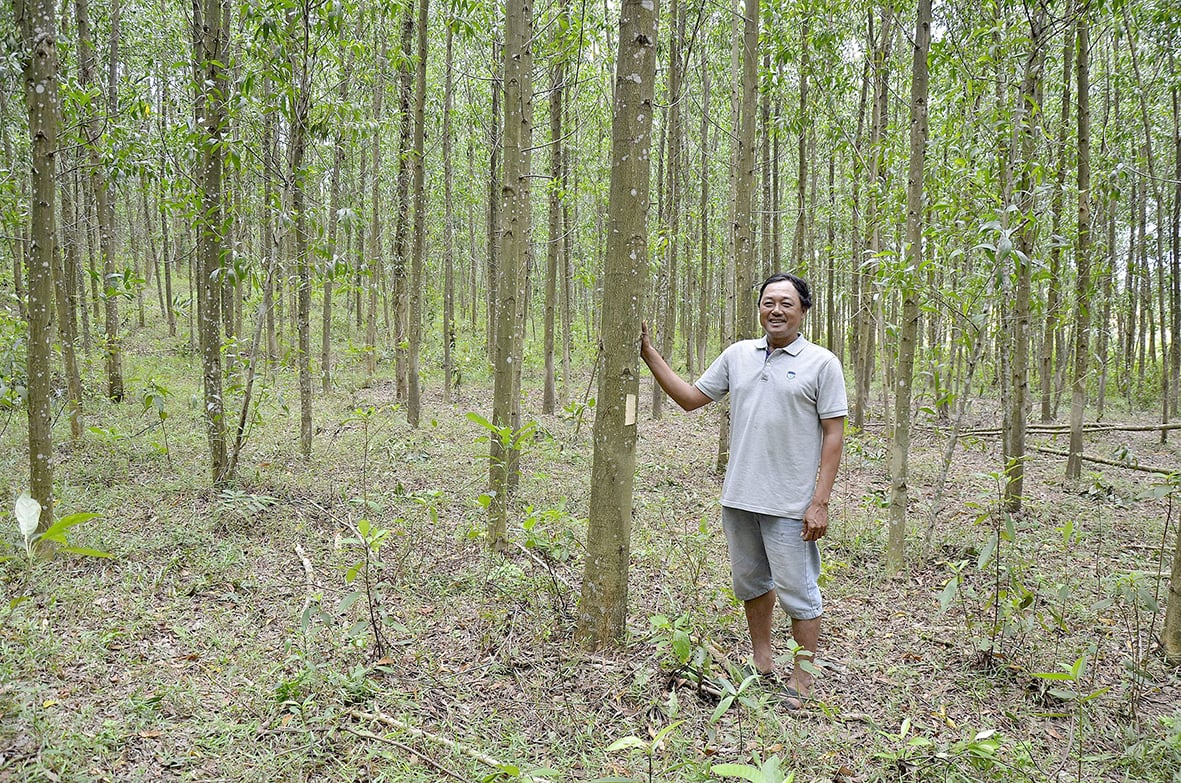
Mr. Cap Quoc Ha stands beside his forest in Hai Chanh commune, Hai Lang district - Photo: LA
Initially, the cooperative established a forest certification group consisting of 8 participating households with an area of 87 hectares. In the first harvest, this group of households obtained over 800 tons of wood, selling it at a price approximately 1.2 million VND/ton higher than the market price. Based on this, and taking full advantage of the local potential in forest planting, the cooperative expanded the area of FSC-certified planted forests to 178 hectares.
At the same time, the cooperative has established links with businesses such as Scansia Pacific Company and Thu Hang Wood Company to ensure stable output and higher selling prices for timber, 10% to 20% higher than the market price. This creates more jobs and stable income for cooperative members. "Besides the cooperative's forest area, recognizing the effectiveness of this type of forest, six local households with an area of 130 hectares have also joined the cooperative's FSC-certified large timber forest planting model," Mr. The added.
According to Dao Van Tram, Deputy Head of the Agriculture and Rural Development Department of Hai Lang District, in order to improve the economic efficiency of planted forests, create concentrated large-scale timber raw material areas, and FSC-certified forests to supply factories, production facilities, wood processing and export industries, and increase people's income; and at the same time fulfill the goals and targets of large-timber planted forests and FSC-certified forests as set out in the Resolution of the 16th District Party Congress, term 2020 - 2025, the District People's Committee has issued a plan for the development of large-timber planted forests and FSC-certified forests for the period 2023 - 2025, with orientation to 2030.
Specifically, according to the plan, the goal is to have over 1,000 hectares of large-timber plantations and FSC-certified plantations in the entire district by 2025, and over 2,000 hectares by 2030. The plan aims to maintain the stability of existing large-timber plantations and FSC-certified forests, and to plan and demarcate areas for planting large-timber forests and FSC-certified forests. The plan also aims to increase the average yield of large-timber plantations using fast-growing trees to over 25 m3/ha/year.
Mr. Tram stated that, to realize the above goal, Hai Lang district has actively coordinated with organizations and businesses such as the Corenarm Consulting Center and Quang Tri Paper Materials Co., Ltd. to organize workshops and training sessions introducing FSC-certified forest planting in hilly areas such as Hai Chanh, Hai Son, Hai Lam, Hai Phu, Hai Truong communes, etc. More than 445 households have registered to participate, covering an area of nearly 4,500 hectares. Based on this, Quang Tri Paper Materials Co., Ltd. has supported all costs for FSC certification and annual maintenance fees, and has committed to purchasing FSC-certified timber at a price equal to or higher than the market price at the time of harvesting.
According to Mr. Tram, as of now, more than 3,200 hectares of forest area have been certified with FSC for the first time as committed, bringing the total FSC-certified forest area in the district to nearly 3,600 hectares, far exceeding the set target. "Planting forests according to FSC standards not only yields high economic efficiency but also brings environmental benefits such as high forest cover and reduced damage from storms," Mr. Tram affirmed.
Building the future
Hai Lang district has over 20,600 hectares of forest land, achieving a forest cover rate of 42.09%. Of this, over 15,300 hectares are production forests and approximately 5,280 hectares are protection forests, mainly concentrated in the hilly areas of Hai Phu, Hai Thuong, Hai Lam, Hai Truong, Hai Son, Hai Chanh communes and Dien Sanh town. According to Duong Viet Hai, Vice Chairman of the Hai Lang District People's Committee, recognizing the strengths of its natural conditions, land resources, labor force, and market, Hai Lang district has consistently prioritized leadership, guidance, and investment in forestry infrastructure over the years. Many policies have been implemented to support the people, leading to the widespread development of production forest planting, initially creating jobs for thousands of rural workers, and contributing to increased income and improved living standards for those engaged in forestry.
In particular, initial steps have been taken to establish a supply chain linking the consumption of FSC-certified plantation timber with businesses, resulting in a value-added increase of 12% - 15% compared to uncertified timber. Some businesses have taken the initiative in production and processing, and have formed joint ventures and partnerships with businesses inside and outside the province in product consumption.
However, Mr. Hai also acknowledged that, apart from some areas of large timber forests and FSC-certified forests, the majority are small timber forests. The reason is that although large timber forests yield higher economic value than small timber forests, forest owners are still hesitant to plant them for a long time due to the high risks such as forest fires and tree collapse caused by storms. Furthermore, some forest-planting households face difficult living conditions, forcing them to harvest early to make ends meet.
The procurement of FSC-certified small-scale timber by businesses for processing and export production remains limited. On the other hand, while people plant small-scale timber, they haven't focused on developing FSC-certified forests. Sustainable supply chains linking planting, harvesting, processing, and trading of forest products haven't been established.
Furthermore, forest protection and fire prevention efforts are still limited due to inadequate investment in forestry infrastructure, equipment, and vehicles to meet actual needs; the system of forest roads, access roads, firebreaks, and staging areas has not been properly invested in; and many roads for motorized vehicles to access some forest areas are very difficult.
According to Mr. Hai, the district's orientation for developing planted forests is towards intensive cultivation and long-cycle forest management to produce large timber for the export wood processing industry, creating added value for planted forest timber products. In the coming time, along with strengthening propaganda work, Hai Lang district will continue to expand and develop production linkage models with the goal of closely linking production with the market; especially production linkage models in the form of joint ventures and partnerships, gradually forming concentrated plantation timber raw material production areas with large scale and area to create favorable conditions for investment in infrastructure, processing, sustainable forest management, and FSC forest certification assessment. The district will encourage markets within and outside the district, promote products, develop cooperatives producing civil furniture and handicrafts, and participate in production linkage chains with processing facilities.
Mobilize and integrate resources, and combine programs, projects, and schemes to improve the effectiveness of forest development and the production of FSC-certified plantation timber. Introduce new high-yielding, high-quality timber varieties that are resilient and adaptable to adverse weather conditions for reforestation. Promote the transfer of advanced techniques for intensive cultivation of large timber forests to forest owners.
At the same time, there are policies to support tissue-cultured hybrid acacia seedlings and fertilizer supplies to develop high-quality plantation timber raw material areas, aiming for FSC certification. This will develop the forestry sector in line with its potential, contributing to the successful achievement of the district's socio-economic development goals; and simultaneously realizing the Resolution of the District Party Congress for the 2020-2025 term.
"Currently, in addition to Quang Tri Paper Raw Materials Co., Ltd., Hai Lang Green Energy Joint Stock Company in the district is also conducting surveys and developing raw material areas to move towards obtaining FSC forest certification for forest-planting household groups," Mr. Hai added.
From the first forests that sprouted on the barren hills, Hai Lang has transformed into a sustainable forestry economic zone, where each forest not only provides livelihoods for the people but also symbolizes powerful change.
Now, with a sustainable development strategy, the close cooperation between the government, businesses, and forest growers has not only brought high economic value but also created a solid "green shield," helping to mitigate the impacts of climate change, protect the environment, and preserve prosperity for future generations. From the green of today's forests, a prosperous and sustainable future for Hai Lang is gradually emerging – a place where people and nature together create a livable countryside.
Le An
Source: https://baoquangtri.vn/kien-tao-tuong-lai-tu-nhung-canh-rung-191890.htm

![[Image] Pleasant weather helps students enter the 10th grade entrance exam with confidence.](https://vphoto.vietnam.vn/thumb/1200x675/vietnam/resource/IMAGE/2026/05/29/1780034401612_ngay-1-thi-lop-10-minh-duy-8-5009-jpg.webp)
![[Photo] Ba Lang An Lighthouse - the "eye of the sea" amidst the "rock museum" of Quang Ngai province.](https://vphoto.vietnam.vn/thumb/1200x675/vietnam/resource/IMAGE/2026/05/29/1780038698840_anh-man-hinh-2026-05-29-luc-14-10-42.png)









































































Comment (0)