

In the mid-16th century, while Hoi An was already a bustling trading center in the South, Da Nang was merely a pre-port location, serving as a transshipment point for goods and a ship repair facility.
In the early 18th century, Da Nang's position as a port gradually transformed into a trading port, replacing Hoi An, especially as shipbuilding techniques in Europe developed, allowing for larger, deeper vessels to easily navigate Da Nang Bay.
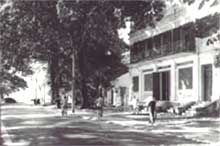
In 1835, when Emperor Minh Mạng issued a decree stating, "Western ships are only allowed to dock at Hàn estuary; they are not permitted to trade at other seaports," Da Nang became one of the largest trading ports in Central Vietnam. Local small-scale industries flourished, including ship repair and the processing of agricultural, forestry, and marine products; commercial services also prospered.
After conquering the entire country in 1889, the French colonialists separated Da Nang from Quang Nam and renamed it Tourane, placing it under the direct administration of the Governor-General of Indochina. In the early 20th century, Tourane was developed by the French into a Western-style city. Social infrastructure and production technology were invested in. Various industries and businesses were established and developed: agricultural production, small-scale handicrafts, processing of export goods (tea, grains, food, soft drinks, ice, wine, fish sauce, dried fish), ship repair, and service businesses. Along with Hai Phong and Saigon, Tourane became an important commercial center of the country.
In 1950, France handed Da Nang back to the Bảo Đại government.
In March 1965, US Marine units landed in Da Nang and established a large joint military base there. In 1967, Da Nang was designated by the US-backed South Vietnamese government as a centrally-governed city, with the goal of developing it into a political , military, and cultural center for Tactical Zones I and II. The US built military bases and infrastructure in Da Nang: an airport, port, warehouses, roads, public works, communication facilities, and established a banking credit system. The Hoa Khanh industrial zone produced oxygen, acetylene, detergents, milled rice, textiles, etc. During this period, industry developed to a higher level: industrial zones replaced handicraft workshops. However, the war left devastating consequences; hundreds of thousands of rural people fled to refugee camps and urban slums; social ills increased rapidly, and production stagnated.
In 1975, with the restoration of peace, Da Nang (a city under the administration of Quang Nam - Da Nang province) began the process of recovering from the devastating consequences of the war. Despite numerous difficulties, the city's recovery and development have achieved many successes, especially during the Doi Moi (Renovation) period after 1986.
On November 6, 1996, at its 10th session, the 9th National Assembly passed a resolution allowing the Quang Nam - Da Nang province to be separated into Quang Nam province and Da Nang city, both directly under the central government. In terms of administrative boundaries, the new Da Nang city comprises the former Da Nang city, Hoa Vang district, and Hoang Sa island district.


![[Photo] Golden season of organic farming under the canopy of the vast Mang Den forest.](/_next/image?url=https%3A%2F%2Fvphoto.vietnam.vn%2Fthumb%2F1200x675%2Fvietnam%2Fresource%2FIMAGE%2F2026%2F01%2F24%2F1769247398190_ndo_br_cam-15-jpg.webp&w=3840&q=75)



Comment (0)