

Careful partner selection, prioritizing quality, and effectively implementing advanced programs help Vietnamese students access a modern, practical academic environment and open up career opportunities in the era of global integration.
Choose your partners carefully.
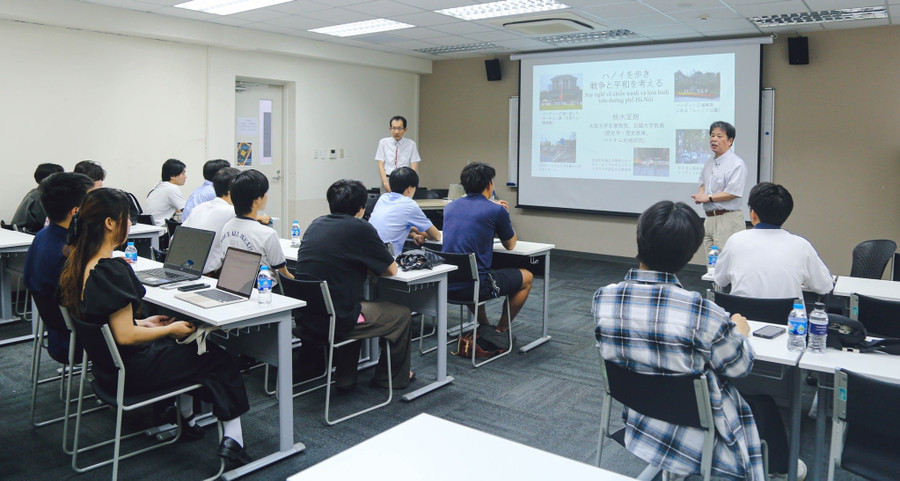
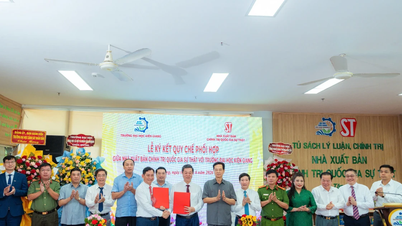
Recently, the Global Innovation and Development Program (BGDI) - International Studies major of the Vietnam-Japan University (Vietnam National University, Hanoi) reached a cooperation agreement with the Berlin University of Applied Sciences (Germany). According to the agreement, students will have the opportunity to study and gain experience in Germany; the two sides will implement a student and faculty exchange program starting in February 2027, the time when BGDI officially operates entirely in English.
Mr. Nguyen Minh Phuong, Deputy Head of the Training and Student Affairs Department at the Vietnam-Japan University, stated that the Berlin University of Applied Sciences will send professors and students to participate in teaching and learning at the Vietnam-Japan University. Conversely, five BGDI students with outstanding academic achievements will be selected to participate in an exchange program in Germany for one semester. This is an opportunity for them to experience a modern, multicultural, and highly practical academic environment.
As one of the leading higher education institutions in international collaborative training activities, Associate Professor Dr. Dao Ngoc Tien - Vice Rector of the Foreign Trade University, stated that the university always considers international collaborative training as an integral part of its overall operations, with a reciprocal impact on other activities. Regarding the criteria for selecting partners in international training activities, good universities will always seek out other good universities. The choice of partners depends on the strategy and stage of development of each university.
“We have received many invitations and collaboration offers from partners and universities. However, the Foreign Trade University selects partners very carefully and cautiously, aligning their choices with the University's strategy of becoming a leading university in the region and the world ,” Assoc. Prof. Dr. Dao Ngoc Tien emphasized.
Quality is our priority.
Sharing the criteria for selecting collaborative partners, the Vice Rector of the Foreign Trade University stated that the first and most important factor is quality. Secondly, the partnership must be compatible with the university's field and training programs.
“We consider and take into account the relationship and commitment of our partners. This is a difficult issue to assess but is very important. In addition, we consider what added value the training program brings to the university and finally, we must ensure diversity in terms of regions and countries,” Assoc. Prof. Dr. Dao Ngoc Tien emphasized.
According to the Vice Rector of the Foreign Trade University, the Government and the Ministry of Education and Training have granted universities significant autonomy, facilitating their flexibility in developing joint training programs, making the programs more practical and responsive to students' needs. As a result, the number of students enrolling in these joint programs has increased.
According to Mr. Nguyen Anh Dung, Deputy Director of the Department of Higher Education (Ministry of Education and Training), most joint training programs with foreign countries in Vietnam utilize the training programs of partner universities, with significant involvement in quality assurance and direct participation of domestic lecturers.
Furthermore, Vietnamese law regarding international joint training programs is strict and clear. Specifically, the programs of partner institutions used in joint training must be accredited for educational quality in their home country or recognized by a competent authority. In addition, international joint training programs are always among the programs prioritized for investment by educational institutions, with infrastructure and facilities meeting the requirements of both the partner institution and the program.
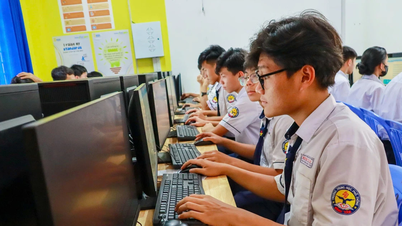
According to Mr. Dung, most of the program's lecturers are trained abroad, possess strong professional skills, and have excellent foreign language proficiency. Since the language of instruction is a foreign language, proficiency in a foreign language is a competitive advantage for students entering the labor market in the era of global integration.
According to a report by the Ministry of Education and Training, there are more than 430 joint training programs with foreign countries nationwide. Of these, universities have autonomously approved 186 programs; 124 programs at the undergraduate level, 58 master's programs, and 4 doctoral programs.
Programs categorized by country are primarily linked to the United Kingdom (101 programs), the United States (59 programs), France (53 programs), Australia (37 programs), and South Korea (27 programs). Countries with developed education systems such as New Zealand (16 programs), Germany (10 programs), and Belgium (10 programs) also participate.
Classified by subject group, economics and management programs account for the majority at 64% (including 85/408 business administration programs). Science and technology programs account for approximately 25%, social sciences and humanities programs account for 8%, and other fields such as medicine, pharmacy, and law only account for 3%.
In the context of deep integration, there is no reason why education should not be internationalized. Major universities around the world are interested in the Vietnamese education market. Students and parents alike desire a high-quality educational environment. If the quality is equivalent to studying abroad and the cost is affordable, this will become an inevitable trend. - Dr. Tran Duc Quynh, International University (Vietnam National University, Hanoi)
Source: https://giaoducthoidai.vn/lien-ket-dao-tao-toan-cau-nang-tam-tri-thuc-post752128.html


![[Photo] General Secretary and President To Lam presides over a meeting on preparations for the review of one year of operation of the three-tiered government system.](https://vphoto.vietnam.vn/thumb/1200x675/vietnam/resource/IMAGE/2026/06/02/1780391821195_a1-bnd-4595-9717-jpg.webp)













































































Comment (0)