

 |
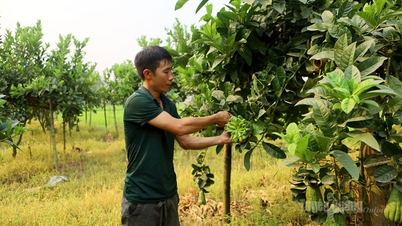
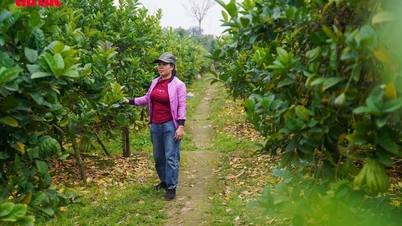
| Ms. Nguyen Thi Thu, from Hamlet 4, Minh Phu, Yen Phu Commune, meticulously cares for each Buddha's hand fruit. |
Buddha's Hand Village
As the year draws to a close, the atmosphere in the Buddha's hand citron orchards of Yen Phu commune is bustling with activity, reflecting the approaching spring. In Minh Phu village, specifically in Hamlet 4, Mrs. Nguyen Thi Thu's family orchard is currently undergoing meticulous care and fruit quality improvement in preparation for the Tet harvest.
Amidst the lush green garden, Mrs. Thu meticulously inspects each tree, pruning small branches and adjusting the trellises to ensure the fruit develops evenly, maintaining its color and beautiful shape. Her family currently has 130 Buddha's hand citron trees, planted more than two years ago. According to Mrs. Thu, Buddha's hand citron trees yield the highest productivity between 2 and 2.5 years old, so the care before harvest is especially important.
"Careful care is essential during this stage so that the fruit will be beautiful, with evenly shaped fingers, and won't be tough or ripen prematurely by Tet," Ms. Thu shared. After about 5 years, the Buddha's hand citron orchard needs to be renovated, with old branches pruned to encourage new growth and continued fruit production. Currently, many orchard owners in the commune choose to graft Buddha's hand citron onto pomelo rootstock to increase the tree's durability and extend its harvesting period.
 |
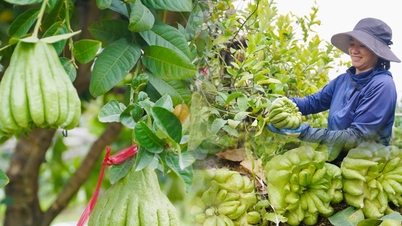
| Farmers in Yen Phu commune are harvesting Buddha's hand citron. |
According to projections, Mrs. Thu's family will earn approximately 190 million VND from this year's Tet harvest. Thanks to the consistent quality and attractive appearance of the fruit, many traders have come to discuss and place orders 2-3 months before Tet, giving her family more motivation to focus on caring for the orchard in the final days of the year.
Meanwhile, in Minh Phu village, specifically in Hamlet 3, the Buddha's hand citron orchard of Mr. Vu Ngoc Quang, the village Party Secretary, has entered its peak harvesting season. As the sun rose over the mountains, with morning dew still clinging to the leaves, the atmosphere in the orchard was already bustling with activity. Dozens of workers were present from early morning, some pruning, others selecting fruit, and still others packaging to ensure timely delivery to traders.
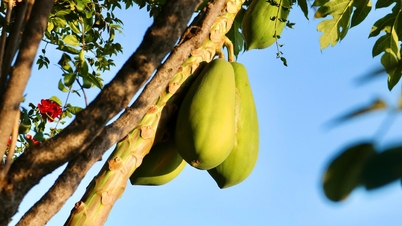
The Buddha's hand fruits, with their glossy skin and long, evenly spread fingers resembling flowers, are carefully placed into each crate. For Buddha's hand growers, each beautiful fruit not only holds economic value but also embodies cultural and spiritual significance in the traditional Vietnamese New Year's fruit platter.
Mr. Quang's Buddha's hand citron orchard currently has 125 trees, which have been continuously planted and cared for for 8 years. On average, each tree yields 50 to 100 fruits, harvested year-round to serve occasions such as the full moon, the first day of the lunar month, and Tet (Lunar New Year); at the same time, a portion of the yield is used as raw material for drying and export. Mr. Quang said: "The Tet season is the most important season; we look forward to this time of year. We have to carefully plan everything from caring for the trees, stimulating flowering and fruit setting, to the harvesting time so that the fruit doesn't ripen too early."
To facilitate the harvest, his family's Buddha's hand citron orchard requires 15-20 workers working continuously for 2-3 days. According to Mr. Quang, the orchard generates approximately 250 million VND in revenue annually, with this year's Tet season alone reaching around 170 million VND. The price of Buddha's hand citron this year is higher than in previous years due to low yields in many growing areas being affected by flooding.
Besides growing Buddha's hand citron for commercial purposes, Quang's family also invested in cultivating 100 bonsai Buddha's hand citron trees, selling them for between 600,000 and 1,200,000 VND per tree. These bonsai trees, grafted with 3-5 buds and shaped into beautiful forms with long, outstretched branches, are often pre-ordered by customers well in advance.
"To have a beautiful bonsai tree, you have to start working on it at the beginning of the year. Pruning, grafting, shaping, and continuous care until the end of the year are all necessary to complete it. Some trees take a whole year to meet the requirements," Quang said with a smile.
 |
| A bustling atmosphere prevails as people harvest Buddha's hand citron in the orchards of Yen Phu commune in the days leading up to Tet (Lunar New Year). |
A good harvest, good prices.
According to orchard owners, this year, beautiful Buddha's hand fruits with many fingers, balanced shapes, and high spiritual value can fetch 2-3 million VND per fruit. Meanwhile, ordinary Buddha's hand fruits weighing 300 grams or more sell for 27-30 thousand VND per kilogram at the orchard.
According to Ms. Vu Thi Tuyet Phuong from Hanoi , a trader who buys Buddha's hand fruit in Yen Phu commune, this year she purchased about 6-7 tons of Buddha's hand fruit locally for Tet (Lunar New Year). Ms. Phuong said that Yen Phu Buddha's hand fruit has the advantage of a beautiful, glossy appearance, with long, evenly spaced fingers, and is meticulously cared for by the growers. Depending on customer preferences, some people like Buddha's hand fruit with closed fingers symbolizing good fortune, while others prefer fingers that spread out like a flower; the longer and more numerous the fingers, the higher the price. "Some beautiful Buddha's hand fruits are worth 2-3 million VND. This is a very difficult segment to choose from, but many growers in Yen Phu commune can meet the demand," Ms. Phuong commented.
Comrade Ha Thi Mua Xuan, Chairwoman of the Farmers' Association of Yen Phu commune, said: “Currently, the entire commune has about 25 hectares of Buddha's hand citron trees, mainly concentrated in hamlets 3, 4, 5, and 6 of Minh Phu. Towards the end of the year, as Tet approaches, people pay close attention to caring for and harvesting Buddha's hand citron trees to meet market demand, contributing to a lively working atmosphere in the days leading up to Tet. Buddha's hand citron is a crop suitable for the local soil and climate conditions, gradually becoming a key crop in agricultural production. Expanding the area of Buddha's hand citron cultivation, especially to serve the Tet market, has contributed to the transformation of the crop structure, improving production efficiency and increasing income for the people.”
Text and photos: Mai Dung
Source: https://baotuyenquang.com.vn/kinh-te/nong-lam-nghiep/202602/loc-vang-tren-dat-yen-phu-0414f8f/


















































































Comment (0)