

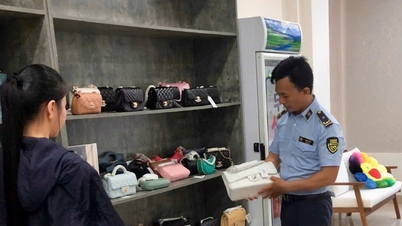
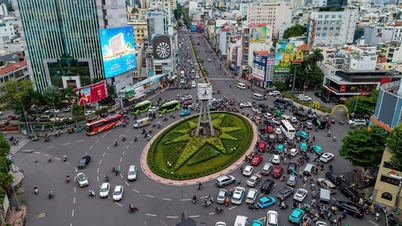
Instead of choosing to open stores on prime locations in the heart of Ho Chi Minh City, business owners are increasingly moving into alleyways and suburban areas, resulting in more and more vacant premises in the city center.
There are more and more vacant spaces.
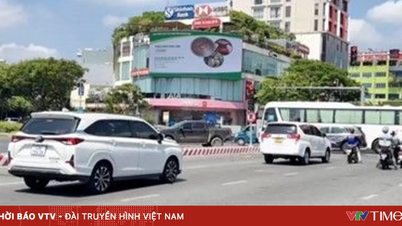
The wave of businesses returning their leased premises on main streets, which began at the end of last year, shows no signs of slowing down. According to observations by reporters from the Nguoi Lao Dong newspaper, along central streets in Ho Chi Minh City such as Nguyen Thi Minh Khai (District 1, District 3), Ba Thang Hai (District 10), Nguyen Trai (District 5), Phan Xich Long (Phu Nhuan District)... the number of premises and townhouses displaying "for rent" signs is increasing, even though after Tet (Lunar New Year), some landlords have accepted price reductions to attract tenants.
Recent data from Nha Tot shows that rental prices for retail street-front properties in most districts of Ho Chi Minh City have decreased significantly compared to a few months ago. District 1 and Binh Thanh District saw the deepest declines, with an average decrease of 20%-32% compared to the end of 2024.

While shops are scrambling to move into side streets, many warehouses and shipping companies are expanding into prime locations.
Specifically, rental prices in Binh Thanh District decreased by 32%, from VND 39.5 million/month (October 2024) to VND 26.8 million/month (January 2025). Prime locations in District 1 saw average rental prices drop from VND 77 million/month to VND 62 million/month. Further out, Binh Tan and District 7 also experienced decreases ranging from 7% to 18%.
According to business sources, the wave of businesses returning prime locations will continue as vendors tend to move their businesses to alleyways or suburban areas for cheaper rent to save costs. In addition, the shift in business models towards online platforms has made them less interested in properties costing hundreds of millions of dong.
However, amidst the widespread trend of businesses returning leased premises, delivery companies like Viettel Post, Giao Hang Tiet Kiem (Economical Delivery), J&T Express, etc., are continuously expanding into prime locations, accepting rents of up to hundreds of millions of VND per month. A representative of a transportation company in Ho Chi Minh City revealed that the main reason businesses accept high-priced storefronts on busy streets is to affirm their position, brand, and reputation, as well as to process goods faster in the increasingly fierce e-commerce competition.
Relocation to reduce costs.
Mr. Nguyen Lien, owner of Na.Store fashion store in Thu Duc City (Ho Chi Minh City), said he moved his store from a storefront to an alleyway due to the shift in consumer shopping trends from offline to online. Since moving to the alley, his monthly expenses have decreased by more than half, from 20 million VND to 9-10 million VND.
"Rent in alleyways is 50% cheaper than storefronts, while the space is 2-3 times larger. This is also a trend in the fashion industry. Now, doing business on main streets doesn't necessarily offer the same advantage as online. However, selling online isn't easy either because of intense competition from KOLs selling through affiliate marketing and tens of thousands of other online sellers, so you need a well-planned strategy and strategy, otherwise you'll fail. Currently, I'm looking for more local regional specialties to sell on e-commerce platforms to increase profits," Mr. Lien shared.
Retail expert Nguyen Quang Thai commented that in the context of a still challenging economy , the boom in e-commerce, and changing consumer habits, prime storefronts with rental prices reaching hundreds of millions of dong are now only suitable for businesses aiming for expansion and increased brand recognition.
Traditional shops and small and medium-sized enterprises (SMEs) will tend to move into alleyways or further away from the city center to save costs, allocating their budget to advertising or social media marketing. Therefore, the wave of returning prime locations will certainly continue.
Mr. Thai cited the example of many food establishments currently tending to relocate to alleyways or suburban areas in Ho Chi Minh City such as Thu Duc City, Go Vap District, etc., to reduce cost pressure. "Industries like fashion, food and beverage, or offices only provide services and are not overly dependent on storefronts."
"If the product or service is good and affordable, customers will come. The move into smaller alleys reflects the changing economy where almost everything can be put online. Businesses that want to operate effectively must integrate technology, build a multi-channel connected ecosystem, and adapt to new consumer behavior to do business successfully, instead of just focusing on renting prime locations for 200-300 million VND/month and then having to close down early," Mr. Thai said.
Startups also moved into alleyways.
According to Mr. Nguyen Quang Thai, this trend is not limited to the retail sector; office rental services are also shifting in line with this trend. Start-ups and small and medium-sized enterprises are now seeking workspaces in alleys and side streets with low costs to optimize their budgets, combining online and offline models.
Source: https://nld.com.vn/mat-bang-dac-dia-qua-thoi-dat-khach-196250305211908494.htm

![[Photo] General Secretary and President To Lam presides over a working session with the Central Policy and Strategy Committee on the development of the materials industry.](https://vphoto.vietnam.vn/thumb/1200x675/vietnam/resource/IMAGE/2026/05/21/1779359935432_a3-bnd-3129-1412-jpg.webp)























































































Comment (0)