


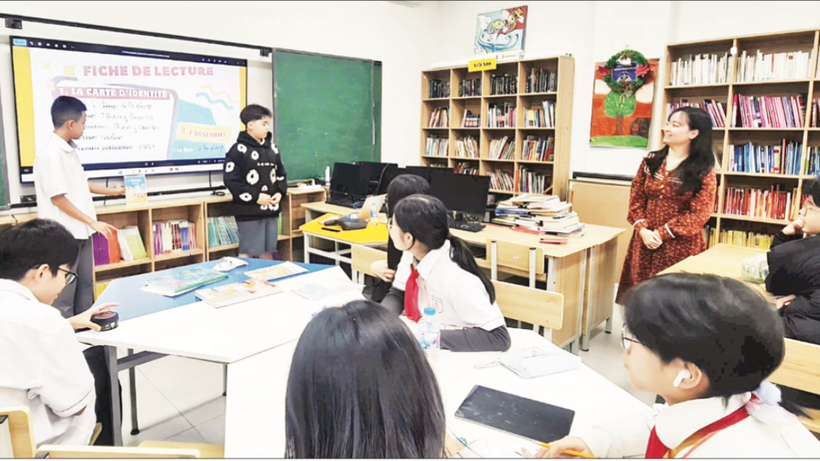
According to the Ministry of Education and Training , tutoring and supplementary education are currently not conditional business services. Therefore, the management of this activity needs to be carried out in a comprehensive and synchronized manner, ensuring legal discipline, transparency, and practicality.
The Ministry of Education and Training does not prohibit legitimate tutoring or supplementary classes; nor does it restrict the legitimate learning needs of students or the teaching rights of teachers as stipulated by law. However, to ensure that this activity is carried out in accordance with regulations, it is necessary to strengthen management measures and limit disguised tutoring practices, coercion of students, profiteering, and negative impacts on the educational environment.
The overarching theme of the draft is to strengthen the management of teachers' tutoring activities; to link tutoring activities with professional ethical standards, duties, rights, and prohibited actions for teachers; and to clarify the accountability of principals in managing tutoring and supplementary learning activities.
New points in the draft include the principal's right to increase the time allocated for extra classes within the school; and the requirement to report the relationship between teachers providing extra classes and those registered to conduct extra classes...
Regarding the adjustments to the management of extracurricular tutoring, many educational institutions believe that some aspects need further clarification to ensure feasibility and avoid differing interpretations and applications among institutions.
Teacher Trinh Dieu Hang, Deputy Principal of Chu Van An Secondary School in Hanoi, believes that the draft regulations lack specific provisions or explanations defining what constitutes "coercion" in tutoring and supplementary classes. This could lead to inconsistent understanding and application, easily giving rise to misinterpretations, causing apprehension among teachers, and creating difficulties in school management.
Therefore, the Ministry of Education and Training needs to add regulations clarifying that "coercion" is defined based on specific behaviors, not just on subjective feelings; and to list some behaviors that are considered "coercion".
At the same time, clarify the boundary between prohibited behavior and legitimate, voluntary learning support activities for students; provide unified guidelines for educational institutions and local authorities to apply consistently, avoiding misinterpretations, rigid application, or inconsistency.
On the other hand, the Ministry of Education and Training needs to consider and clarify the concept of "relatives" as stated in the draft Circular; clarify the difference in responsibility between cases where teachers have a normal relationship with the business entity and cases where the business entity is a relative; and provide specific guidance on the form, scope, and responsibility for receiving and processing "disclosure and explanation" to avoid overlapping responsibilities for teachers and heads of educational institutions...
According to Mr. Luong Van Duong, Principal of A Phu Ly High School in Ninh Binh province, the time allotted for extra classes in schools is inadequate, especially during periods when remedial classes are organized for weak students and advanced training for gifted students and those preparing for the graduation exam.
The daily schedule is limited to no more than 7 lessons (including regular classes and extra classes); and no more than 2 lessons per subject per week, which is insufficient for the students mentioned above. Many students live 5-7km away from the school, making it very difficult for them to attend 5 lessons in the morning and 2 extra lessons in the afternoon. Each extra lesson at school costs 7,000 VND, so if they attend 4 lessons a day, they would have to pay 28,000 VND.
Meanwhile, due to the inability to meet the demand for extra tutoring, many students still attend tutoring centers at a cost of 80,000 to 100,000 VND per two lessons. The school cannot control the quality of teaching at these centers, leading to wasted resources and creating a burden for parents and students.
Dr. Hoang Ngoc Vinh, former Director of Professional Education (Ministry of Education and Training), analyzed: One of the main causes of the current situation of extra tutoring lies primarily in the examination-admission policies, curriculum, and the quality of regular teaching in high schools.
In many places, the entrance exam for public high schools remains a fierce competition, and tutoring has become a crucial support for parents and students. With limited access, the market for exam preparation and tutoring will expand. Furthermore, the curriculum is heavy, classes are large, and time is limited. Therefore, the "blurry" between regular schooling and tutoring must be eliminated through simple, clear criteria; what constitutes remedial instruction should be the responsibility of the school; and what is considered competency-building activities that are essentially tutoring should be managed according to the tutoring regulations.
At the same time, it is necessary to open more "doors" after lower secondary school to reduce the pressure on admission to public high schools; develop vocational high schools as an alternative, with articulation, quality, and job opportunities… Then, the pressure of enrollment, the need for exam preparation, and extra classes will decrease.
Source: https://nhandan.vn/minh-bach-hoat-dong-day-them-post938979.html















![[Video] Asking for calligraphy at the beginning of the year - a beautiful traditional cultural practice](https://vphoto.vietnam.vn/thumb/402x226/vietnam/resource/IMAGE/2026/02/17/1771326318769_dung00-10-46-17still003-png.webp)






















































Comment (0)