

Previously, at a meeting of the Politburo and the Secretariat in May, General Secretary To Lam mentioned the idea of teaching two sessions per day and suggested inviting singers and artists to teach music, athletes to teach physical education and sports, and painters to teach drawing to students. In Official Dispatch No. 61/CD-TTg, the Prime Minister requested that provincial and city People's Committees mobilize and encourage artists, artisans, athletes, and experts to organize cultural, artistic, and sports activities to develop talents for students.
What is the current state of art education in secondary schools, and what solutions are there to effectively involve artists and athletes in teaching?
CHALLENGES IN MUSIC AND FINE ARTS
Although music and art are compulsory subjects in the curriculum aimed at developing aesthetic qualities and abilities, and providing career guidance, they pose a challenge for schools.
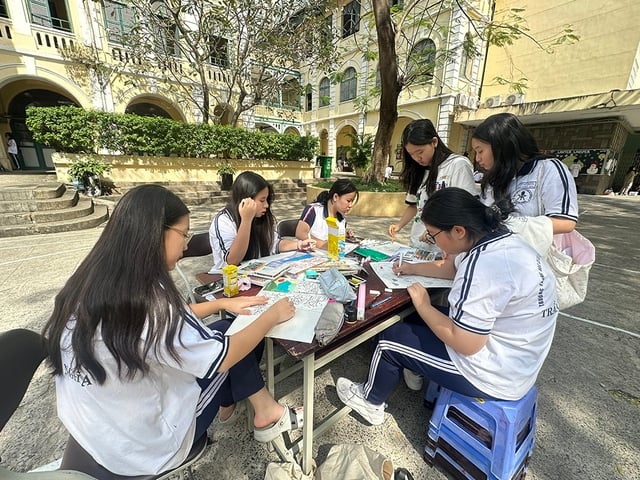
Students of Tran Dai Nghia High School, Saigon Ward (formerly District 1), Ho Chi Minh City, during a practical art class.
PHOTO: BICH THANH
Under the previous 2006 and current 2018 General Education Programs, music and fine arts were always core subjects at the primary and lower secondary levels. However, at the upper secondary level, with the implementation of the 2018 General Education Program, which aims to develop students' qualities and competencies while expanding opportunities for choosing subjects that match their strengths and career aspirations, these two subjects have become compulsory electives.
According to statistics from the former Ho Chi Minh City Department of Education and Training and based on information about the organization of elective subjects in over 100 high schools, 23 schools offer art classes and 19 schools offer music classes. Of these, approximately 10 schools offer two art subjects, including Le Hong Phong High School for the Gifted, Tran Dai Nghia Secondary and High School, Hung Vuong High School, Gia Dinh High School, Trung Vuong High School, Nguyen Huu Cau High School, Phu Nhuan High School, University of Pedagogy Practice High School, Binh Chanh Sports and Physical Education Gifted High School, Nguyen Huu Tho High School, and Binh Hung Hoa High School.
Ms. Nguyen Thi Hong Chuong, Principal of Nguyen Thi Minh Khai High School, Xuan Hoa Ward (formerly District 3), said that because these are two elective subjects, the school only opens classes when there are enough registered students.
In addition, many schools face difficulties in organizing music and art classes due to a shortage of qualified teachers and inadequate infrastructure.
The principal of a high school in Ho Chi Minh City stated that the number of students registering for music and art classes in many high schools is currently quite low. The main reason is that these are not popular subjects in the career choices of most students. Another noteworthy issue, according to this principal, is that many high schools do not have readily available music and art teachers. When implementing the new curriculum, some schools are forced to invite guest lecturers or collaborate with art and cultural centers to organize classes, a temporary solution lacking long-term stability.
"Even with official teaching staff, many schools may face a shortage of classes to assign teachers to. With a limited number of teaching hours and an unstable number of classes each school year, music and art teachers find it difficult to meet the current requirement of 17 hours per week, making it challenging to allocate and assign duties," this principal informed.
In the context of a shortage of qualified teachers and a scarcity of qualified candidates, many schools have adopted the option of hiring visiting lecturers to meet the program's requirements. For example, Hung Vuong High School hires visiting lecturers: a music teacher from the Ho Chi Minh City Conservatory of Music and an art teacher from the fine arts department of a university.
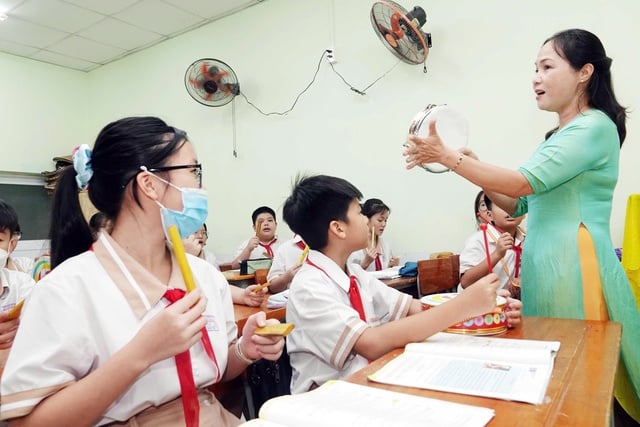
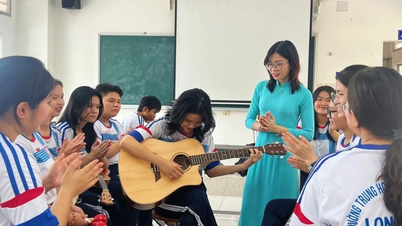
A music lesson for middle school students. At this level, music and art are two core subjects.
Photo: Dao Ngoc Thach
C. Has not fully achieved the goal of comprehensive education.
In light of the aforementioned situation, Mr. Huynh Thanh Phu, Principal of Bui Thi Xuan High School, Ben Thanh Ward (formerly District 1), Ho Chi Minh City, believes that implementing art as a subject in the 2018 General Education Program, in addition to career guidance, also contributes to nurturing the soul and developing aesthetic, creative, and emotional abilities in students. However, the current implementation in educational institutions faces numerous obstacles, preventing the full achievement of the goal of comprehensive education.
Most secondary schools, especially in rural and disadvantaged areas, lack standard functional classrooms for art subjects. This lack of facilities leads to teaching that is merely 형식적인 (formalistic), failing to promote practical application and experiential learning—the core elements of art education.
Human resources for this subject are also limited. Most schools do not have dedicated art or music teachers. Hiring contract teachers is very expensive, while the current budget does not allow for such payments. This situation leads to program implementation being merely reactive or temporary integration, reducing the quality of teaching.
Furthermore, many parents and students still have a dismissive attitude towards art, considering it a secondary subject only for gifted students. This leads to a lack of motivation for students to learn and a lack of motivation for teachers to teach.
We need specific standards and evaluation mechanisms.
In this context, mobilizing artists and athletes to teach arts and sports is a suitable solution. The question is how to implement it effectively.
Mr. Ho Ngoc Khai, Editor-in-Chief of the music textbook series (Creative Horizons), Head of the Department of Art and Physical Education, Faculty of Primary Education, Ho Chi Minh City University of Education, believes that General Secretary To Lam's opinion opens up a new perspective on art education for children, aiming to utilize resources other than teachers. Schools could invite professional or retired artists to participate in art education in secondary schools. This would both utilize qualified individuals in the educational process and identify talented students for advanced training.
However, according to Mr. Khai, there needs to be standards and evaluation mechanisms for the quality of this resource to ensure quality and prestige in art education in secondary schools or in activities outside the community and society.
"Artists and athletes must be well-trained, qualified, and possess clear credentials. They need experience and teaching methods in their respective fields. They must also have a good character to avoid negative impacts later on, especially in the context of the current development of social media," said Mr. Ho Ngoc Khai.
According to Mr. Khai, priority should be given to artists who have already received training at professional schools. For young artists, it is necessary to have pedagogical certificates issued by teacher training universities. (to be continued)
Specific and feasible solutions
According to Master Nguyen Dinh Tinh, Deputy Head of the Basic Sciences Department at the Central College of Pedagogy in Ho Chi Minh City, in order to effectively implement the idea of inviting singers, artists, and athletes to participate in teaching at schools, specific and feasible solutions are needed.
Firstly, a flexible cooperation mechanism needs to be established. Schools should coordinate with the Department of Education and Training to set up short-term or long-term contracts with singers, artists, athletes, etc. Next is the selection of suitable experts. It is necessary to seek out and invite artists and athletes with pedagogical skills or teaching experience. It is also necessary to strengthen the organization of training courses and professional development programs for teachers, focusing on teaching methods and classroom management, to help artists and athletes effectively convey knowledge to the students they are responsible for.
Priority should be given to local artists, singers, or athletes to reduce travel costs and make it easier to invite them to lecture.
The curriculum needs to be integrated. The duration and content of subjects such as music, physical education, and fine arts need to be adjusted to accommodate the participation of invited artists and athletes.
Mr. Huynh Hoang Cu, Head of the Faculty of Arts at Van Hien University, also believes that for effective implementation, schools need to be given the flexibility to sign short-term contracts with artists and athletes in the form of collaborators. At the same time, they need to coordinate with art and sports centers in localities to develop age-appropriate programs…
Source: https://thanhnien.vn/moi-nghe-si-van-dong-vien-day-hoc-sao-cho-hieu-qua-185250806213151962.htm

![[Photo] Ba Lang An Lighthouse - the "eye of the sea" amidst the "rock museum" of Quang Ngai province.](https://vphoto.vietnam.vn/thumb/1200x675/vietnam/resource/IMAGE/2026/05/29/1780038698840_anh-man-hinh-2026-05-29-luc-14-10-42.png)
![[Image] Pleasant weather helps students enter the 10th grade entrance exam with confidence.](https://vphoto.vietnam.vn/thumb/1200x675/vietnam/resource/IMAGE/2026/05/29/1780034401612_ngay-1-thi-lop-10-minh-duy-8-5009-jpg.webp)












![[Photo] Admire the coral "masterpiece" amidst the million-year-old heritage of Dak Lak province.](https://vphoto.vietnam.vn/thumb/1200x675/vietnam/resource/IMAGE/2026/05/30/1780107638639_y25-jpg.webp)








































Comment (0)