

Amidst the hustle and bustle of the twelfth lunar month, when every household is busy cleaning and preparing, people still set aside a special time to visit cemeteries and the graves of their loved ones, light incense, and pay their respects to their ancestors. For many families, if they haven't done this, Tet (Lunar New Year) seems to have not truly begun.
Around the 28th, 29th, and 30th of the twelfth lunar month, the roads leading to the cemeteries suddenly become busier than usual. People carry flowers, fetch water, and carry bundles of incense sticks still smelling fresh. Some families visit with three generations. Others, busy all year, still try to arrange a trip back to their hometown at the end of the year. No one makes an appointment, but every year, the cemeteries in the days leading up to Tet (Lunar New Year) are as crowded as a quiet festival.
.jpg)
It wasn't a scene of noise. There was a sense of reverence. Elderly people, leaning on canes, walked slowly between rows of graves. Middle-aged people meticulously wiped each tombstone and pulled out weeds. Young children stood beside their parents, learning to clasp their hands and bow their heads. One child asked, "Why do we have to come here, Mom?" The mother replied softly, "To invite our ancestors to come and celebrate Tet with us, my child."
A simple saying, yet it encapsulates an entire cultural tradition.
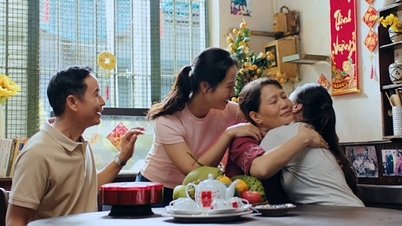
In the Vietnamese psyche, Tet (Lunar New Year) is a time for complete family reunion. The first meal of the year is not just for those sitting around the table. On the altar, extra chopsticks are placed. The incense sticks are carefully trimmed. The plate of five fruits is meticulously selected. It's not simply a ritual, but a reminder: each family today is built upon the foundations laid by previous generations.
At the cemetery in the final days of the year, the atmosphere is far from somber. People tell their ancestors about the past year: about the harvest, their work, their children's growth. Some sit silently for a long time before the graves, as if engaging in a dialogue with themselves. In that moment, people find it easier to slow down and reflect than at any other time of the year.
What is noteworthy is that in today's increasingly modern lifestyle, this custom has not only not faded away but is still preserved naturally. Nowadays, many families have the means to travel during Tet (Lunar New Year). Some choose to celebrate New Year's Eve in another city, or even abroad. But before leaving, they still return to the cemetery. The invitation to their ancestors to come home for Tet is still offered with a stick of incense.
.jpg)
There are people who work far from home, living in foreign lands for many years. Whether they are well-off or struggling to make ends meet, they still find ways to maintain these traditional customs. Some ask relatives back home to light incense for them. Some return late after Tet but still visit the graves to pay their respects. Others can only light incense before a small altar in a foreign land, turning their hearts towards their homeland.
The essence lies not in lavish feasts or outward appearances, but in a heartfelt devotion to one's roots. It is this sincerity that gives tradition its enduring strength.
In an open world where geographical distances are shrinking, people can travel far, but they still need a spiritual anchor. For Vietnamese people, that anchor is family and ancestors. Therefore, the custom of inviting ancestors home for Tet (Lunar New Year) is not only a spiritual ritual but also a concrete expression of the principle of "drinking water, remembering the source."
Perhaps the most precious image is that of children being led to the cemetery by their parents during the final days of the year. It's not meant to frighten them, but to help them understand that they are not alone in this life. Behind them are their grandparents, their parents, and an entire lineage that has persevered through countless changes. These lessons don't need lengthy explanations. Just a bow of the head, a simple introduction – "This is your great-grandfather" – is enough to plant a seed of gratitude in a child's heart.
A nation that cherishes its past is a nation with a solid foundation. In the flow of development and integration, when many values are challenged, customs like inviting ancestors to celebrate Tet (Lunar New Year) are the threads that keep families together and generations from becoming separated.
.jpg)
Therefore, Tet is not just a moment of transition into the new year. Tet is a time to return home. To return to one's home, to one's homeland, to the graves of ancestors. To return to remind oneself to live more virtuously, to be more responsible towards family and society.
The cemetery is crowded in the days leading up to Tet (Lunar New Year), but not noisy. It's a crowd of memories, of affection. And amidst the delicate smoke of incense, perhaps each person silently entrusts a very simple wish: to pray for their family's health, peace, and harmony.
Amidst the many changes of modern life, the custom of inviting ancestors to celebrate Tet (Lunar New Year) is quietly maintained through generations. No one forces anyone to do it, no one sets a rule, but everyone feels the need to do it. Because more than just a ritual, it is how Vietnamese people preserve their roots.
And perhaps, it is from those last incense sticks of the year that each family reminds each other once again: no matter how far you go, you must remember the way home.
Source: https://congluan.vn/moi-ong-ba-ve-an-tet-10330637.html






![[E-Magazine]: Leaning on January](https://vphoto.vietnam.vn/thumb/402x226/vietnam/resource/IMAGE/2026/03/06/1772799934602_e-magazine-nghi-w1200t0-di2609d199d5155355t11920l1-nvtg-104.webp)














































Comment (0)