If it hadn't been for my travel companion's insistence on stopping in Dak Mil for a "drinking session" with an old acquaintance, Dak Nong might have slipped past me in the darkness of my journey from Pleiku to Da Lat. However, that invitation to a "meet-and-greet" unexpectedly became the pretext for a fascinating adventure later on.
MONTAGNARD AFTERNOON
A year after that invitation, I returned to Dak Nong, this time intending to explore the land for its true and unspoiled beauty, not just for impressive features like the bauxite project in a province that had only been re-established for over 20 years. This time, Dak Mil greeted me with an unusually heavy downpour at the beginning of the dry season.
It turns out that Dak Mil looks quite different during the day. The hazy grayness of a rainy border afternoon gives the place a familiar feel reminiscent of the mountain towns of the Central Highlands like Mang Den or Da Lat. Beneath the thin veil of water, the red color of the basalt soil shines even brighter, like the vibrant yellow of the last patches of wild sunflowers in bloom.
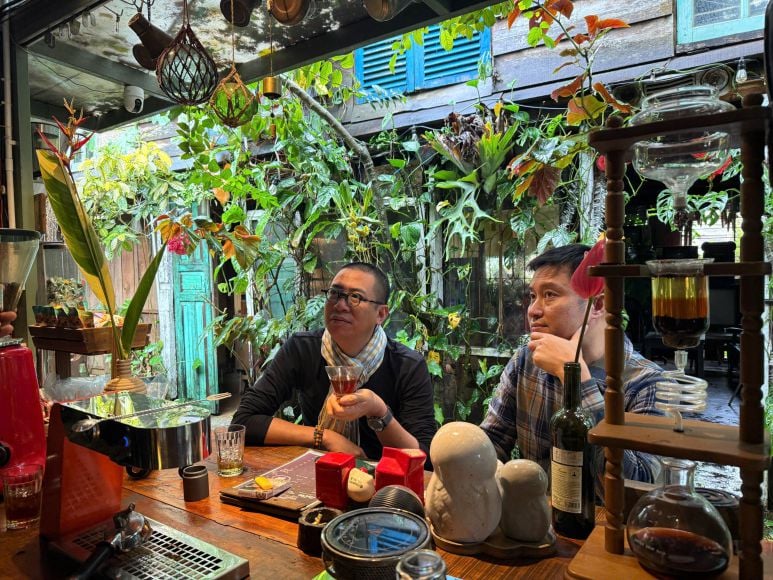
After much searching using Google Maps and making phone calls to relatives, we finally arrived at our friend's house. It was a stilt house built in the style of the Montagnards – a term used to refer to the indigenous people living on the M'nong plateau for millennia, similar to mountain dwellers or highlanders.
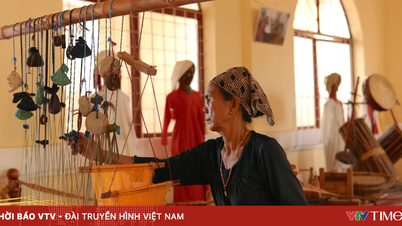
Montagnard – the stilt house of the Montagnard people – is the name given to the house by its owner, densely packed with materials of the M'Nong and Ede people, with household items, patterns, and decorative styles... creating a space that is very Montagnard.
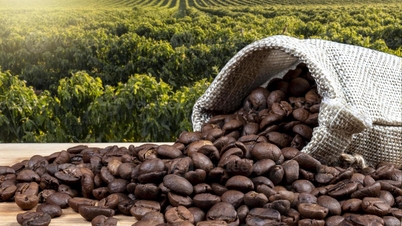
The chill of that seemingly endless rainy afternoon created the perfect setting for a delightful coffee experience. Regardless of the pattering raindrops on the tin roof or the rustling through the leaves, the warm, aromatic flavors of various coffees unfolded one after another through different brewing methods.
The story also blossoms with the excitement brought about by caffeine, about the land of Dak Mil from ancient times to the present day, about the explorer Henri Maitre and his book "The Forest of the Montagnards," which researched the mountainous highlands of Central Vietnam...
If represented by color, Dak Mil would be a red dot, the color of the red basalt soil and also the dominant color of this land. Dak Mil is located near the Krong No Volcanic Geopark, so it has a plateau terrain of fertile red basalt soil. Volcanoes from millions of years ago erupted and then died out, allowing wind and water to transform magma into this precious, nutrient-rich soil.
Thanks to this, the landscape of Dak Mil looks very desolate, but not desolate. Because here, countless pepper and cashew plantations flourish on the red basalt soil, providing a huge source of long-term industrial crops for the people. And it's not just pepper and cashew that thrive in this soil; rubber, tea, coffee, macadamia, cocoa, durian, avocado... also love the soil here.
The high elevation in the south and low elevation in the north (from 900m down to 400m) of Dak Mil makes it a transitional area between the two sub-climatic regions of Dak Lak and Dak Nong , characterized by a tropical monsoon climate near the equator with two distinct seasons: the rainy season and the dry season.



From a hydrological perspective, Dak Mil has a dense network of streams, becoming the primary water source for the majestic Serepok and Dong Nai rivers. This explains why Dak Mil has the word "Dak" (meaning water - in the local language) in its name, similar to Dak Lak or Dak Nong.
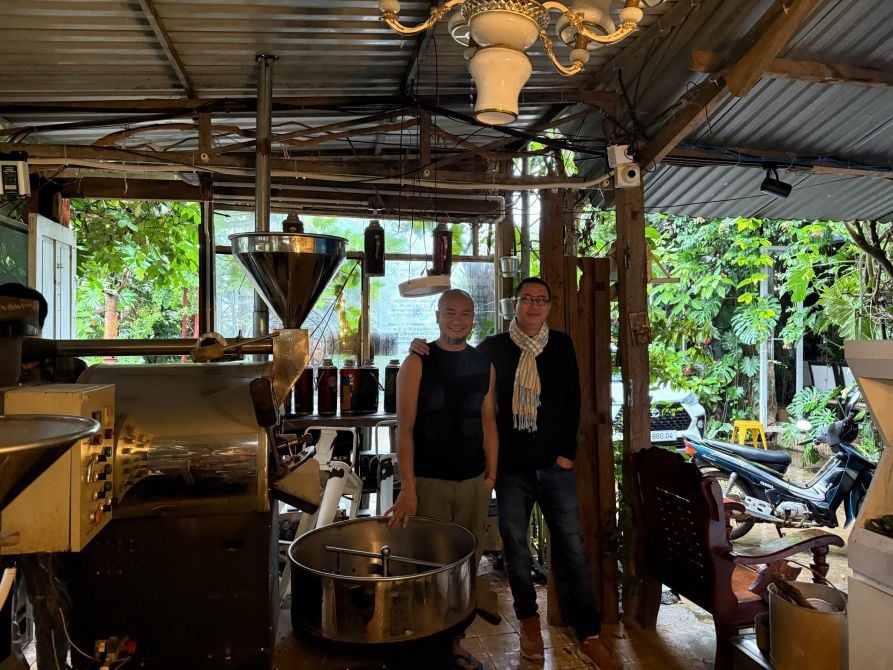
Enjoying a delightful coffee experience at the Montagnard stilt house in Dak Mil. Photo: An Le
WEST LAKE ON THE HIGHLANDS
While chatting about the land, water, and strange stories of the place bordering Cambodia, the host of the coffee meeting posed a question: "Did you know that Dak Mil also has a West Lake like Hanoi , though of course, the West Lake here is only about one-fifth the size of the West Lake in the North?"
We were quite surprised by this information, because lakes are everywhere, but West Lake (Hồ Tây) was truly unusual. We thought there were only two West Lakes in the world, one in Hangzhou (China) and one in Hanoi. Therefore, we couldn't contain our curiosity and had to go see what West Lake in Dak Mil was like.
This lake isn't named West Lake because it's located west of the capital city, like West Lake in Hanoi and Hangzhou. Nor was it naturally formed like in Hangzhou, nor was it dug up by a golden buffalo searching for its mother, as the legend of West Lake in Hanoi suggests.
This semi-artificial lake is simply called West Lake because it was dug by the French; that is, the French colonial government dug this lake in the 1940s with the aim of transforming small streams flowing from the fissures of the Nam Gle volcano in this area into a lake to regulate the landscape and store water for various uses.
Because it was dug by the French, it's called West Lake, but it must be acknowledged that West Lake is a highlight that creates a romantic beauty for the town of Dak Mil, much like the "eye" of Bien Ho Lake in the mountain town of Pleiku or Xuan Huong Lake in Da Lat. With a circumference of about 10km and a surface area of 108 hectares, West Lake is an abundant water source for the coffee plantations in the surrounding area.
This project was not conceived by chance. From the very beginning of the lake's construction, the French calculated that it would be a water source for coffee cultivation, a crop they introduced here in the 1940s. As a result, Dak Mil became the coffee hub of Dak Nong province, with over 20,000 hectares dedicated to coffee.
It's worth noting that Dak Nong is the third largest coffee-growing region in Vietnam, with 130,000 hectares and a total annual production of approximately 350,000 tons. However, Dak Mil coffee aims not for quantity but for high quality, in order to "sell at a high price," as concluded by the homeowner.
Returning to the story of West Lake. The lake also has another name: Dak Mil volcanic lake. The small underground water sources that the French collected to form West Lake flow from the Nam Gle volcano crater, located within the volcanic system of the Dak Nong Global Geopark, which was recognized and mapped by UNESCO in 2023.
The volcanic lake is numbered 23 on the "Symphony of New Waves" exploration route in this global geopark. If photographed from above, we can see that Dak Mil's West Lake has the arc of a real volcanic crater, albeit only a partial view.



Although the West Lake in Dak Mil doesn't have as many myths and legends as the two real West Lakes, its ancient volcanic origins have given it a unique, mysterious, and captivating beauty. The lake is truly a precious gem, a refreshing drop of water that cools Dak Mil during the dusty, red-hued dry season!
The cool, refreshing waters of West Lake also nurture a unique and very famous specialty of Dak Mil: the West Lake goby fish. This species is raised in natural conditions and reproduces quite quickly. The fish meat is soft and smooth, not fishy, and can be prepared into many delicious dishes, such as braised goby fish.
The fish is marinated thoroughly with spices, including locally grown black peppercorns, then simmered in an earthenware pot over low heat until the liquid evaporates. Eating this fish with hot rice on a cold, rainy day like this is truly divine, incomparable.
That alone is enough to captivate the hearts and stomachs of travelers who have even a fleeting glimpse of Dak Mil!
Ky Lam
Source: https://laodong.vn/du-lich/kham-pha/mot-thoang-dak-mil-1445040.html

![[Image] Ho Chi Minh City: Ma Lang area, Chicken-Rice Market about to change its appearance](https://vphoto.vietnam.vn/thumb/1200x675/vietnam/resource/IMAGE/2026/06/25/1782377698627_ndo_br_m1-jpg.webp)
![[Image] Schools organize meetings and introduce teaching models to students admitted to grade 10.](https://vphoto.vietnam.vn/thumb/1200x675/vietnam/resource/IMAGE/2026/06/25/1782368077271_ndo_br_z7970052192242-1ec8daeb77a6eed1a4e9f58c564ddd3e-jpg.webp)
![[Photo] General Secretary and President To Lam receives Palestinian Ambassador Saadi Salama](https://vphoto.vietnam.vn/thumb/1200x675/vietnam/resource/IMAGE/2026/06/25/1782365384740_a1-bnd-9423-8322-jpg.webp)