

BHG - Arriving in Na Chi commune (Xin Man district) at this time, along both sides of Provincial Road DT.178, many tarpaulins are spread out by locals to dry cinnamon bark, filling the area with its fragrant aroma. On the hillsides, a vast expanse of green stretches out as cinnamon trees are in harvest season. For many years, cinnamon trees have not only contributed to environmental protection but also provided income for local people, helping many families escape poverty and become wealthy on their own land.
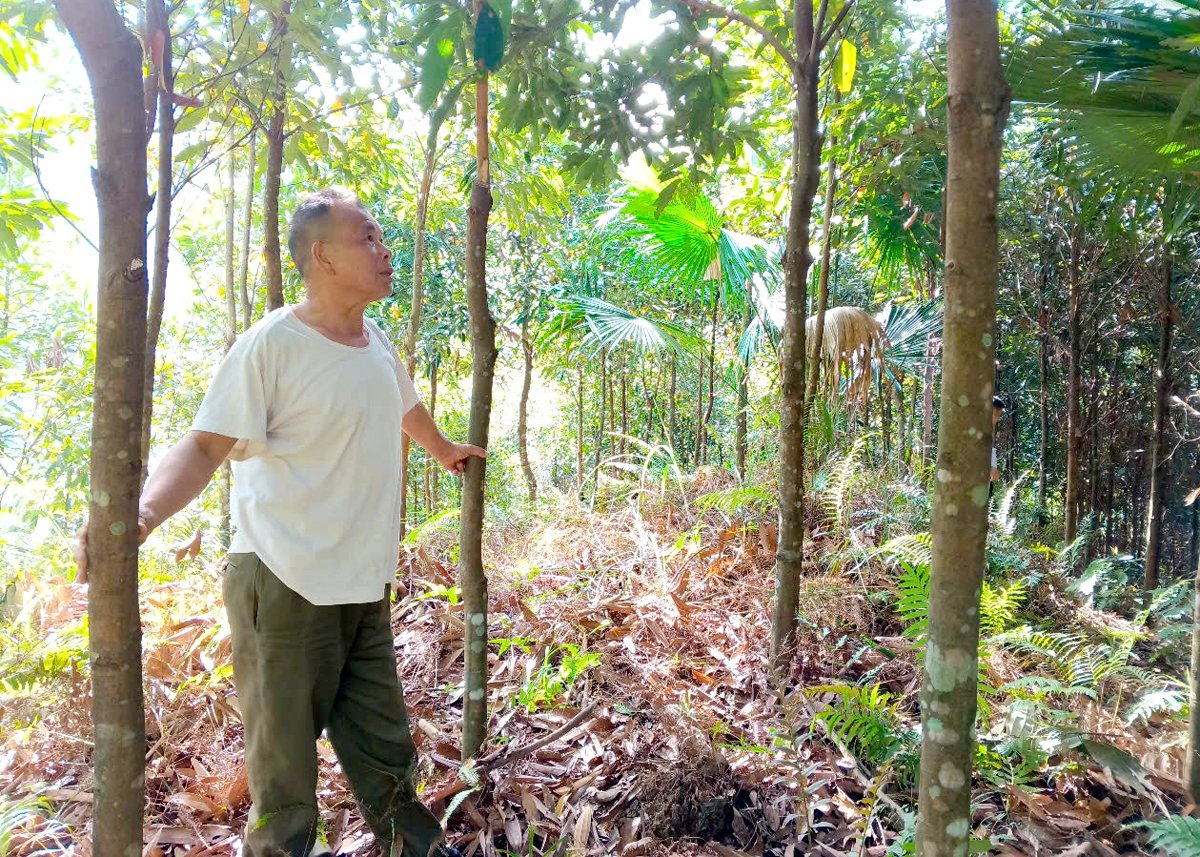 |
| Mr. Luc Hai Duong, from Tan Son village, introduces his family's cinnamon hill, which is now old enough to be harvested. |
We spoke with Mr. Luc Hai Duong, born in 1957, in his spacious and well-maintained concrete stilt house, the most impressive in Tan Son village. Mr. Duong is a prime example of successful forest-based economic development. Many villagers know him as a "big shot" in cinnamon cultivation. Over a cup of golden tea, still imbued with the essence of spring, Mr. Duong shared his story of how he became involved with cinnamon trees. In 1996, he was a commune official, but due to declining health, he could no longer continue his work. At a meeting with constituents at the Na Chi Commune People's Committee headquarters, a provincial leader suggested he try planting cinnamon on the hills. After much research and learning from various sources, he decided to invest in planting 0.4 hectares of cinnamon trees. Mr. Duong recounted: "In the early years, the work of caring for the trees was quite difficult due to a lack of technical knowledge, limited capital, and harsh weather conditions." However, with perseverance and a spirit of overcoming difficulties, I overcame the challenging period. To improve my farming techniques, I regularly participated in agricultural training courses organized by the local authorities, and proactively sought out relevant materials on how to plant and care for cinnamon trees. After 7 years, the first cinnamon harvest brought in a large profit, providing my family with capital to expand the area. To date, Mr. Duong's family owns nearly 12 hectares of cinnamon trees; in 2024, he earned nearly 200 million VND from cinnamon. On average, each hectare of mature cinnamon trees can yield an income of 200-250 million VND, or even more if market prices are high. With this cinnamon farming model, his family has earned over 1 billion VND after deducting expenses; the accumulated money has helped his family build a house and buy household items. In addition to its economic value, cinnamon cultivation also brings many environmental benefits. Cinnamon trees help retain soil and water, reduce erosion, and improve soil fertility; thanks to the green cinnamon forests, the ecosystem in this area is gradually recovering.
According to Mr. Duong, cinnamon trees are like a long-term investment, their value increasing over time. Currently, he has over 1 hectare of cinnamon trees ready for harvesting, but he doesn't need to spend money on anything yet, so he's leaving them there. He plans to sell them when he's in need. When selling, people can peel the bark and sell it to traders, or traders can buy the entire plantation and harvest it themselves. With decades of experience in cinnamon cultivation, Mr. Duong further shared: For cinnamon trees to thrive, planting and caring must adhere to the technical process of "selecting the right variety – planting at the right time – planting at the right density and proper care." If planting cinnamon, it's best to plant from October of the previous year to the spring of the following year when the weather is cool and there is sufficient water for optimal growth. When planting, choose seedlings that are not too old, and that have the right height and thickness of trunk. In addition, weeding and pruning must be done regularly.
The success of Mr. Luc Hai Duong's family has become an example of overcoming difficulties for many other farmers in the region. From pioneering cinnamon cultivation, nearly 500 hectares of cinnamon trees have now been planted by households in various villages across the commune. Mr. Lu Van Luyen, Vice Chairman of the Na Chi Commune People's Committee, shared: "Mr. Luc Hai Duong is a shining example of economic development from the forest. His model not only brings economic benefits but is also very sustainable and aligns with the commune's New Rural Development orientation."
Text and photos: VAN LONG
Source: https://baohagiang.vn/kinh-te/202505/na-chi-thu-nhap-cao-tu-trong-que-38e34ac/

![[Photo] Prime Minister Pham Minh Chinh receives the Governor of Tochigi Province (Japan)](/_next/image?url=https%3A%2F%2Fvphoto.vietnam.vn%2Fthumb%2F1200x675%2Fvietnam%2Fresource%2FIMAGE%2F2025%2F12%2F16%2F1765892133176_dsc-8082-6425-jpg.webp&w=3840&q=75)
![[Live] 2025 Community Action Awards Gala](/_next/image?url=https%3A%2F%2Fvphoto.vietnam.vn%2Fthumb%2F1200x675%2Fvietnam%2Fresource%2FIMAGE%2F2025%2F12%2F16%2F1765899631650_ndo_tr_z7334013144784-9f9fe10a6d63584c85aff40f2957c250-jpg.webp&w=3840&q=75)
![[Image] Leaked images ahead of the 2025 Community Action Awards gala.](/_next/image?url=https%3A%2F%2Fvphoto.vietnam.vn%2Fthumb%2F1200x675%2Fvietnam%2Fresource%2FIMAGE%2F2025%2F12%2F16%2F1765882828720_ndo_br_thiet-ke-chua-co-ten-45-png.webp&w=3840&q=75)
![[Photo] Prime Minister Pham Minh Chinh receives Lao Minister of Education and Sports Thongsalith Mangnormek](/_next/image?url=https%3A%2F%2Fvphoto.vietnam.vn%2Fthumb%2F1200x675%2Fvietnam%2Fresource%2FIMAGE%2F2025%2F12%2F16%2F1765876834721_dsc-7519-jpg.webp&w=3840&q=75)








































![[Live] Closing Ceremony and Award Presentation for the "Impressive Vietnam Tourism" Video/Clip Creation Contest 2025](https://vphoto.vietnam.vn/thumb/402x226/vietnam/resource/IMAGE/2025/12/17/1765974650260_z7273498850699-00d2fd6b0972cb39494cfa2559bf85ac-1765959338756946072104-627-0-1338-1138-crop-1765959347256801551121.jpeg)















Comment (0)