

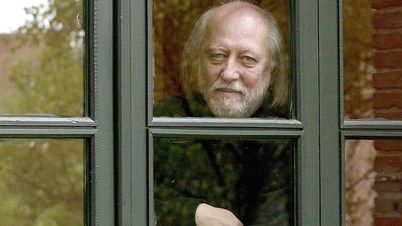
Han Kang, 54, is the first South Korean writer to win the Nobel Prize in Literature for his "powerful, poetic prose that directly addresses historical traumas and exposes the fragility of human existence."
Professor Mats Malm, permanent secretary of the Swedish Academy, announced the winner at 1 PM in Stockholm on October 10th (6 PM Hanoi time). He said he shared the good news with writer Han Kang by phone, while she was having dinner with her son. The writer will receive a prize of 11 million Swedish krona (over 26 billion VND).
The chairman of the Nobel Literature Committee, Anders Olsson, commented on the author: "She has a unique understanding of the connection between body and soul, between life and death. Her experimental, poetic writing style makes her an innovator in contemporary prose."
At 54 years old, Han Kang is one of the youngest writers ever to win the Nobel Prize, after the author... The story of the green forest - Rudyard Kipling (1865-1936). Kipling received the award in 1970, at the age of 41.
Ms. Kang was born on November 27, 1970, in Gwangju, South Korea, to novelist Han Seung Won. In an interview with... The Guardian, She once said: "When my mother was pregnant with me, she was weak and had to take a lot of medicine. The moment she felt my movements, she decided against having an abortion. I think life is short and I came into this world by luck."
Growing up, she was inspired by books by Korean authors such as Kang So Cheon and Ma Hae Song. Additionally, Kang developed a love for Russian literature, particularly the works of Fyodor Dostoyevsky. Her characters were often women who suffered significant physical and emotional trauma.
At the age of 23, Ms. Kang began her literary career when five of her poems were published in a magazine. Literature & Society. A year later, the short story The Scarlet Anchor This is the work of the author who won first prize in the Seoul Shinmun Spring Literary Competition. In 1995, she released her first novel. A Love of Yeosu .
The writer's name gained recognition when he received many prestigious awards such as the Korean Literature Novel Award (1999), the Young Artist Today Award (2000), the Yisang Literature Award (2005), and the Dongri Literature Award (2010).
In 2016, The Vegetarian Han Kang's novel, about the character Yeong Hye who refuses to eat meat before going on a hunger strike, became the first Korean novel to win the International Booker Prize, through its English translation by Deborah Smith. However, the translation later sparked controversy in South Korea. A translation teacher in Seoul named Charse Yun argued that Smith's translation distorted the meaning of the work. The Vegetarian.
Following the success of The Vegetarian , an author who has garnered significant attention worldwide , nevertheless prioritizes privacy and returned to her normal life shortly after receiving the Booker Prize. She holds a professorship in creative writing at the Seoul Arts Academy.
Ahead of the announcement of the 2024 Nobel Prize in Literature, author Han Kang was not among the experts' predictions. Instead, the Chinese writer was included. Tàn Tuyết, Japanese writer Haruki Murakami, and many other prominent figures in European literature are recognized by critics and readers alike. assessment Winning the prize.
Last year, Norwegian author Jon Fosse, a writer relatively unknown to Asian readers, honored thanks to "modern plays and prose that speak out for the unspeakable."
In 1895, Swedish scientist Alfred Nobel signed his will, bequeathing the majority of his fortune to the prizes he established. Literature is one of the six categories of the Nobel Prize, honoring authors from any country.
To date, the Nobel Prize in Literature is a prestigious and highly regarded award in the world of literature, honoring the entire career of a writer rather than a specific work. Each award ceremony attracts significant attention from many authors and researchers. Furthermore, it is one of the prizes with the highest monetary rewards. Since 1901, 116 Nobel Prizes in Literature have been awarded.
The Swedish Academy, founded by King Gustav III in 1786, is responsible for making decisions on The Nobel Prize in Literature. They never reveal any indication of who might win until the results are announced. The list of finalists is only revealed 50 years after that year's award.
The award was interrupted in 1914, 1918, 1935, 1940, 1941, 1942, and 1943 due to the two World Wars. According to the regulations, if no impressive work is submitted, the prize money is carried over to the following year. The medal, designed by Swedish sculptor Erik Lindberg, depicts a young man sitting under a laurel tree, captivated by the music of a muse. The certificate recognizes a unique work of art created by Swedish and Norwegian calligraphers.
In recent years, the Nobel Prize in Literature has been plagued by numerous controversies. Controversy. The 2018 award was canceled due to accusations against Jean-Claude Arnault, husband of poet Katarina Frostenson – a key member of the Swedish Academy's council. abuse many women. In addition, he has leaked the winner's name seven times since 1996. Owner The 2019 award winner, Peter Handke, faced backlash for publicly defending the late politician. Slobodan Milosevic.
Source
![[Photo] National Assembly Chairman Tran Thanh Man attends the groundbreaking ceremony for the National Highway 1A spatial axis project.](https://vphoto.vietnam.vn/thumb/1200x675/vietnam/resource/IMAGE/2026/05/19/1779161360398_ndo_br_bnd-1412-jpg.webp)

![[Photo] Capturing the moment the tide recedes at Yen Binh Son rapids - a million-year-old scenic spot in Quang Ngai.](https://vphoto.vietnam.vn/thumb/1200x675/vietnam/resource/IMAGE/2026/05/19/1779175463885_yen9-1199-jpg.webp)

















































![[Photo] General Secretary and President To Lam receives Indian Defense Minister Rajnath Singh](https://vphoto.vietnam.vn/thumb/402x226/vietnam/resource/IMAGE/2026/05/19/1779184046302_anh-man-hinh-2026-05-19-luc-16-46-58.png)




























Comment (0)