

“I joined a delegation of veterans from the 320th Division to visit the memorial monument commemorating the victory at Dong Du base in Cu Chi district, Ho Chi Minh City, to light incense for our comrades who fell there on April 29, 1975. As the car turned into the base, a strange feeling of nostalgia welled up inside me. I remembered my comrades! I told the driver to stop and walked a short distance,” Major General, Associate Professor, and Doctor Nguyen Huu Mao shared emotionally.
According to Major General, Associate Professor, and Doctor Nguyen Huu Mao, the Dong Du base was once the barracks of the 25th Division, the "American Tropical Lightning." Throughout its existence, the Dong Du base was very strongly fortified, serving as a "fortress" and "steel gate" defending the northwest of what was then Saigon.
After the 1973 Paris Agreement was signed, American soldiers returned home. This base was handed over to the 25th Division of the Saigon regime. The base was structured into four lines, with approximately 4,000 enemy troops inside in April 1975.
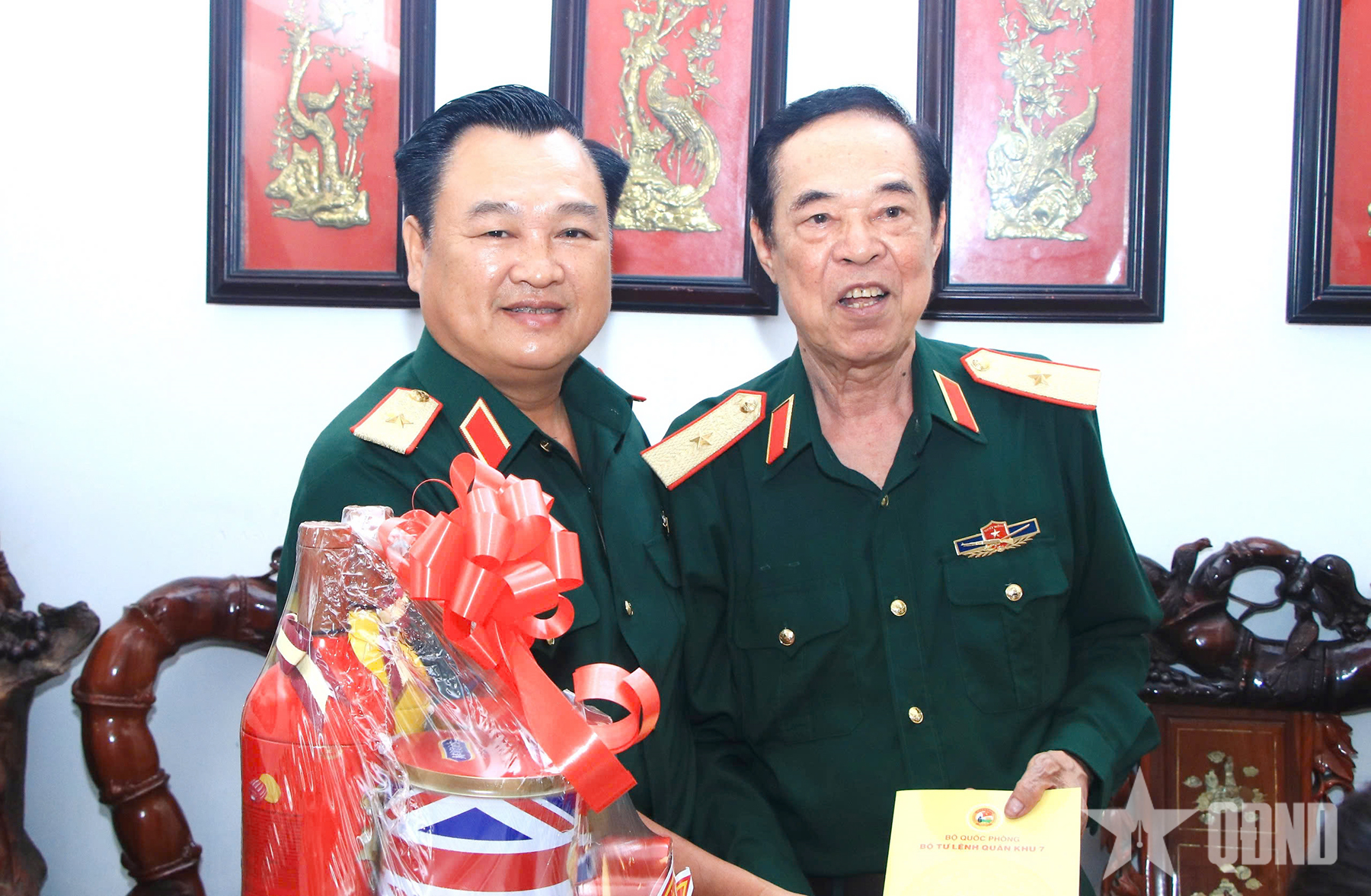 |
Major General Tran Vinh Ngoc, Secretary of the Party Committee and Political Commissar of Military Region 7 (left), visits and presents gifts to Major General, Associate Professor, and Doctor Nguyen Huu Mao. |
He recounted that his unit was the main force of the Central Highlands Army Corps (3rd Corps) – a corps that had just gloriously completed the Central Highlands Campaign, liberating the Central Highlands, and then, building on that victory, advanced down to the central coastal plains to liberate the provinces of Phu Yen, Khanh Hoa , and the city of Nha Trang, effectively dividing the Vietnamese battlefield in two. From the central coast, the unit was ordered to the Central Highlands, marching along Highway 14 to Binh Long, then to Ben Cat, and finally crossing the Saigon River to the "steel land" of Cu Chi, preparing for battle and taking charge of one of the offensive directions in the Ho Chi Minh Campaign.
“Our regiment was the 48th Regiment, named the Thang Long Regiment, belonging to the 320th Division (Dong Bang Division). I was honored to enter a battle that I believed would be the final battles to liberate Saigon. The 320th Division was tasked with attacking the Dong Du base to open the “steel gate” northwest of Saigon for the 10th Division to penetrate and capture Tan Son Nhat Airport and the puppet regime's General Staff Headquarters. In my fighting career, I have never witnessed such a moving send-off ceremony. On the banks of the Saigon River, the troops marched in orderly ranks under the flag and portrait of President Ho Chi Minh. The units successively read their determination letters, then recited their oaths of determination to win the historic Ho Chi Minh Campaign, even if it meant sacrificing their lives,” Major General Nguyen Huu Mao recalled emotionally.
He added that on the day of the troop deployment ceremony, all officers and soldiers in the Regiment took out their newest uniforms to wear, and all wore red armbands on their right arms, symbolizing the spirit of "Fighting to the death for the Fatherland." On the night of April 28, 1975, his unit marched to occupy the battlefield, and at 5:30 a.m. on April 29, 1975, the fighting began. As the Deputy Regiment Commander of Regiment 48, he was assigned the task of directly accompanying Battalion 3, led by Battalion Commander Nguyen Thanh Lich and Political Commissar Dao Xuan Sy, with the mission of opening the way in the main direction to destroy the enemy base.
During the assault to open the bridgehead, his unit faced fierce enemy resistance, resulting in heavy casualties among our troops. Upon reporting the situation to his superiors, he received orders from the commander of the 320th Division to personally lead his troops in clearing the final layers of enemy defenses. At this point, the commander of the 3rd Battalion offered to undertake the mission, but he firmly stated: “The Division commander has assigned this mission specifically to me. As the battalion commander, you must have firm control over your troops and prepare well. When I command the opening of the bridgehead, you must immediately charge forward and seize the bridgehead.”
With his combat experience in the Central Highlands Campaign, he commanded the demolition force to overcome the enemy's "storm of bullets," breaking through layers of barbed wire. When the last barrier was breached, under the command of the Battalion Commander of the 3rd Battalion, our troops launched an assault to seize the bridgehead. Immediately afterward, the deep penetration force and tanks successively passed through the breach. He also followed the troops into the base, successively capturing one target after another. Along with other offensive directions, within a few hours, the Dong Du base was completely destroyed. As a result, our troops captured and neutralized thousands of enemy soldiers, destroyed many vehicles, and seized many war spoils.
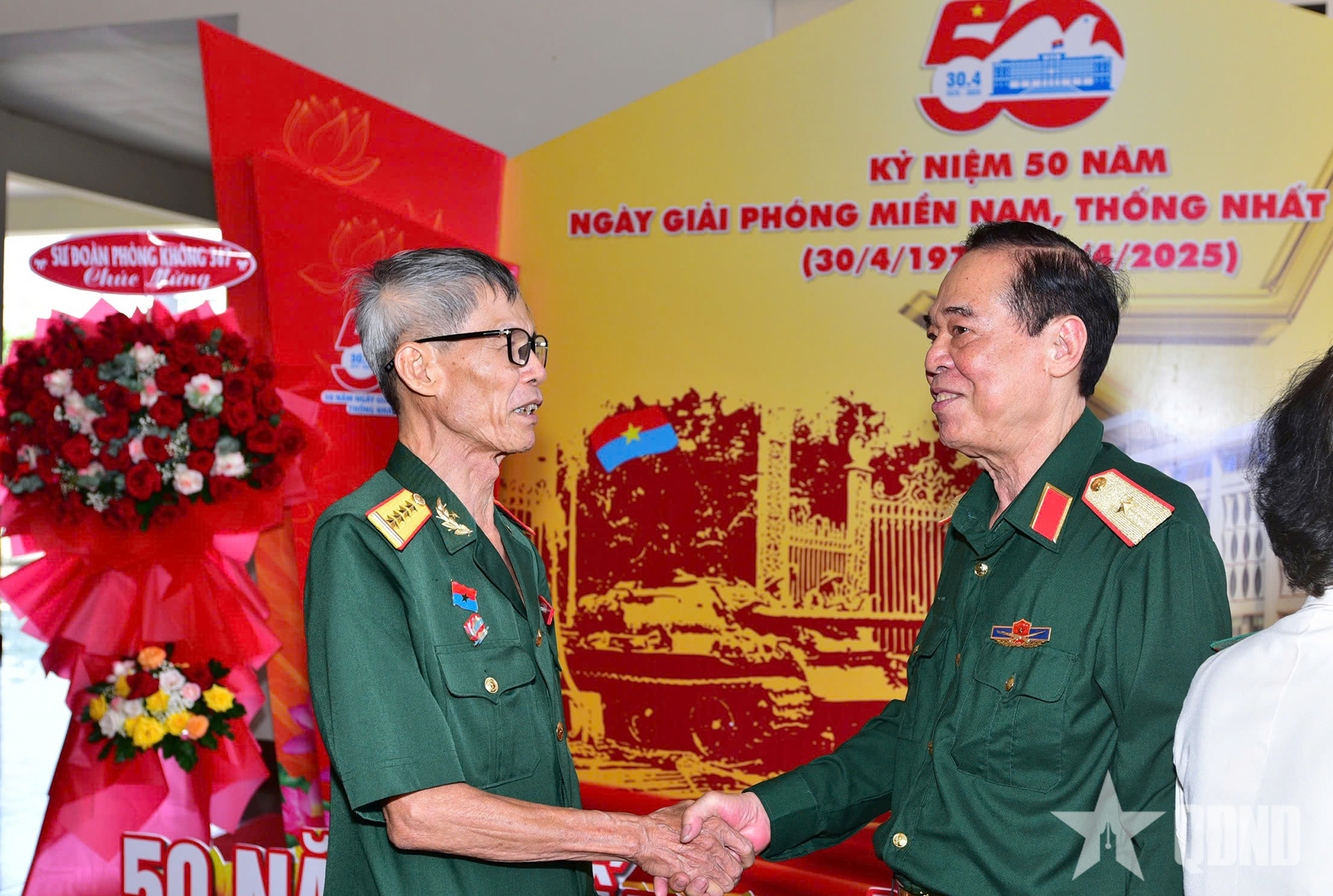 |
| Major General, Associate Professor, Doctor Nguyen Huu Mao reunites with his former comrades from the 320th Division. |
The northwestern gateway to Saigon was opened, allowing the 10th Division, 3rd Corps, to successively cross the Dong Du base, advance rapidly towards Saigon, and capture Tan Son Nhat Airport and the puppet regime's General Staff Headquarters. His unit successfully completed its mission. He said: “The battle was extremely fierce. In my mind, the image of the smoke-shrouded gateway and our soldiers sacrificing themselves one after another continues to haunt me. Hundreds of officers and soldiers of the 320th Division died right at the gateway to Saigon, just before the triumphant victory. For the officers and soldiers of the 320th Division, April 29, 1975, is a day we will never forget.”
The former Dong Du base is now the barracks area of the 9th Division, 34th Corps. Before the grand celebration of the 50th anniversary of the liberation of Southern Vietnam and the reunification of the country, Major General, Associate Professor, and Doctor Nguyen Huu Mao remembered his comrades, those who forever dedicated their youth to the Fatherland, bravely sacrificing themselves on April 29, 1975, so that April 30, 1975, could be immortalized in history.
"Recalling the historic battle of the past is like offering a heartfelt tribute to those who fell for peace and national reunification. Peace is precious!" Major General, Associate Professor, Doctor Nguyen Huu Mao confided.
HUNG KHOA (summary)
Source: https://www.qdnd.vn/50-nam-dai-thang-mua-xuan-1975/nho-dong-doi-truoc-ngay-dai-le-826312


![[Video] General Phan Van Giang working with the General Department of Logistics and Technical Services](https://vphoto.vietnam.vn/thumb/402x226/vietnam/resource/IMAGE/2026/03/14/1773501793755_1-6800-png.webp)




![[Photo] New recruits happily exercise their right to vote at their unit.](https://vphoto.vietnam.vn/thumb/1200x675/vietnam/resource/IMAGE/2026/03/14/1773473286544_stug0337-6388-jpg.webp)



































Comment (0)