

On the morning of April 16th, Deputy Minister of Transport Nguyen Danh Huy held an online meeting with the field task force and representatives from relevant units of Phu Yen and Khanh Hoa provinces to discuss solutions to the landslide at the Bai Gio railway tunnel, aiming to reopen the North-South railway line as soon as possible and ensure absolute safety.
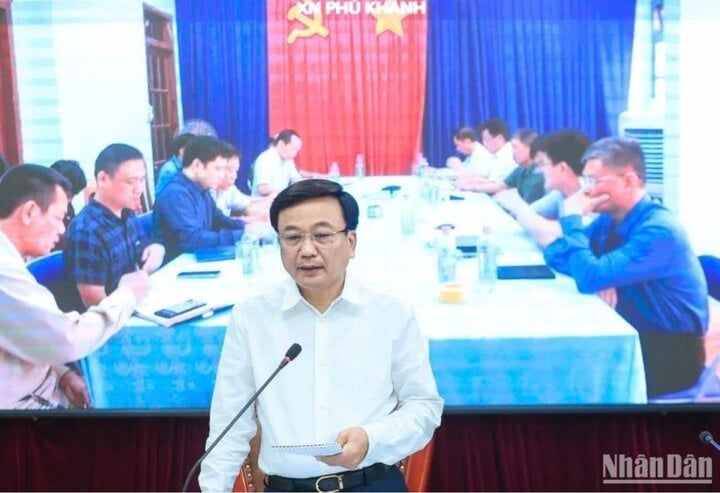
Deputy Minister of Transport Nguyen Danh Huy requested the establishment of a forward command team to address the incident at the Bai Gio tunnel.
“Handling the Bai Gio tunnel incident requires adherence to the ‘four on-site’ principle in emergency situations and ensuring five requirements: restoring traffic as soon as possible; mobilizing forces as quickly as possible; implementing the most innovative solutions; ensuring absolute safety for officials, engineers, and workers involved in the remediation; and units concentrating their resources to work 24/7, striving to complete the remediation before April 22nd, in accordance with the Prime Minister ’s directive,” Deputy Minister Nguyen Danh Huy emphasized.
Appreciating the efforts of units and localities in promptly supporting and handling the landslide incident, Deputy Minister Nguyen Danh Huy said that immediately after the incident occurred, the Ministry of Transport directed forces and organizations to khắc phục the situation.
On the morning of April 13th, the Ministry reported to the Prime Minister. The Prime Minister directed the Ministry of Transport to urgently mobilize all available resources to promptly address the landslide at the Bai Gio tunnel, striving to reopen the road as soon as possible.
The Ministry of Transport also issued a document requesting the Traffic Police Department, the police forces of Phu Yen and Khanh Hoa provinces, and other relevant units to be on duty at the scene 24/7 to promptly provide solutions, with the goal of implementing the Prime Minister's directives as quickly and decisively as possible.
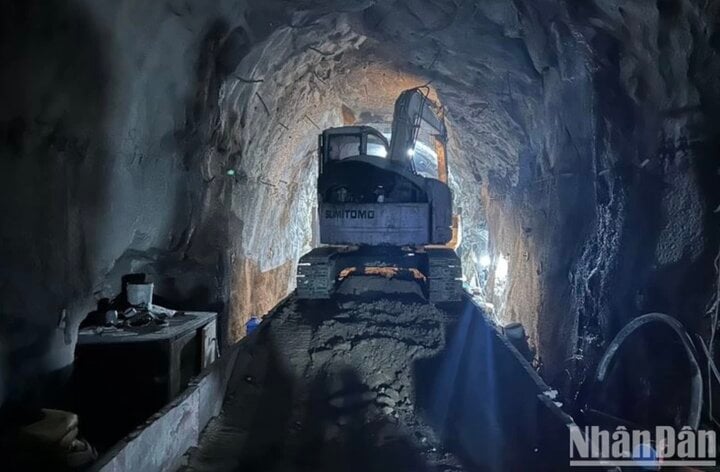
The units are focusing their resources on working 24/7, striving to complete the repairs before April 22nd.
Regarding the next steps and course of action, Deputy Minister Nguyen Danh Huy emphasized that the field task force and experts unanimously assessed that the Bai Gio tunnel has very complex geological conditions, was constructed a long time ago, its structure has deteriorated, and the landslide was predicted by state management agencies since 2020. The incident occurred during the tunnel's reinforcement process, but fortunately, it did not cause any casualties or damage to construction property.
Based on the proposals from the consultants and the field task force, the Ministry's leadership basically agreed with the proposed plan. However, to complete the remediation as quickly as possible, the Deputy Minister requested the immediate establishment of a forward command team headed by the Deputy General Director of Project Management Board 85, the project's investor; directed the ensuring of safe construction 24/7, with daily meetings with the Ministry of Transport's task force; and established a Ministry of Transport task force headed by Deputy Minister Nguyen Danh Huy, holding daily meetings to monitor construction progress hourly and provide timely guidance.
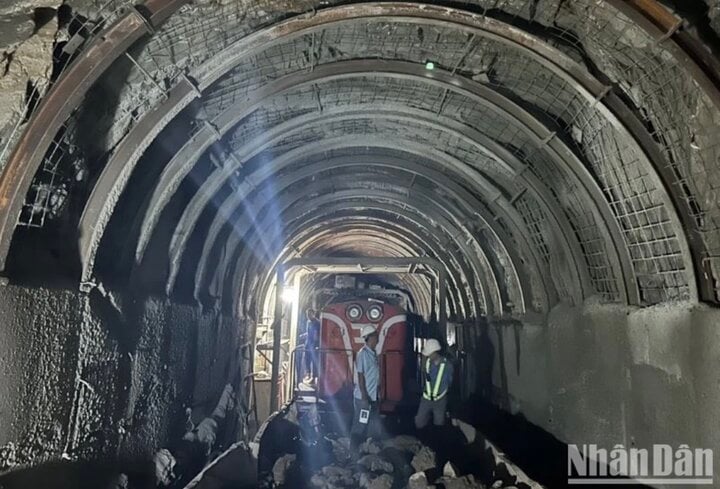
The main companies involved in resolving the Bai Gio tunnel incident are Song Da 10 Company, Construction and Investment Company No. 3, and Phu Khanh Railway Joint Stock Company.
The forward command post clearly defined the responsibilities of each unit and divided the workload during the remediation work, with three main units being Song Da 10 Company, Construction and Investment Company No. 3, and Phu Khanh Railway Company.
The units mobilized machinery, equipment, materials, and human resources, and were responsible for ensuring all finances during the remediation work. Project Management Board 85 mobilized additional units to ensure sufficient and timely supply of materials during the remediation work,...
According to Mr. Dang Sy Manh, Chairman of the Board of Members of Vietnam Railways Corporation, the railway industry transports an average of 10 trains per day.
By the evening of April 15th, over 13,000 passengers had been transferred on 38 passenger trains from Tuy Hoa station (Phu Yen) to Gia station (Khanh Hoa) and vice versa; free meals and drinks were provided; and passenger train services continued to operate according to the schedule for which tickets had been sold, combined with improving the quality of passenger transfer services.
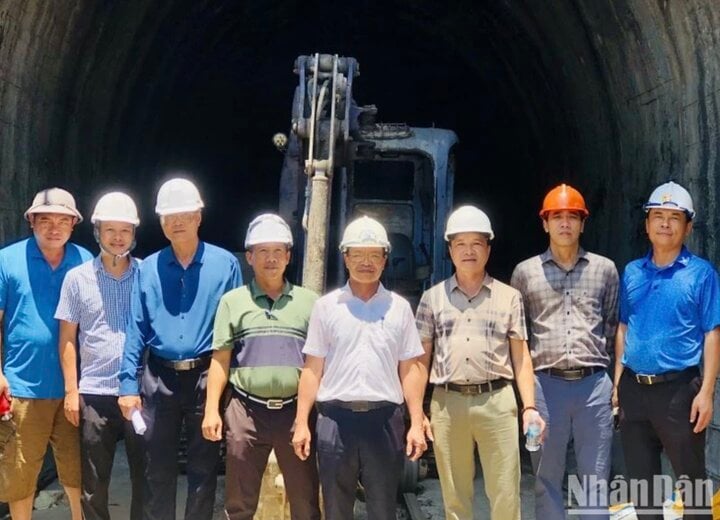
Chairman of the Board of Members of Vietnam Railways Corporation, Dang Sy Manh (wearing a white shirt, standing in the middle), was present at the site to directly supervise and encourage the construction units.
Due to the incident, 77 freight trains were delayed. The railway company had to negotiate with shippers to reroute cargo; currently, 16 trains have been rerouted through the affected area, prioritizing perishable goods, frozen goods, and express delivery shipments.
" This incident was beyond our control, resulting in significant damage to railway transport. The Corporation requests that relevant authorities consider providing financial support and, to minimize losses, propose that the local authorities arrange for sufficient and adequate transport vehicles to serve passengers; and request that the competent authorities waive road usage fees for vehicles transporting passengers and goods through the Deo Ca tunnel ...", Mr. Manh suggested.
Mr. Manh also suggested that, after the Bai Gio tunnel incident is resolved, the competent authorities should consider allocating funds for the first phase of reinforcement for 12 weak tunnels on the line that need priority attention, with an estimated cost of less than 500 billion VND, and develop a plan to address the 27 weak tunnels along the entire Thong Nhat railway line.
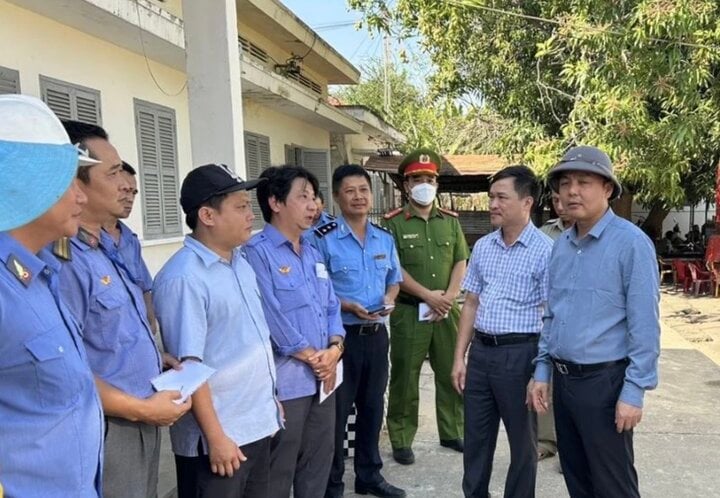
General Director of Vietnam Railways Corporation, Hoang Gia Khanh (wearing a pith helmet on the far right), was present at the scene to direct the khắc phục sự cố (rectification of the incident) and encourage the construction units.
Reporting at the meeting, the representative of the field task force directly handling the landslide stated that the Bai Gio tunnel (tunnel No. 23) is a Class II railway tunnel on the North-South railway line located in Dong Bac village, Dai Lan commune, Van Ninh district (Khanh Hoa province), at kilometer markers 1230+991 - 1231+385, with a length of nearly 394m. The tunnel is currently undergoing reinforcement construction, funded by the medium-term public investment plan for the period 2016-2020.
On April 12th, the construction contractor received orders to close the tunnel from 9:32 AM to 1:32 PM for construction. At approximately 12:45 PM, while demolishing the old tunnel lining concrete, a landslide occurred due to weak soil layers above the tunnel arch. Approximately 150 cubic meters of earth and rock fell, causing no casualties or damage to construction equipment, but disrupting train operations.
Immediately after the incident occurred, the project owner, supervisory consultant, and construction contractor coordinated with the Vietnam Railway Corporation and relevant units to cordon off the Hao Son-Dai Lanh section and reroute road traffic through the tunnel to carry out landslide remediation.
By approximately 3:30 AM on April 13th, the authorities had essentially removed all the landslide debris and were preparing to install Type A support frames at the landslide site and spray concrete.
However, due to the complex geological conditions above the tunnel lining (weathered rock), soil and rocks continue to fall, posing a safety risk to personnel and equipment involved in the excavation. Weathered soil and boulders have fallen and completely filled the tunnel's cross-section. Currently, approximately 150 cubic meters of large rocks have completely filled the gaps in the tunnel's arch. The geology at the top of the tunnel consists of stacked and interwoven rocks, creating large voids.
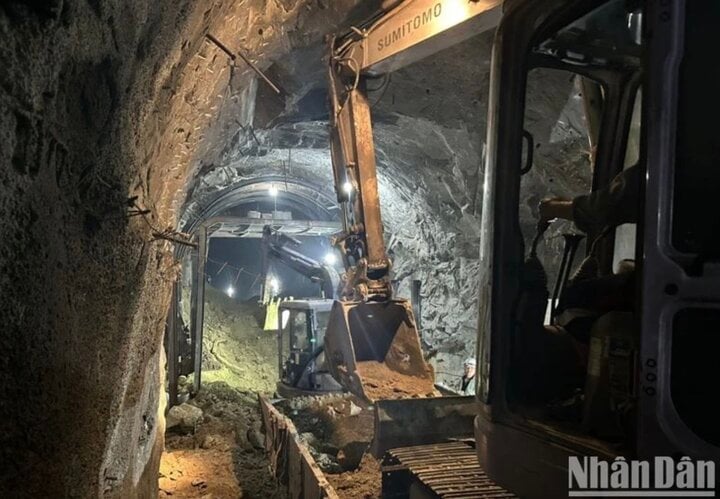
After installing all the support frames, the construction units proceeded with grouting and pouring concrete for the tunnel lining, striving to open the North-South railway line no later than April 22nd.
During the night of April 13th and the morning of April 14th, the relevant parties continued to survey and propose solutions, following the principle of maintaining stability on and within the tunnel. On April 15th, the units reinforced the subsided soil in the tunnel by spraying open-sided cement grout and inserting anchors to create a rigid framework.
At the top of the mountain, at the location of the collapse, geological exploration drilling was carried out, and cement grout was pumped into the collapsed soil to fill the void, stabilizing the rock mass at the top of the tunnel and preventing further collapse.
After the basic subsidence location had stabilized, on April 16th, the units continued to prepare equipment for drilling and inserting anchors at the pit opening and pumping high-pressure grout to create stable cohesion, gradually excavating the subsided soil and rock mass in the tunnel, and installing support frames as they excavated to hold the rock in place.
After installing all the support frames in place, proceed with grouting and pouring concrete for the tunnel lining as approved in the design. The goal is to complete the work by April 22nd at the latest, allowing North-South train traffic to resume.
Source
![[Photo] My Son at night: A thousand-year-old heritage site amidst the Milky Way](https://vphoto.vietnam.vn/thumb/1200x675/vietnam/resource/IMAGE/2026/04/15/1776261039184_ndo_br_chon6-jpg.webp)
![[Photo] National Assembly Chairman Tran Thanh Man attends the opening session of IPU-152](https://vphoto.vietnam.vn/thumb/1200x675/vietnam/resource/IMAGE/2026/04/16/1776277863731_ctqh5-jpg.webp)
![[Photo] Mrs. Ngo Phuong Ly meets and exchanges views with Mrs. Peng Li Yuan](https://vphoto.vietnam.vn/thumb/1200x675/vietnam/resource/IMAGE/2026/04/16/1776277858080_phu-nhan-1-jpg.webp)
![[Photo] The General Secretary, President and his wife meet with Vietnamese-Chinese friendship leaders.](https://vphoto.vietnam.vn/thumb/1200x675/vietnam/resource/IMAGE/2026/04/15/1776264829725_vna-potal-tong-bi-thu-chu-tich-nuoc-to-lam-gap-mat-nhan-sy-huu-nghi-viet-nam-trung-quoc-8703641-3130-jpg.webp)

























































Comment (0)