

A groundbreaking study has challenged the decades-long notion that the human brain's "temporal voice area" (TVA) is specialized solely for processing human speech.
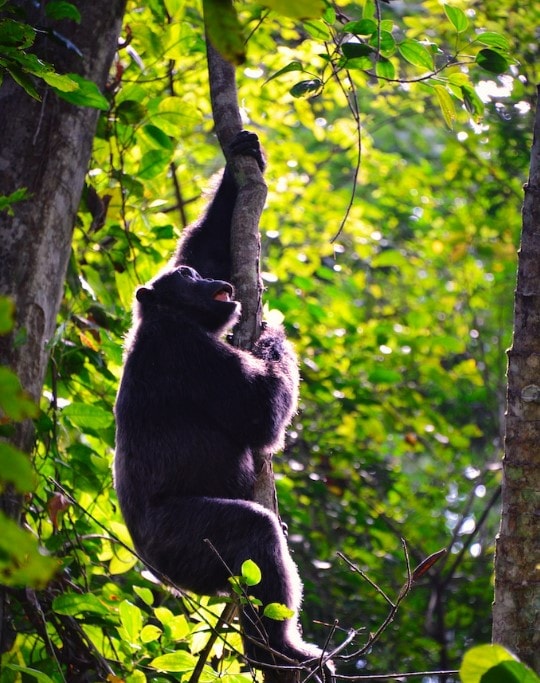
Instead, this research suggests that these ancient neural circuits may be shared with other primates, reinforcing the deep evolutionary origins of speech recognition.
For decades, neuroscientists have viewed the temporal lobes as a specialized system that helps humans recognize and interpret speech. However, the UNIGE research team conducted an experiment to investigate whether these regions reflect a deeper evolutionary origin.
To clarify this issue, the research team conducted an experiment with 23 participants. While lying in an MRI scanner, they listened to a total of 72 sounds, including 18 human voices, 18 chimpanzee calls, 18 bonobos' calls, and 18 macaques' calls. These animal sounds varied widely, from friendly growls to alarm or threatening cries.
Unexpected results
Contrary to expectations that only familiar areas of the brain would become highly active when hearing human voices, MRI scans revealed something surprising.
When hearing the chimpanzee's call, the anterior superior temporal lobe lights up in a pattern very similar to its reaction to hearing human speech.
Meanwhile, the calls of bonobos and macaques do not trigger this specific neurological response.
This difference is particularly noteworthy because bonobos are genetically as closely related to humans as chimpanzees.
However, bonobos typically have a higher pitch and bird-like characteristics, falling outside the range of sounds that the human auditory system is "tuned" to process. In contrast, chimpanzees have a frequency range closer to that of human speech.
To ensure that this brain activation didn't simply stem from basic acoustic characteristics like pitch or volume, the research team developed three models that controlled different acoustic parameters.
The results were consistent across all three models, with only chimpanzee calls producing a reliable increase in activity in the anterior TVA region, even after removing the six most distinguishing acoustic elements.
This suggests that the vocal regions in the human temporal lobe are "programmed" to respond to speech-like sounds produced by species with similar vocal apparatus and acoustic characteristics to our own.
One of the most intriguing implications of the research is that the modern human brain may still retain ancient neural mechanisms that were originally adapted to recognize the calls of our primate ancestors.
Research suggests that the neural circuits processing speech evolved based on ancient neural pathways shared with other primates, possibly dating back millions of years before language emerged.
Source: https://congluan.vn/phat-hien-nao-bo-con-nguoi-phan-ung-manh-voi-tieng-keu-cua-tinh-tinh-10322771.html
![[Photo] Prime Minister Pham Minh Chinh receives Lao Minister of Education and Sports Thongsalith Mangnormek](/_next/image?url=https%3A%2F%2Fvphoto.vietnam.vn%2Fthumb%2F1200x675%2Fvietnam%2Fresource%2FIMAGE%2F2025%2F12%2F16%2F1765876834721_dsc-7519-jpg.webp&w=3840&q=75)
![[Photo] Prime Minister Pham Minh Chinh receives the Governor of Tochigi Province (Japan)](/_next/image?url=https%3A%2F%2Fvphoto.vietnam.vn%2Fthumb%2F1200x675%2Fvietnam%2Fresource%2FIMAGE%2F2025%2F12%2F16%2F1765892133176_dsc-8082-6425-jpg.webp&w=3840&q=75)
![[Live] 2025 Community Action Awards Gala](/_next/image?url=https%3A%2F%2Fvphoto.vietnam.vn%2Fthumb%2F1200x675%2Fvietnam%2Fresource%2FIMAGE%2F2025%2F12%2F16%2F1765899631650_ndo_tr_z7334013144784-9f9fe10a6d63584c85aff40f2957c250-jpg.webp&w=3840&q=75)

![[Image] Leaked images ahead of the 2025 Community Action Awards gala.](/_next/image?url=https%3A%2F%2Fvphoto.vietnam.vn%2Fthumb%2F1200x675%2Fvietnam%2Fresource%2FIMAGE%2F2025%2F12%2F16%2F1765882828720_ndo_br_thiet-ke-chua-co-ten-45-png.webp&w=3840&q=75)
























































![[Photo] Prime Minister Pham Minh Chinh attends the Vietnam Economic Forum 2025](https://vphoto.vietnam.vn/thumb/402x226/vietnam/resource/IMAGE/2025/12/16/1765893035503_ndo_br_dsc-8043-jpg.webp)






























Comment (0)