

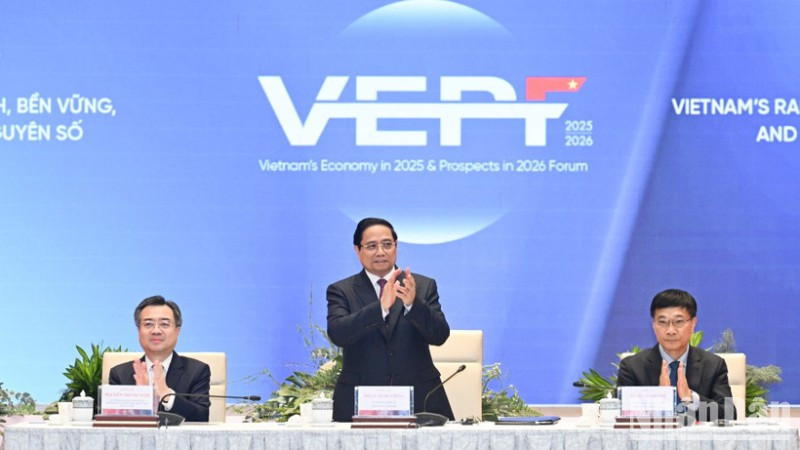
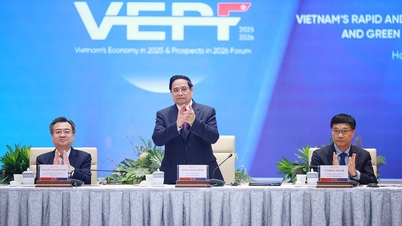
Central Committee members Nguyen Thanh Nghi, Head of the Central Policy and Strategy Committee, and Vu Hong Thanh, Vice Chairman of the National Assembly, co-chaired the Forum. Also attending was Le Hoai Trung, Secretary of the Central Committee and Minister of Foreign Affairs . The Forum connected online to 34 provinces and cities nationwide.
The VEPF 2025 Annual Forum takes place over one day and includes two thematic sessions and one plenary session.
The Finance-Banking thematic session focused on the theme "Mobilizing and effectively utilizing financial resources for economic growth targets in the 2026-2030 period". Accordingly, the main issues addressed, discussed, and analyzed aimed to clarify: capital needs for double-digit growth in the 2026-2030 period; the ability to access and mobilize resources; and the effective use and risk management of capital sources.

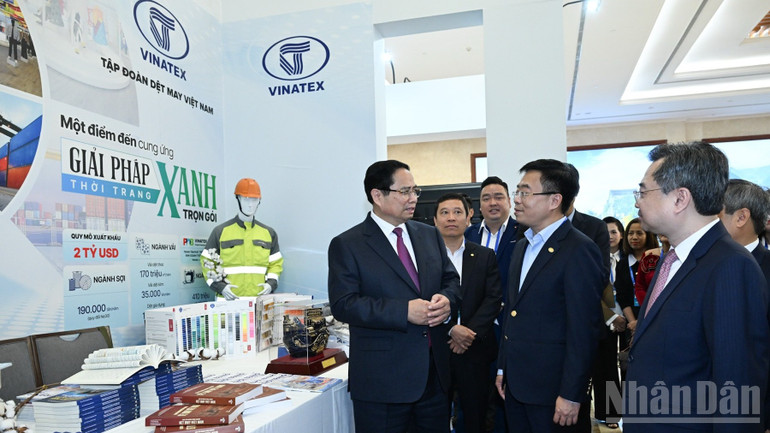
The Circular Economy and Green Transformation thematic session focuses on reflecting on the practical application of the circular economy model in various economic sectors and fields. It identifies and evaluates the advantages in implementing green transformation and applying the circular economy, as well as the policy, resource, and management capacity barriers to model implementation, through sharing practical experiences from corporations, businesses, and localities.

The forum attracted considerable attention from embassies, international organizations, foreign business associations, industry associations, domestic business associations, as well as leaders of Vietnamese corporations and FDI enterprises.
The Forum's keynote reports synthesized and analyzed important, fundamental, and core information on the Vietnamese economy during the 2021-2025 period in relation to the regional and global economic context.
The discussions focused on the international context, analyzing Vietnam's comparative advantages, and identifying opportunities and challenges for an economy with a high degree of trade openness like Vietnam. The presentations also highlighted urgent needs that Vietnam must address, including policy mechanisms, financial resources, the capacity for applying and developing science and technology, and the investment and development management capabilities of economic entities, especially domestic businesses.
The seminar received nearly 20 suggestions from leaders of corporations, businesses, associations, and domestic and international experts on economics, technology, and sustainable development.
The suggestions all focused on quickly institutionalizing and concretizing mechanisms and policies from major resolutions issued in the past, while simultaneously creating new mechanisms to promote the expansion of investment and development opportunities for domestic businesses and foreign investors.
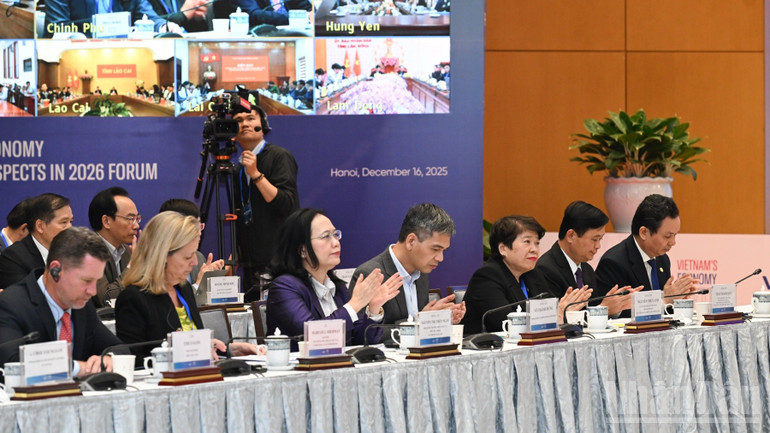

The suggestions and proposals from businesses were highly appreciated by the Government and National Assembly leaders, and directly received participation, exchange, and feedback from leaders of several ministries, sectors, and localities attending the Forum.
Speaking at the Forum, Prime Minister Pham Minh Chinh highly appreciated the Central Policy and Strategy Committee and relevant ministries and agencies for choosing an important and highly topical theme and for coordinating closely to organize this significant Forum well.
The Prime Minister stated that, based on the clear identification of the inevitable and irreversible trend of green transformation in the digital age, Vietnam has clearly defined "dual transformation: greening and digitalization" as an objective requirement, a strategic choice, and a priority for investment and development; it serves as both a foundation and a driving force for the rapid and sustainable development of the country in general and the economy in particular. The Party, State, and Government of Vietnam have always paid special attention to and issued many policies and mechanisms to promote rapid and sustainable development based on the foundation of "dual transformation: greening and digitalization".
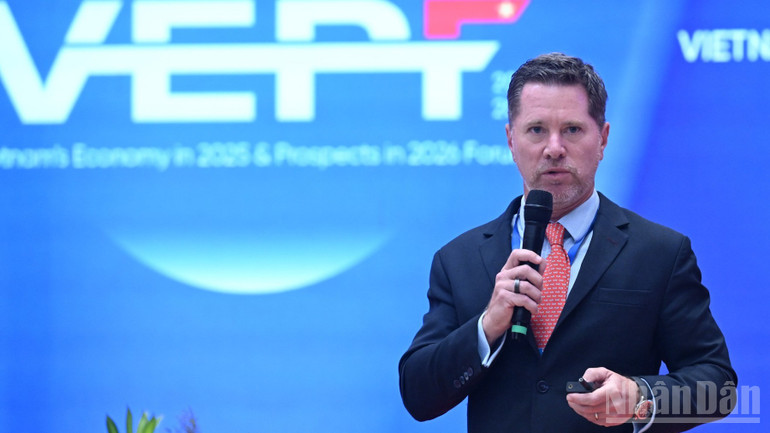
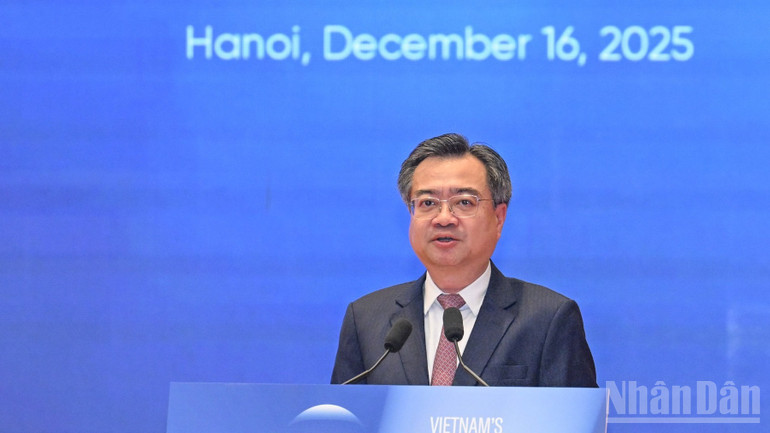
A foreign delegate delivers a speech at the Forum. (Photo: Tran Hai)
Presenting at the Forum on the socio-economic development situation and the country's achievements in recent years, the Prime Minister affirmed that Vietnam's economy is strong enough to withstand external shocks and overcome "headwinds"; emphasizing that agricultural development helped Vietnam escape poverty after the war and achieve the United Nations Millennium Development Goals (MDGs) earlier than other countries; industrialization, urbanization, and attracting FDI... have helped Vietnam achieve middle-income status.
To become a developed, high-income country, Vietnam must rely on science and technology, innovation, digital transformation, and green transformation. Vietnam views stability as an impenetrable fortress. Rapid and sustainable development must be an eternal, never-ending engine. The prosperity, freedom, well-being, and happiness of the people are the ultimate goals; progress, fairness, social welfare, and the environment will not be sacrificed for mere economic growth.

Prime Minister Pham Minh Chinh delivers a speech at the Forum. (Photo: Tran Hai)
Referring to the key tasks and solutions for 2026 and the coming period, the Prime Minister emphasized several main points:
Promoting rapid and sustainable development based on a "dual transformation: greening and digitalization," striving for double-digit growth while maintaining macroeconomic stability, controlling inflation, and ensuring major economic balances; focusing on enhancing the resilience and competitiveness of the economy; improving analytical and forecasting capabilities, and proactively responding flexibly, promptly, and effectively to external fluctuations. Vietnam is steadfast in its goal of maintaining macroeconomic stability, controlling inflation, and ensuring major economic balances to create a favorable environment and conditions for rapid and sustainable growth and development at a double-digit rate.
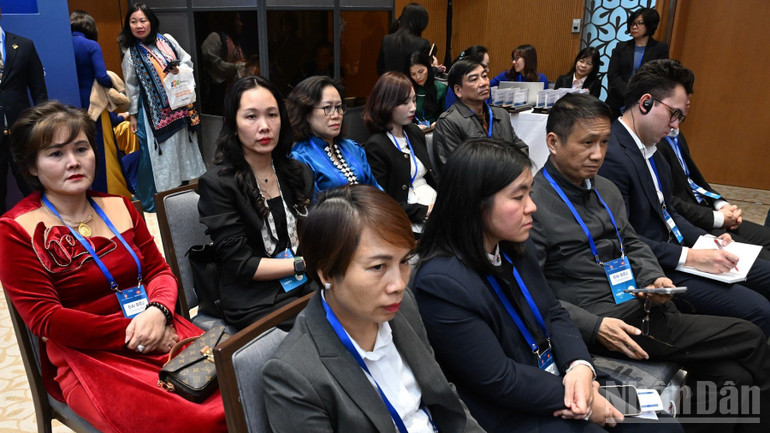
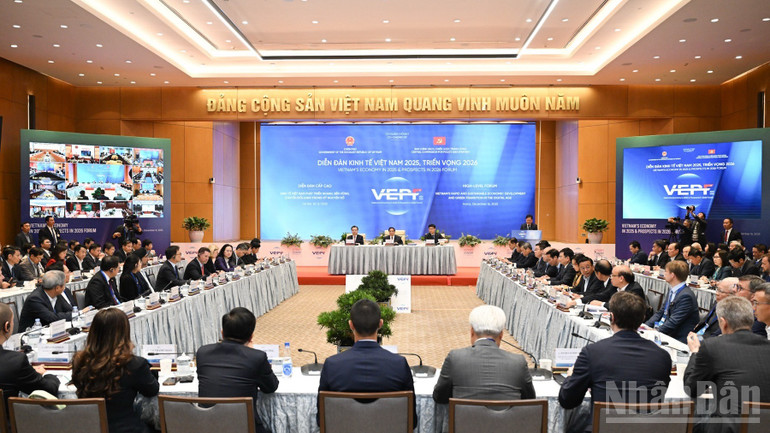
Delegates attending the Forum. (Photo: Tran Hai)
Accelerate the implementation of the three strategic breakthroughs, including the strategic breakthrough in institutions, transforming institutions that are currently the "bottleneck of bottlenecks" into a competitive advantage and the main driving force for rapid and sustainable development; strengthen decentralization and delegation of power, coupled with resource allocation and improved implementation capacity; simultaneously renew traditional growth drivers and promote new growth drivers. Build and put into operation international financial centers, free trade zones, and cross-border economic zones;
Develop groundbreaking scientific research programs and projects in 11 strategic technology groups; develop nuclear energy and high-speed rail; effectively exploit new development spaces, delve deeper into the earth, develop underground transportation, efficiently utilize land resources, reach out to the open sea, and soar high into the sky to explore outer space. Diversify forms of resource mobilization.
Continue to diversify forms of resource mobilization and utilization; promote socialization and strongly attract non-state investment; prioritize attracting FDI into high-tech industries, green and circular production, and connect with domestic investment. The Prime Minister emphasized the need to value and promote intelligence and creativity; save time for rapid and sustainable development, green development, and digital development; and select appropriate priorities to mobilize feasible and effective resources. Based on this, the Prime Minister affirmed that Vietnam's goal of double-digit growth in the coming years is feasible and has room for maneuver.
Source: https://nhandan.vn/phat-trien-nhanh-ben-vung-chuyen-doi-xanh-trong-ky-nguyen-so-post930690.html


![[Image] Leaked images ahead of the 2025 Community Action Awards gala.](/_next/image?url=https%3A%2F%2Fvphoto.vietnam.vn%2Fthumb%2F1200x675%2Fvietnam%2Fresource%2FIMAGE%2F2025%2F12%2F16%2F1765882828720_ndo_br_thiet-ke-chua-co-ten-45-png.webp&w=3840&q=75)
![[Live] 2025 Community Action Awards Gala](/_next/image?url=https%3A%2F%2Fvphoto.vietnam.vn%2Fthumb%2F1200x675%2Fvietnam%2Fresource%2FIMAGE%2F2025%2F12%2F16%2F1765899631650_ndo_tr_z7334013144784-9f9fe10a6d63584c85aff40f2957c250-jpg.webp&w=3840&q=75)
![[Photo] Prime Minister Pham Minh Chinh receives Lao Minister of Education and Sports Thongsalith Mangnormek](/_next/image?url=https%3A%2F%2Fvphoto.vietnam.vn%2Fthumb%2F1200x675%2Fvietnam%2Fresource%2FIMAGE%2F2025%2F12%2F16%2F1765876834721_dsc-7519-jpg.webp&w=3840&q=75)
![[Photo] Prime Minister Pham Minh Chinh receives the Governor of Tochigi Province (Japan)](/_next/image?url=https%3A%2F%2Fvphoto.vietnam.vn%2Fthumb%2F1200x675%2Fvietnam%2Fresource%2FIMAGE%2F2025%2F12%2F16%2F1765892133176_dsc-8082-6425-jpg.webp&w=3840&q=75)




























![[Photo] Prime Minister Pham Minh Chinh attends the Vietnam Economic Forum 2025](https://vphoto.vietnam.vn/thumb/402x226/vietnam/resource/IMAGE/2025/12/16/1765893035503_ndo_br_dsc-8043-jpg.webp)

















Comment (0)