

Currently, the province has over 5,000 hectares of water surface area for aquaculture. In recent years, along with exploiting water surface area for intensive and specialized fish farming, people in the province are promoting the development of various aquatic specialties, with a total farming area estimated at nearly 100 hectares. Among these, several species are gaining popularity in the market, such as eels, freshwater prawns, and snails. This direction helps to increase production value and income for the people.
Research conducted in the province's aquaculture areas reveals a growing trend in both scale and area towards the cultivation of specialty species. Among these, the farming of apple snails is particularly noteworthy, with many localities in the province experiencing strong growth.
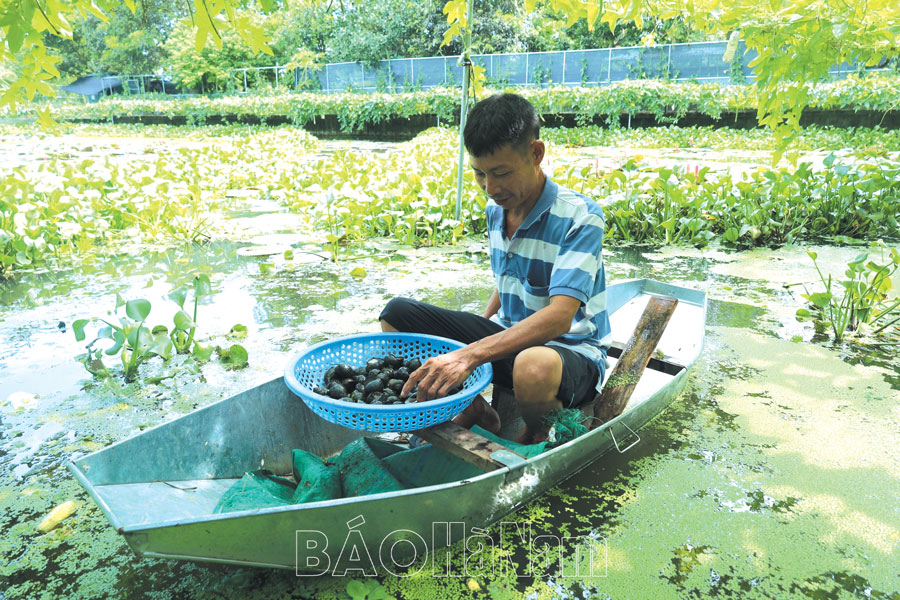
For example, in Nhan Thinh commune (Ly Nhan district), a specialized snail farming area has been established with a total area of approximately 30 hectares. Most ponds along the Red River dike and within residential areas of the commune are used by locals for snail farming. This aquatic specialty has many advantages compared to other aquatic species. Farmers only need to buy breeding stock once; after that, they can produce their own snails by collecting and hatching eggs. The snails' food is entirely natural, consisting of discarded vegetables, fruits, and other agricultural products.
Apple snails are particularly suitable for small ponds, where fish farming is less efficient and disease-prone. Economically , farmers currently sell 1 kg of commercial apple snails for an average of 70,000 VND/kg. Apple snail yields reach 6-7 tons/ha, generating a value of 450-460 million VND/ha, 3-5 times higher than traditional fish farming (white carp, silver carp, catfish, etc.). The market for commercial apple snails is very broad, with traders coming directly to the ponds to purchase and transport them to other provinces and cities.
Mr. Nguyen Huu Hung, from Hamlet 1 – Dong Thuy (Nhan Thinh), shared: "I was the first person to bring apple snails to raise in the commune, starting with about 50 pairs of parent snails more than 15 years ago. From there, I bred them to supply farmers in the area and sold them to many provinces and cities. At the same time, I bought commercial snails to sell on the market; at one point, the area I bought snails from was about 20 hectares. Currently, the market is more favorable and wider, so Mr. Hung no longer buys snails from people, but he is still maintaining his family's apple snail farming area of over 1 hectare."
Along with snail farming, other specialized aquaculture models are proving quite effective. The province has approximately 8 hectares of industrial-scale, specialized farming of snakehead fish and spotted catfish. Stocking densities range from 5-10 fish per square meter, with harvest sizes of 0.8-1.2 kg per fish. The yield of snakehead fish and spotted catfish in these models reaches about 40 tons per hectare, generating a production value of 2.5 billion VND per hectare, resulting in a profit of 300-350 million VND per hectare after deducting costs. Giant freshwater prawns are also a popular choice for some specialized aquaculture households, with an estimated total area of 10 hectares, yielding a value of approximately 300 million VND per hectare… Cage farming on the Red River is also being adopted by many households for the cultivation of specialty catfish.
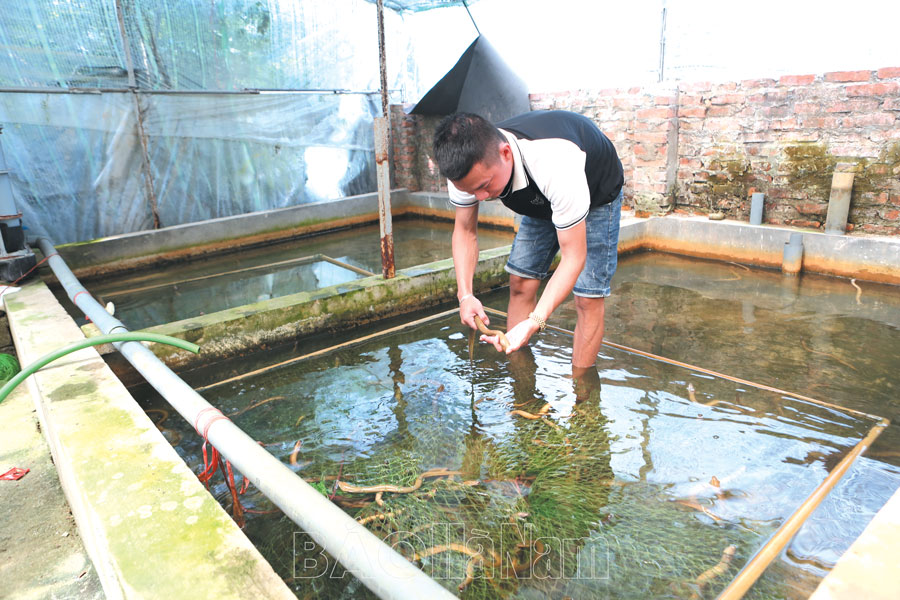
The model of raising eels without mud in cement tanks has also been adopted by some households. Mr. Hoang Dai Long, from Dong Lac village, Dong Hoa commune (Kim Bang district), built 8 mudless eel tanks on an area of 100 m2. In these tanks, Mr. Long imported 20,000 eel fry for breeding, yielding 3 tons of commercial eels each year. This new farming method does not require a large pond area; people can utilize existing barns, yards, and gardens.
According to Mr. Hoang Dai Long, the most important aspect of mudless eel farming is mastering the techniques. Eel tanks require water changes twice daily (morning and evening). The market for marketable eels is currently quite abundant, mainly supplying restaurants and eel shops within the province; there's no need to seek additional markets outside the province. The price of marketable eels is stable at 120,000 VND/kg, yielding a profit margin of approximately 40%, which is quite high compared to other aquatic products.
In reality, raising specialty aquatic products is not as complicated as traditional fish farming. Households can utilize and convert existing pond areas. The increasing market demand for specialty aquatic products is a great advantage for the development of production for the people... However, people still need to master the techniques of caring for and preventing diseases in some of the farmed species to ensure high efficiency. This is an issue that requires the attention and support of the relevant professional sectors to guide the people.
Discussing this issue, Mr. Pham Anh Tuan, Head of the Livestock and Veterinary Sub-Department (Department of Agriculture and Rural Development), said: The effectiveness of raising specialty aquatic products has been proven in the models already applied in the province. Most importantly, people need to carefully consider and research to choose the species suitable for their family's actual conditions. The sub-department will undertake training and technology transfer in aquaculture and disease prevention for specialty aquatic products when needed by the locality and people, along with general professional duties…
Aquaculture is a promising new direction with significant potential for future development. This approach not only enhances value but also aims to create key aquatic products, contributing to the growth rate of the fisheries sector in particular and the province's agricultural production in general.
Manh Hung
Source: https://baohanam.com.vn/kinh-te/nganh-nghe-nong-thon/phat-trien-nuoi-thuy-dac-san-131962.html


![OCOP during Tet season: [Part 3] Ultra-thin rice paper takes off.](/_next/image?url=https%3A%2F%2Fvphoto.vietnam.vn%2Fthumb%2F402x226%2Fvietnam%2Fresource%2FIMAGE%2F2026%2F01%2F28%2F1769562783429_004-194121_651-081010.jpeg&w=3840&q=75)


Comment (0)