
Fishermen in coastal areas buy mackerel to use as raw material for making fish sauce - Photo: SH
Now, Mr. Phan Thanh Thiềm has officially "inherited" the shrimp paste making business from his mother (Mrs. Võ Thị Thơi, who has passed away). Mr. Thiềm readily revealed to me the recipe for making a delicious, amber-colored fish sauce that has a salty taste on the tip of the tongue and a sweet aftertaste in the throat. According to Mr. Thiềm, making good fish sauce requires careful selection of ingredients, and he usually uses mackerel, anchovies, and black anchovies...
Once the ingredients have been selected, the next step is to marinate the fish with salt (the ratio varies depending on the type of fish). For example, with scad or anchovies, mix 1 kg of salt with 5-6 kg of fish; for mackerel, the ratio is 1 kg of salt with 3-4 kg of fish. In the fish sauce making process, mixing the fish is the most important step, and the fish-to-salt ratio must be neither too salty nor too bland.
If the fish is too salty, the hydrolysis process will be slow, resulting in fish sauce that is not tasty; conversely, if it is too bland, the fish sauce will spoil quickly and change color. After salting, the fish is placed in jars or tanks, with a thick layer of salt sprinkled on top, then tightly packed to speed up the fermentation process and ensure hygiene. The salted fish is fermented for about 7 months to 1 year until it is fully fermented, at which point it is filtered to produce fish sauce.
The process of filtering fish sauce also requires careful timing, and it usually takes place at night to avoid flies and other insects. The filtering equipment, as well as the bottling and labeling process, must always be clean and hygienic.
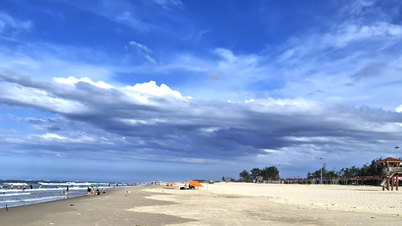
As for the "secret" to making delicious thick or thin shrimp paste, it's revealed that from November of the previous year to April (lunar calendar) of the following year, sea shrimp are carried ashore by waves from the open sea. Fishermen in coastal areas begin walking along the shore, observing the clear blue water gradually turning a deep red, bubbling and frothing – that's when they've encountered a large school of shrimp.
Fishermen will quickly use hand-pulled nets to catch krill. At that time, people who make fish sauce and krill, like Mr. Thiềm, will go ashore to buy them directly. After being purchased from the fishermen, the krill are washed clean and mixed with salt (at a ratio of 6 buckets of fresh krill to 1 bucket of salt (for salty krill); 12 buckets of fresh krill to 1 bucket of salt (for mild krill)) and left for about 24 hours. Then, the krill carcasses are removed separately, and the brine, which turns a bright red color, is kept.
The shrimp paste, once removed from the water, is sun-dried for about a day before being pounded into a fine paste (the finer the paste, the thicker and more viscous it becomes). This paste is then mixed with brine, stirred well, and placed in jars or containers, where it is sun-dried again for about half a month until it begins to ripen. The longer the shrimp paste is sun-dried, the more fragrant it becomes.
Mr. Thiềm stated that, during the recent Lunar New Year (Tet) holiday in 2025 alone, Thanh Thủy Fish Sauce Production and Processing Facility sold over 3,000 liters of fish sauce. In 2024, Thanh Thủy Fish Sauce Production and Processing Facility sold over 10,000 liters of delicious fish sauce to markets within the province and in other provinces such as Quang Binh, Hue City, and Ho Chi Minh City.
In the afternoon, I sat with Mr. Phan Thanh Minh on the beach, simply watching the small, powerful composite boats making their way towards the shore after a day of fishing. As far as I knew, these composite boats were handcrafted by Mr. Phan Thanh Minh himself, with all his heart and love for the sea.
Minh recalled that the coastal area of Hai An and Hai Khe communes in Hai Lang district lacked river mouths or estuaries suitable for purchasing large ships and boats for offshore fishing. Therefore, since ancient times, people have "anchored" their lives to small bamboo boats to venture out to sea. The craft of building bamboo boats originated in this coastal area and has since developed and flourished to this day. As for Minh himself, since childhood, he followed his father, enduring the sun and rain along the coastal areas of Quang Binh, Quang Tri , and Hue provinces, building and modifying bamboo boats for fishermen.
Inheriting the craft from his father, a skilled boat builder, and possessing innate talent and aptitude, Minh gradually became one of the most highly regarded young boat builders in the region and even in neighboring coastal provinces. Minh is renowned for the durability, compactness, beauty, and longevity of the bamboo boats he makes, and notably, they weigh almost half as much as boats from other workshops.
According to Mr. Minh, the most important part of building a traditional wooden boat for sea travel is preparing the materials. Once all the materials are ready, it only takes about 12-15 days to complete a boat. The wood, planks, and bamboo used for building the boat must be of good quality, mainly jackfruit wood, Terminalia catappa, Shorea spp., and mature bamboo, as these can withstand rain, sun, and the corrosive effects of seawater.
Once all the materials are prepared, the next step is assembling the boat frame (the boat frame consists of two long wooden planks bent at the bow and stern down to the bottom of the boat). After the frame is assembled, the next step is reinforcing the sides (pressing two long, thick wooden planks, about 3-4 cm wide and 40 cm long, onto the ends of the frame to create the boat's sides). Of all the steps, reinforcing the sides is the most difficult, requiring a skilled boat builder to understand the structure and age of the wood to press the planks firmly and shape them to the desired boat form.
Once the hulling process is complete, the shape and frame of the boat are formed. Now the craftsman begins the process of weaving the bamboo strips to be pressed against the sides of the boat. The strips are woven into a sheet (about 0.5 cm thick) and then pressed against the sides of the boat (this process is called "pressing the strips" by those in the trade). After the "pressing" process is complete, the craftsman will apply a layer of cow dung to the strips, wait for it to dry, and then apply asphalt over the dung.
By doing so, the bamboo slats will be durable and resistant to seawater corrosion (the lifespan of the bamboo slats is about 7-9 years before the boat owner needs to replace them). The final step in completing the bamboo boat is the "construction - river construction - boat building" process.
"Công" refers to long wooden beams arranged along the bottom of the boat to provide vertical rigidity. "Giang" refers to several short wooden beams placed along the sides of the boat to provide horizontal rigidity. "Đà" refers to wooden beams used to connect the two ends of the boat's hull. On average, each bamboo boat usually has 5 giang beams and 5 đà beams.
The "constructing and finishing" process is usually carried out after the asphalt coating on the boat's frame has hardened. After this stage, the boat builder will paint the "eyes" on the bow of the boat. According to traditional beliefs, the boat's "eyes" are symbols to ward off sea monsters and evil spirits, and to help the boat owner catch more shrimp and fish.
By 2022, the craft of building bamboo boats was no longer in its "golden age," and fishermen in coastal areas began using composite boats instead of traditional bamboo boats. Minh then continued learning the craft of coating traditional bamboo boats with composite materials. Boats made from composite materials have many advantages and benefits over traditional bamboo boats.
The first advantage is that composite boats use very little wood, planks, old bamboo, etc., making them environmentally friendly and lighter than traditional wooden boats. When fitted with an engine, the boat can reach speeds many times higher. However, because composite materials are used, they are waterproof, preventing them from becoming heavier and making it difficult and tiring for fishermen to bring them ashore after each fishing trip.
From 2022 to the present, Mr. Minh has personally built nearly 300 composite boats of various sizes to sell to fishermen in the coastal areas of Quang Tri province and Hue city. The price for building a new composite boat ranges from 20 to 100 million VND/boat (depending on the size of the boat). Converting traditional bamboo boats to composite boats costs approximately 10 to 17 million VND/boat.
Sy Hoang
Source: https://baoquangtri.vn/rang-danh-nghe-truyen-thong-192319.htm





![[Photo] General Secretary and President To Lam receives Amazon's Senior Vice President David Zapolsky](https://vphoto.vietnam.vn/thumb/1200x675/vietnam/resource/IMAGE/2026/05/22/1779466547770_a1-bnd-3513-6601-jpg.webp)


















































































Comment (0)