

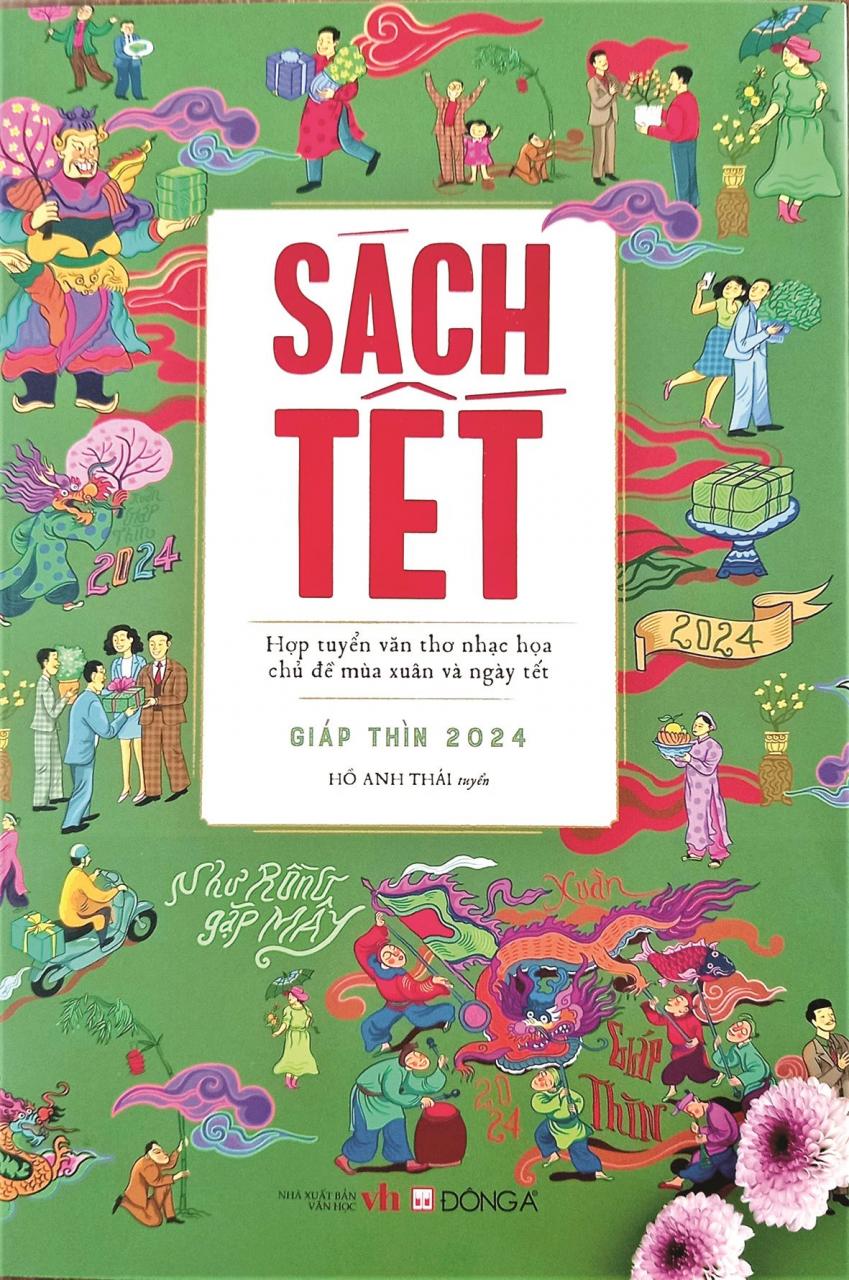
Five years ago, during the Lunar New Year of the Pig (2019), Dong A Cultural Joint Stock Company published a book with a very interesting title – "New Year's Book". At the time, out of curiosity, we also bought a copy to read. To this day, the New Year's book has become a familiar spring publication for our family every New Year.
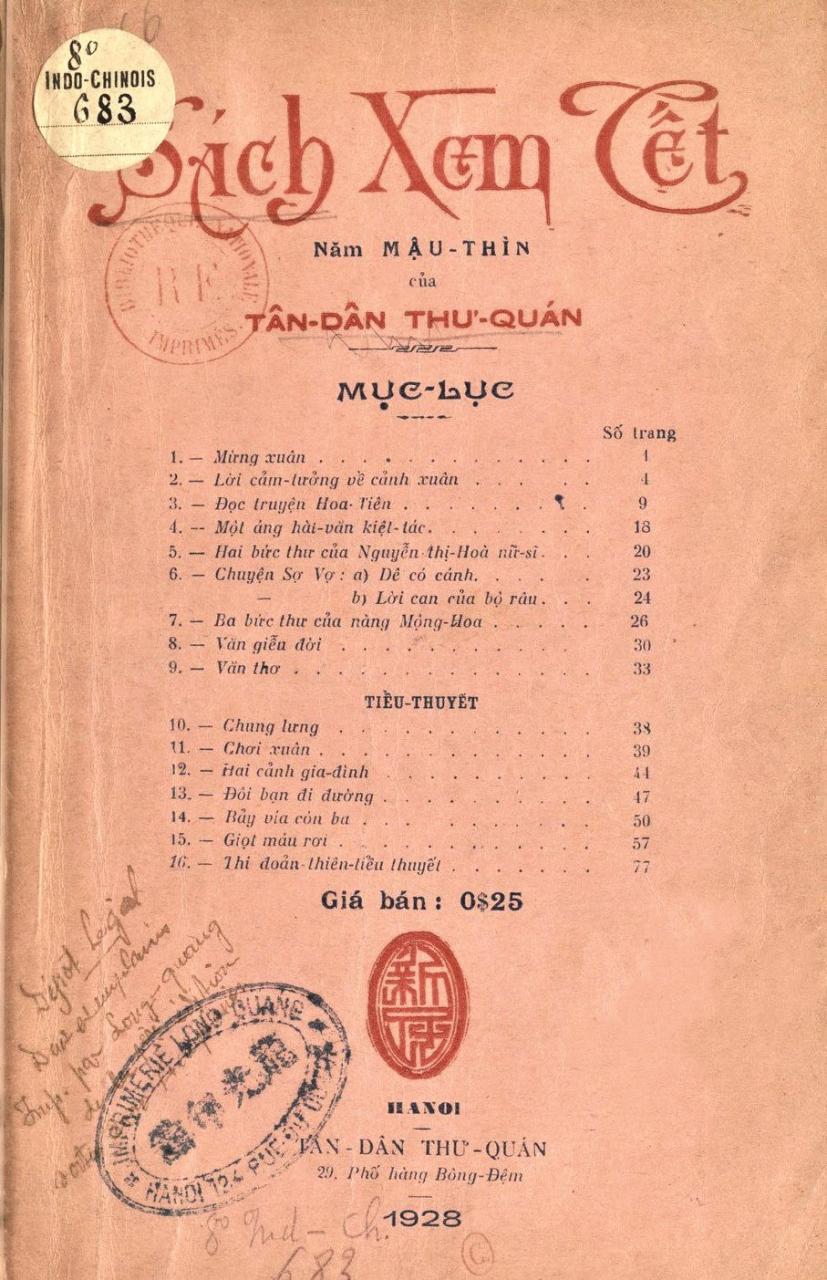
Through research, we have learned that Tet (Lunar New Year) books in Vietnam first appeared in the early 20th century. Specifically, in 1928 in Hanoi , Tan Dan Bookstore (which later developed into a publishing house) released a New Year's publication called "Book for Tet in the Year of the Earth Dragon".
Tet book of the year Mau Thin 1928
According to the PDF file we found on the website of the French National Library, the book on Tet (Lunar New Year) in the year of the Earth Dragon has a modest number of pages, few articles (16 articles), and no illustrations.
Although few in number, the entries encompass a wide range of genres. These include essays such as "Celebrating Spring," "Reflections on Spring Scenery," etc.; poems such as "Bewildered by Spring," "On Mountains and Rivers," "A Gift to a Friend," etc.; novels such as "Together," "Celebrating Spring," "Two Family Scenes," "Two Friends on the Road," "Seven Souls Remaining, Three," etc.; and even jokes, couplets, spoken songs, and a short story writing contest.
Besides the 78 main pages of text, the Lunar New Year book for the Year of the Dragon also features advertisements introducing new books, pharmacies, photo studios, and various goods for the Tet holiday such as tea, cakes, wine, firecrackers, wooden furniture, fabrics… and even Lien Thanh fish sauce (Phan Thiet).
The book of New Year's readings from the year of the Earth Dragon (1928), though rudimentary and simple in form, was, in the context of the time, a truly valuable literary platform where literati and poets could publish their masterpieces, a beneficial spring gift for the spirit and knowledge. As the preface states, "although all are playful writings, each piece maintains a very dignified attitude." Looking back at this New Year's book, written 96 years before the New Year of the Earth Dragon (1928), helps us understand the thinking and writing style of our predecessors, as well as the joys and pleasures of celebrating the New Year as our ancestors did.
Lunar New Year books for the Year of the Dragon 2024
Following in the footsteps of previous years, this year's Tet book is also an anthology of literature, poetry, music, and art with the theme of spring and Tet, evoking a range of delightful emotions. The Spring Anthology for the Year of the Dragon has five parts: The Prelude to Spring, Literature, Poetry, Music, and Art.
The prelude to spring begins with the article "Is There Anyone Still Named Xoan?", a nostalgic reflection by author Trung Sy on the rows of xoan trees in the villages of Northern Vietnam. Every spring, the xoan trees would sprout tiny green buds and their flowers would turn a pale purple, emitting a gentle fragrance. However, over time, these rows of xoan trees in the villages of Northern Vietnam have disappeared. Meanwhile, "Hanoi Historian" – writer Nguyen Ngoc Tien, with his rich documentation, helps readers better understand the spring customs of the people of Hanoi in the past. He states: "To have a proper Tet celebration, each family had to buy nearly a hundred things… However, no traditional market in Thang Long – Hanoi had enough goods to satisfy the extravagance and sophistication. Therefore, the Tet markets of Hang Street appeared, specializing in selling the finest produce." Specifically, Hang Luoc Street sold flowers; Hang Buom Street offered a full range of products from the mountains, sea, and plains, serving as ingredients (along with meat) for a traditional Tet feast with four bowls and six plates; Hang Duong Street offered drinks, and for buying zodiac paintings or Tet couplets, one couldn't miss the "calligraphy market" at the intersection of Hang Bo and Hang Thiec streets today… But from the latter half of the 20th century, the Tet markets on Hang Buom Street in Hanoi gradually faded away and eventually disappeared. "A Toast to Good Health" (Thu Uyen), "The Endless Return" (Cao Huy Thuan), "Tet in the Homeland" (Nguyen Trong Chuc), "Meeting Thi No on the First Day, Welcoming a Tycoon on the Full Moon" (Kieu Bich Huong)… are the heartfelt sentiments of Vietnamese people living abroad during the Tet holiday.
The largest portion of the 2024 Tet (Lunar New Year) books is occupied by emotionally charged works in the Literature and Poetry sections. The Literature section opens with "Money Falling at the Flower Market" (Hoang Cong Danh), recounting the story of two elderly people (60 years old) selling flowers at the Tet market. Author Huu Vi's "Getting Married as if in a Joke" depicts the journey of the character Vui in the northern border highlands (bordering Laos) on the last afternoon of the year. There, he meets Sa and takes her home as his wife. Thus, "after Tet, there was a wedding in Ke Hin. Vui got married." The heroic spirit of the Vietnamese people emerging from war into peacetime is portrayed in "The Cockfight" (Ma Van Khang). Ho Anh Thai's "Mr. "The Transporter" is a humorous story from our country's diplomatic field in the years before the Doi Moi (Renovation) period... And many other stories such as: "The Lucky Crow" (Huynh Trong Khang), "The Misty Sea" (Le Minh Khue), "Walking Together" (Van Thanh Le), "The School Transfer Campaign" (Phan Thi Vang Anh)... Reflecting many interesting perspectives of the authors on people and contemporary life realities.
Regarding poetry, author Van Hien states: “The Tet holiday in the countryside arrives later/But the cakes are still square and round – the same land and water as before” (Tet in the Countryside). It expresses the feeling of homesickness, of missing parents during springs spent far from home: “This year again, I surely dare not make a promise/Afraid of the dew falling, my hair turning gray and my skin wrinkled/On New Year's Eve, will Mother sit leaning against the door/Waiting for me to come home to be the first visitor, Mother?” (Spring Missed Appointment - Tu Uyen). “Mother Going to the Tet Market” (Tran Duc Cuong) captures the eager emotions of country children seeing their mother go to the market and “bringing the whole spring with her.” Although written by Nguyen Binh (1918-1966) nearly 90 years ago, “Spring Rain” still carries an endless vitality…
The Music section consists of three reviews by author Nguyen Thi Minh Chau on famous songs: "Swallows of Childhood" (Pham Tuyen), "The Small Path into Life" (Pham Minh Tuan), and "Lullaby for You with the Warmth of Spring" (Trinh Cong Son).
This year's Art section features an article by Nguyen Le Chi introducing artist Nguyen Trung and his tireless journey of "drawing - writing - reading," along with his distinctive style of depicting Vietnamese women. The Tet book concludes with an article about the Codex Leicester, a notebook by the painting genius Leonardo da Vinci.
Author Dang Bay stated that it is "a rare manuscript, containing many ideas and inventions on various topics." The pages are further enhanced by colorful illustrations reflecting the joyful and warm atmosphere of the Lunar New Year from artists such as Kim Duan, Quyen Thai, Dao Hai Phong, Ngo Xuan Khoi, Dang Xuan Hoa, Ta Huy Long, Do Hoang Tuong, and Hoang Phuong Vy…
Compared to the Tet book published 96 years ago, this year's Tet book (Year of the Dragon - 2024) is printed in color using modern technology on high-quality paper. The publisher has meticulously crafted both the content and the design, making it very appealing both to read and to the eye. It can be said that, in any era, Tet books are truly beautiful works of art, a springtime treasure worth enjoying during Tet and giving as gifts during the New Year.
Source


![[Photo] General Secretary and President To Lam presides over the meeting to approve the draft report on the results of inspection and supervision of the Standing Committee of the Hanoi City Party Committee (phase 3)](https://vphoto.vietnam.vn/thumb/1200x675/vietnam/resource/IMAGE/2026/09/17/1789654292939_ndo_br_1-jpg.webp)

















Comment (0)