From the time of the Hung Kings to modern society today, Tet (Vietnamese New Year) remains present as a red thread connecting the ages, preserving the cultural essence and spiritual vitality of the Vietnamese people.
Tet in historical records - the origin of Vietnamese identity.
In the historical memory of the nation, Tet (Vietnamese New Year) appeared very early, closely linked to the legendary history of nation-building. The legend of Lang Liêu offering sticky rice cakes (bánh chưng and bánh giầy) is not only a story about the origin of Tet cuisine, but more profoundly, it is the first cultural declaration of the ancient Vietnamese people: taking earth and sky, agriculture and family as the center of their worldview. From the time of the Hung Kings, Tet has carried the sacred meaning of gratitude: gratitude to heaven and earth for the harvest, gratitude to ancestors for pioneering and protecting the country. This is what caused Tet to quickly transcend the realm of daily life to become a community ritual, where beliefs, customs, and morals converge. Ancient historical texts, from the Đại Việt sử ký toàn thư (Complete History of Đại Việt) to records of rituals in the feudal court, all show that Tet was a momentous occasion for the nation. The king issued a general amnesty, held spring festivals, offered sacrifices to heaven and earth and ancestors; the people gathered their families and prepared for the ceremonies. Therefore, Tet is not just a private matter for each family, but a shared rhythm of the entire society, where everyone is united, and the past and present intertwine.

|
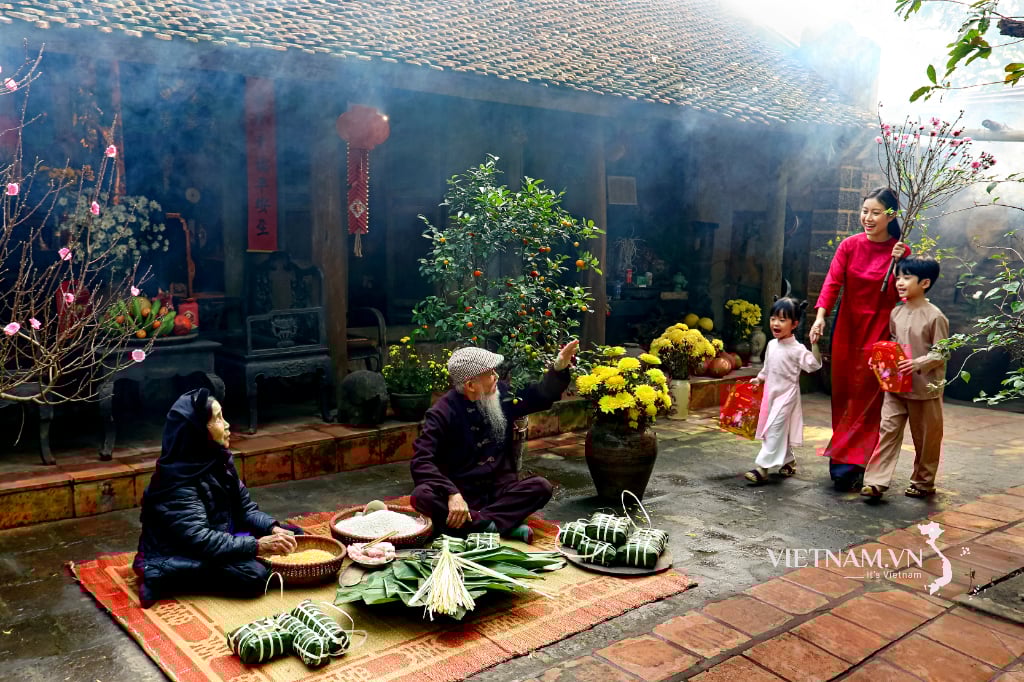
Family members gather to wrap banh chung – a traditional cake that is indispensable during the Lunar New Year. Photo: Khanh Hoa |
Traditional Tet customs - the cultural order of Vietnamese villages.
In the traditional social structure, the village was the basic cell of the nation. And it was within this village space that Tet (Vietnamese New Year) was nurtured into a tightly knit system of customs, reflecting the cultural and moral order of the Vietnamese people.
Tet, or Lunar New Year, is a time when people turn to their roots: cleaning their homes, tidying up ancestral altars, and visiting the graves of their ancestors. These rituals are not merely formalities, but rather a way for Vietnamese people to place themselves within the flow of family and national history. Each incense stick is a reminder of the responsibility to continue the tradition, and each New Year's greeting is a commitment to living better in the new year. Ancient Tet customs also clearly demonstrate the spirit of community: villages hold festivals, people visit each other, and old grudges are put aside. In the first days of the year, negativity is put aside, and goodness begins. Tet, therefore, becomes a mechanism for social self-regulation, helping communities maintain stability and cohesion over centuries.

|
Gò Đống Đa Festival. |
Tet during wartime - a warm flame amidst the smoke and flames of war.
Vietnamese history is a history of protracted resistance wars. But even during the most difficult times, Tet (Vietnamese New Year) never disappeared. On the contrary, Tet during wartime revealed its extraordinary spiritual strength. Tet celebrations in trenches, deep in the forests, on the front lines lacked the traditional square rice cakes and vibrant peach and apricot blossoms. Yet, there was still the communal pot of rice cakes from the unit, letters from home, and hastily written New Year's greetings before going into battle. It was in these circumstances of scarcity that Tet became a spiritual anchor, reminding soldiers that behind them were their families, their homeland, and their nation waiting for reunion. Tet during wartime was not just a continuation of customs, but also an affirmation of cultural resilience. Amidst bombs and bullets, preserving Tet meant preserving the belief that this nation could not be erased, that life and spring would ultimately prevail.
Tet in peacetime - Reconstruction and healing
As the country emerged from war, Tet took on a new meaning: healing and reconstruction. The first Tet celebrations of peace were those of reunion, of tears and smiles intertwined. Families reunited after separation, villages revived from devastation, and society gradually stabilized its rhythm of life.
In peacetime, Tet continues to play a crucial role in social cohesion. Seemingly small customs, such as visiting relatives, exchanging New Year greetings, and giving lucky money, contribute to nurturing compassion, tolerance, and a spirit of sharing. Tet not only marks the end of a year of work but also provides an opportunity for people to reflect on themselves and adjust their lifestyles and behaviors.

|
Seemingly small customs, such as visiting relatives, exchanging New Year greetings, and giving lucky money, contribute to nurturing compassion, tolerance, and a spirit of sharing. Photo: Thanh Huong |
Tet in the era of integration - changing but not disrupted.
Entering the era of integration and globalization, the Vietnamese Lunar New Year faces many challenges. The pace of industrial life, the influx of foreign festivals, and the impact of digital technology have led to a shortened, simplified, and even commercialized version of the New Year. However, history shows that the Lunar New Year has never been an immutable entity. Through each era, the New Year has adapted its form to suit the circumstances, while still retaining its core essence: focusing on family, ancestors, and community. This adaptability is a quality that contributes to the enduring vitality of Vietnamese culture. In the context of integration, the Lunar New Year has become an even stronger indicator of identity. Vietnamese people abroad still find ways to make traditional cakes, prepare festive meals, and organize communal New Year celebrations. Because in foreign lands, the Lunar New Year is not just a holiday, but a thread that holds onto identity, preventing people from being lost in the global flow.

|
Generations of the family prepare together for Tet (Lunar New Year). Photo: Khanh Hoa |
Tet - the red thread connecting the ages.
Looking back throughout history, it's clear that the Vietnamese Lunar New Year has never stood outside the national flow. From the legends of the Hung Kings, through the feudal dynasties, the years of war, and the current era of integration, Tet has always been present as an underlying cultural thread. This red thread connects the past with the present, memory with action, tradition with innovation. Thanks to Tet, the Vietnamese people are not disconnected from their own history, no matter how rapidly society changes. Ultimately, preserving Tet is not about clinging to the past, but about keeping the flow of history continuous, so that each generation knows where it stands in the long journey of the nation.
Tet and the historical resilience of the Vietnamese nation.
A nation may lose many things, but if it loses its memories and fundamental rituals, it will lose its direction. The fact that the Vietnamese Tet (Lunar New Year) has survived, been preserved, and renewed throughout thousands of years of history is proof of the historical resilience and cultural depth of the Vietnamese people.
Tet (Vietnamese Lunar New Year) doesn't flaunt its power or make a fuss. But it is precisely this quietness that allows Tet to weather all changes, becoming a witness to history and a steadfast companion for every Vietnamese person.

|
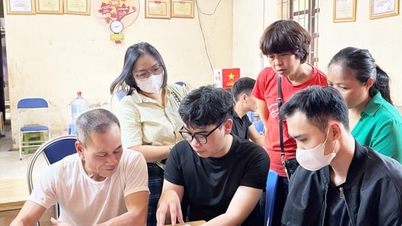
The older members of the family shared stories about the traditional customs of the ethnic group during the Lunar New Year. |
Looking back from today to the past.
Looking back from today, one thing is clear: the Vietnamese Tet holiday exists not only in the calendar, in customs, or in memory, but also in the way the Vietnamese people confront time and history. Each Tet holiday is an opportunity for the nation to remind itself of its origins, of the values that have shaped the vitality of Vietnam.
And as long as Tet is celebrated with reverence, cultural awareness, and genuine affection, that red thread of history will remain intact, guiding the Vietnamese nation through new springs of the modern era.
Source: https://www.qdnd.vn/van-hoa/doi-song/tet-viet-ben-bi-cung-lich-su-dan-toc-1024616










































































Comment (0)