

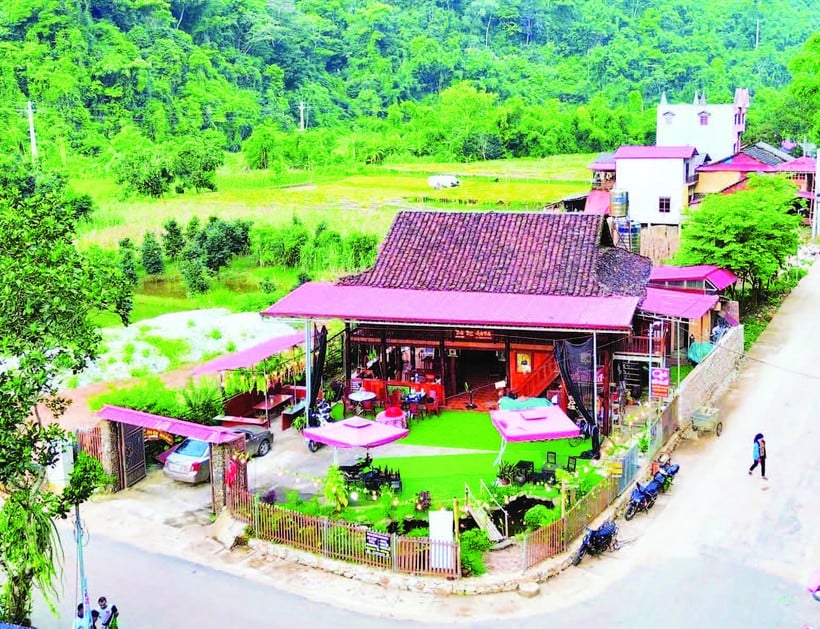
Drawing on their existing values, ethnic minority communities have learned to exploit local advantages and proactively participate in tourism activities. Models of cultural experiences, traditional lifestyles, and cuisine provide a stable source of income while contributing to preserving identity and building a friendly image of Thai Nguyen in the eyes of tourists.
In many localities in Thai Nguyen province, community-based tourism, which was once spontaneous and fragmented, has gradually become the main livelihood of ethnic minority people, with increasingly professional and systematic approaches. In Bo Lu village, Ba Be commune, Mr. Dong Van Hoan is one of the pioneering young people developing homestay tourism. From his family's old stilt house, Mr. Hoan has renovated and upgraded the rooms, decorating them beautifully and serving traditional local dishes.
According to Mr. Hoan, when they noticed an increase in the number of visitors, it was time to change their mindset and approach to meet the tastes of tourists. Besides continuing to improve facilities, his family also participated in many training courses, learned from experience, purchased kayaks for tourists to experience kayaking on Ba Be Lake, and listed their accommodation on online booking websites…
According to Trieu Kim Xuyen, Vice President of the Thai Nguyen Tourism Association and Head of the Bac Kan Tourism Branch: Currently, in the area surrounding Ba Be Lake, people are engaging in tourism more seriously and systematically than in previous years. Homestay owners are collaborating with local tourism groups, performing arts troupes, boat operators, and tour guides, ensuring the best possible service for tourists. Furthermore, locals prioritize using local specialties and agricultural products in their cuisine, thereby contributing to the introduction and promotion of the unique local culture.
To date, in the area surrounding Ba Be Lake, community-based tourism has become the main source of livelihood for ethnic minorities in the villages of Bo Lu, Pac Ngoi, and Coc Toc. Currently, Ba Be commune has nearly 60 accommodation establishments, mostly traditional stilt houses, including two 3-star OCOP-certified homestays, nearly 150 boats serving tourists, and more than 10 folk art troupes, all operating very professionally. The development of community-based tourism in Thai Nguyen is gradually being elevated with many unique models.
Located 12 km from the center of Thai Nguyen province, the Thai Hai Ethnic Ecological Stilt House Village Conservation Area in Tan Cuong commune is one of the most famous community tourism villages both domestically and internationally. It boasts 30 centuries-old stilt houses, restored to their original form, and is home to over 160 residents across generations. The villagers prioritize preserving the cultural identity of the Tay ethnic group and maintaining a vibrant community culture.
According to Deputy Head of Thai Hai Village, Le Thi Nga, the unique feature of Thai Hai that helps develop tourism is the systematic planning of areas such as traditional medicine shops, food stalls, accommodation, and educational facilities. Each stilt house is also planned with specific functional areas, such as places for processing herbal medicine, making tea, and brewing rượu (rice wine). These unique spaces have attracted many tourists to visit and experience.
In 2022, the Thai Hai Ethnic Village Ecological Stilt House Conservation Area was honored by the United Nations World Tourism Organization (UNWTO) as the World's Best Tourist Village. The product "Tay Ethnic Culture Tourism, Thai Hai Village" received a 5-star national OCOP (One Commune One Product) award; and the Thai Hai Ethnic Village Ecological Stilt House Conservation Area received the ASEAN Homestay Award.
In 2025, at the Vietnam Tourism Awards, Thai Hai village was again honored by the Ministry of Culture, Sports and Tourism as the Best Community Tourism Destination and the Best Restaurant Serving Tourists… Thai Hai, from a phenomenon, has become a symbol of community tourism development. On a larger scale, Tan Cuong commune is a prime example of community tourism development in Thai Nguyen province.
According to the Party Secretary of Tan Cuong commune, Duong Thi Thu Hang, developing unique community-based tourism is one of the commune's key tasks in the coming term, aiming to transform Tan Cuong into a center for community-based tourism, ecotourism, and resort tourism, linked with the production, processing, and promotion of Thai Nguyen tea culture.
Xinjiang has determined that for community-based tourism, it will link tourism companies with tea production cooperatives, homestay and farmstay models to organize experiential tours such as "A Day as a Xinjiang Local" through activities like tea picking, traditional tea processing, tea tasting with celebrities, and business tea parties. This systematic approach comes not only from the local people but also receives significant guidance and support from the government.
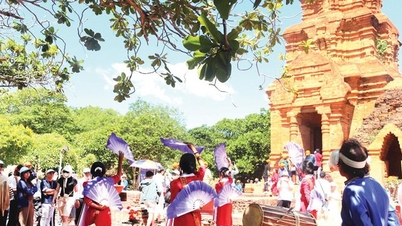
In 2023, Khau Dang village, Bang Thanh commune, embarked on a project to preserve typical traditional cultural villages of ethnic minorities in conjunction with tourism. Khau Dang received support for the construction of a community center; the renovation and upgrading of stilt houses; the construction of a village gate and signposts, etc. According to the village Party Secretary, Hoang Thi Mong, with the support of the State, the people have participated and learned about tourism on their own. Encouragingly, the villagers have recognized the benefits of tourism and are always striving to promote the unique cultural values of their ethnic groups, especially the Ka Dong mask dance.
Similarly, Khuân Bang village in Chợ Mới commune is actively implementing a project to support investment in building a tourist destination for ethnic minority communities. The village currently has 55 beautifully designed stilt houses, harmoniously blending tradition and modernity, to develop homestay tourism. The village has also established a Tourism Management Board; residents receive support and advice on space arrangement, landscaping, products, training, etc., to develop tourism. From a village facing many difficulties, Khuân Bang is now facing new opportunities thanks to tourism, especially with the upcoming Chợ Mới-Bắc Kạn expressway.
According to the Department of Culture, Sports and Tourism of Thai Nguyen province, after the merger, with its larger area, the province has great potential and resources to develop ecotourism, agricultural tourism, and community tourism. In agriculture and rural areas, the province has many models in various localities associated with tea-growing regions, such as: Hao Dat Tea Cooperative, Tien Yen Tea and Community Tourism Cooperative, and La Bang Tea Cooperative. Models related to fruit trees and agricultural crops include: Vo Nhai custard apple, Ba Be seedless persimmon, Ba Be fragrant green pumpkin… In community-based tourism, the province has models such as: Thai Hai Ethnic Ecological Stilt House Village Conservation Area, tourist destinations in Dong Khuan hamlet, Tan Son hamlet, Mo Ga hamlet, Khuon Tat, Pac Ngoi, Coc Toc…
Community-based tourism models in Pac Ngoi, Bo Lu, and Coc Toc are highly appreciated by the tourism community, attracting approximately 50,000 visitors annually, 30% of whom are international tourists. Currently, Thai Nguyen province has directed support for the completion and improvement of community-based tourism, agricultural and rural tourism, homestay, and farmstay models according to OCOP product criteria of 3-star and 4-star ratings to enhance the value and quality of service for tourists.
The province has also determined that the main principle for community-based and ecotourism in the 2025-2030 period is to expand development to create jobs and increase income for the people. In particular, community-based tourism and agricultural tourism associated with tea culture have been identified as the province's signature products.
In addition, the province is also focusing on researching and implementing investments to improve transportation infrastructure for communes, especially in the 34 disadvantaged communes, to expand opportunities for people to develop community tourism.
Source: https://nhandan.vn/thai-nguyen-chu-trong-phat-trien-du-lich-cong-dong-post929941.html

![[Image] Leaked images ahead of the 2025 Community Action Awards gala.](/_next/image?url=https%3A%2F%2Fvphoto.vietnam.vn%2Fthumb%2F1200x675%2Fvietnam%2Fresource%2FIMAGE%2F2025%2F12%2F16%2F1765882828720_ndo_br_thiet-ke-chua-co-ten-45-png.webp&w=3840&q=75)

![[Photo] Prime Minister Pham Minh Chinh receives Lao Minister of Education and Sports Thongsalith Mangnormek](/_next/image?url=https%3A%2F%2Fvphoto.vietnam.vn%2Fthumb%2F1200x675%2Fvietnam%2Fresource%2FIMAGE%2F2025%2F12%2F16%2F1765876834721_dsc-7519-jpg.webp&w=3840&q=75)
![[Photo] Prime Minister Pham Minh Chinh receives the Governor of Tochigi Province (Japan)](/_next/image?url=https%3A%2F%2Fvphoto.vietnam.vn%2Fthumb%2F1200x675%2Fvietnam%2Fresource%2FIMAGE%2F2025%2F12%2F16%2F1765892133176_dsc-8082-6425-jpg.webp&w=3840&q=75)








![[Photo] Prime Minister Pham Minh Chinh attends the Vietnam Economic Forum 2025](https://vphoto.vietnam.vn/thumb/402x226/vietnam/resource/IMAGE/2025/12/16/1765893035503_ndo_br_dsc-8043-jpg.webp)












































Comment (0)