


For generations, the sound of gongs and drums has been familiar to the people of the Central Highlands. Bearing within them the essence of cultural values, the sound of gongs and drums has shaped the identity of this land and its people. Through the inheritance, development, and preservation of countless generations, the gongs and drums of the Central Highlands continue to resonate, representing the distinctive sound of the vast forests.
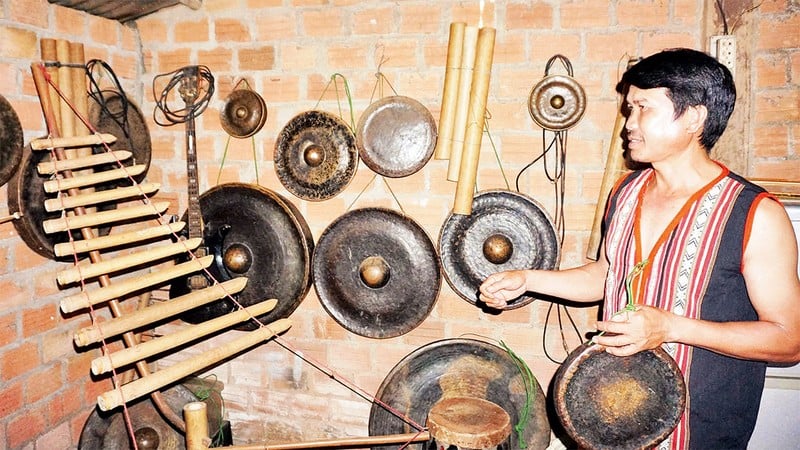 Artisan A Thu stands beside a set of traditional musical instruments of the Xơ Đăng ethnic group.
The resounding gong sounds of the gong ensemble from Dak Tram commune, Dak To district, Kon Tum province, draw listeners to the unique culture of the Central Highlands. The courtyard of artisan A Thu's house in Dak Ro Gia village, Dak Tram commune, suddenly bustled with activity as people gathered to practice and enjoy the gong performances. Those who came were captivated by the melodies and sounds of the gongs, a source of pride for generations of ethnic minorities in the Central Highlands. Their mastery of distinctive performances, such as harvest festivals and welcoming guests, helped Dak Tram commune win first prize at the Dak To District Ethnic Culture Festival.
Artisan A Thu shared that, since ancient times, the sound of gongs and cymbals has been present in the lives of the Xơ Đăng people. The sound of gongs and cymbals is intertwined with every Xơ Đăng person from birth, through adulthood, and even after death. Thanks to the gongs, birds and animals are driven away, protecting crops and fields. Because of this, the people are able to eat, live, and thrive on this land. In festivals, gongs and cymbals are sacred objects, tools of communication between humans and Yàng (the supreme deity); a spiritual anchor through which people entrust their hopes to Yàng for a prosperous and healthy life.
According to artisan A Thu, the Xơ Đăng people's gong set consists of 13 parts (8 gongs, 3 cymbals, 1 drum, and 1 cymbal). Each part produces different sounds; therefore, the player must feel and control them as desired. The Xơ Đăng people breathe life into their gongs, composing melodies that are closely linked to their daily lives.
The gong and drum music, such as celebrating the new rice harvest, building a water channel, and celebrating the communal house, is deeply ingrained in the memory of every Xơ Đăng person. The scene of flickering firelight around the communal house, harmonizing with the sounds of gongs, drums, and traditional dances, is a beautiful image that the Xơ Đăng people always mention whenever they introduce their culture.
Seeing that everyone had gathered, artisan A Thu slowly stood up, distributed the gongs and cymbals to everyone, and began practicing. As a gong and cymbal instructor in Dak Tram commune, artisan A Thu struck the gongs and cymbals in rhythm so that the listeners could feel the music, while kindly explaining the rhythm of each part of the gong and cymbal set to the trainees in the commune.
The melodies in the gong music of the Xơ Đăng people also have their own unique characteristics. According to artisan A Thu, the gong music of other ethnic groups often emphasizes fast-paced, lively, and majestic rhythms along with a high degree of improvisation, making a strong impression on the listener. The gong music of the Xơ Đăng people, on the other hand, mostly has gentle, slow melodies and rhythms that captivate the listener.
More than 10 years have passed since the first gong ensemble of the commune was established, and now Dak Tram commune has three gong ensembles. The ensembles are divided by age group: children's, youth, and middle-aged. However, regardless of age, every Xo Dang person expresses a passion and pride for gongs. It seems that for them, the "essence of gongs" is in their blood from birth.
After hours of hard work, as the sun sets, the gong-playing classes at artisan A Thu's house become bustling with people coming and going. They come not only to listen and enjoy, but each person also wants to hone and refine their skills, hoping to become the best and most skilled gong player.
With its unique characteristics and distinct values, gongs have existed and are inseparable from the daily life of the Xơ Đăng community in Kon Tum. As a UNESCO-recognized intangible cultural heritage, the art of gong music bears the strong imprint and vitality of the ethnic minorities of the Central Highlands in general and the Xơ Đăng people in particular.
The fire blazed brightly in the middle of the forest, and the sounds of gongs and cymbals from artisan A Thu's house still echoed, reaching far into the villages of Dak Tram.
Source: https://baodaknong.vn/thanh-am-cua-dai-ngan-237303.html
















































































Comment (0)