

Contrary to expectations, the two robotic vehicles remain dormant in the lunar south pole region, even though the Indian Space Research Organization (ISRO) is trying to awaken them.
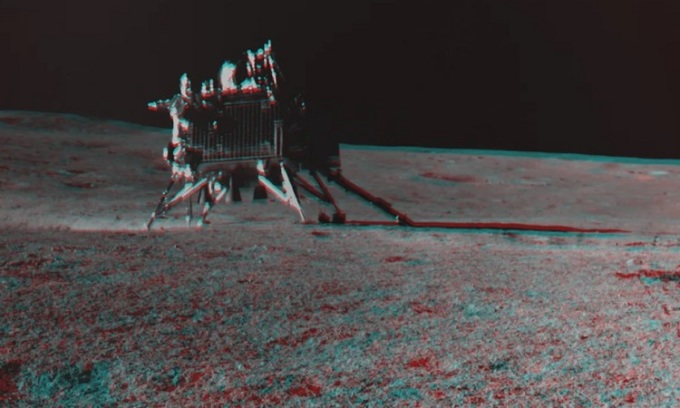
The Vikram lunar lander on the surface of the Moon, as captured by the Pragyan rover. Photo: ISRO.
India's Chandrayaan-3 lunar lander and rover are expected to wake up around September 22nd. The Indian space agency ISRO plans to land the pair on the Moon in August 2023. However, both the Vikram lander and the Pragyan rover are solar-powered. Therefore, they need sunlight to charge their batteries and operate their scientific equipment.
The two spacecraft went into sleep mode in early September as night fell on the Moon and their batteries ran out of power. The next sunrise was on September 22nd. ISRO hoped the photovoltaic panels would recharge and wake the pair. However, they did not respond to messages from the mission control team.
In late August, mission operations director M. Srikanth shared that the team was confident the lander and rover would revive after sunrise. "If that happens, it would be a huge plus. Even if they can't operate, the mission would still be accomplished," said M. Srikanth. Despite M. Srikanth's optimism, the two vehicles faced nighttime temperatures plummeting to -203 degrees Celsius on the lunar night, according to NASA. The lander and rover were not built to withstand such cold conditions.
The mission control team would continue sending messages. Even if the ISRO lander and rover could not wake up, they had accomplished their design goal: exploring the Moon's south pole within 14 days of landing. In just two weeks, the two rovers had made several important scientific discoveries. For example, the rover confirmed the existence of sulfur in the Moon's south pole.
Furthermore, preliminary analysis reveals that the soil in this area contains aluminum, calcium, iron, chromium, titanium, and may have experienced earthquakes. India was the fourth country to land on the Moon after the United States, the Soviet Union, and China, and the first to land near the South Pole. The Moon's South Pole attracts much attention due to its water ice. This is a potentially exploitable resource for producing oxygen for breathing and for use as rocket fuel, along with hydrogen.
An Khang (According to Business Insider )
Source link


![[Photo] Prime Minister Pham Minh Chinh presides over a meeting on private sector economic development.](/_next/image?url=https%3A%2F%2Fvphoto.vietnam.vn%2Fthumb%2F1200x675%2Fvietnam%2Fresource%2FIMAGE%2F2025%2F12%2F20%2F1766237501876_thiet-ke-chua-co-ten-40-png.webp&w=3840&q=75)




















































































Comment (0)