

To commemorate the 79th anniversary of the August Revolution and National Day on September 2nd (1945 - 2024), the National Museum of History, in collaboration with the Vietnam Cultural Heritage Association and collector Dao Danh Duc, is organizing a thematic exhibition: "Treasures of Champa - Marks of Time".
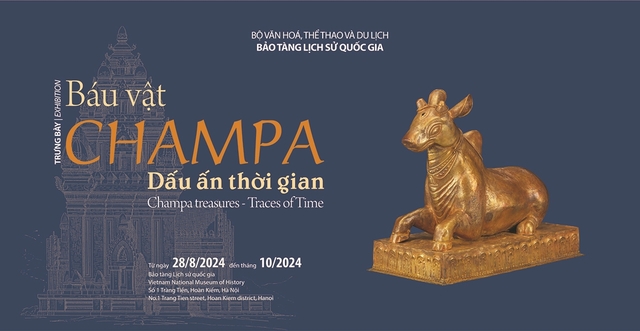
Champa was an ancient kingdom that existed from 192 to 1832 in what is now central Vietnam. Champa culture was influenced by Indian and Javanese cultures, along with its own unique creations, resulting in artistic masterpieces such as the My Son, Dong Duong, and Thap Mam styles. Many surviving temple and sculptural relics show that Hinduism and Buddhism were the two main religions of the ancient Champa kingdom.
Champa flourished most during the 9th and 10th centuries. After the 15th century, the center of the Champa kingdom gradually shifted southward and took on a new character. From 1692 (when the Nguyen lords established Thuan Thanh garrison in Champa territory) to 1832 (when Champa officially merged with Dai Nam under Emperor Minh Mang), issues concerning Champa's history, culture, and art seemed to receive little attention. Accordingly, the museum, in collaboration with other research units, has selected over 60 representative artifacts made of gold and silver from this historical period (17th-18th centuries) to present to the public, most of which are being exhibited for the first time.
The exhibition consists of two parts: Part 1 consists of religious statues and mascots; Part 2 includes jewelry and objects bearing religious symbols and representing royal authority.
Part 1 will introduce some typical artifacts such as: statues of Shiva, male and female deities, Ganesha, Buddha, Avalokitesvara Bodhisattva, Linga-Yoni, Kosalinga, Shiva's head, Nandin the bull statue… made of gold, silver and inlaid with precious stones.
Like other ancient states in the region, Champa adopted and was influenced by both major religions: Hinduism and Buddhism. Therefore, the most common artifacts in Champa's heritage are statues of gods, Buddhas, and mythical creatures and mascots of these two religions.
Part 2 introduces artifacts belonging to the category of jewelry and objects bearing symbols of royal and religious power, including: earrings, rings, necklaces, hairpins, combs, bracelets, gloves, belts, jewelry boxes, headwear, crowns, hair coverings... decorated with religious and traditional Champa art symbols, especially Hindu deities such as: Brahma, Vishnu, Shiva, Ganesha, Nandin the bull, Garuda the bird, Naga the serpent…
These were offerings to the gods or used by the Champa royal family. These artifacts are all exquisitely crafted with high-level goldsmithing techniques, possessing exceptional historical, cultural, and artistic value.
Through this exhibition, the National History Museum hopes that the public, both domestic and international, will have the opportunity to admire artifacts of exceptional historical, cultural, and artistic value, and gain a deeper understanding of a period of Champa's cultural history that seems to be little known. This will foster appreciation and raise awareness of the importance of preserving and promoting the traditional cultural values of the nation.
Furthermore, the exhibition contributes to further strengthening the role of the National History Museum and other public museums in coordinating and supporting private museums and collections to promote the value of heritage to a wider audience.
The exhibition will run from August 28, 2024 to October 2024.
Source: https://toquoc.vn/trien-lam-bau-vat-champa-dau-an-thoi-gian-20240827112608682.htm
![[Photo] General Secretary and President To Lam presides over a working session with the Central Policy and Strategy Committee on the development of the materials industry.](https://vphoto.vietnam.vn/thumb/1200x675/vietnam/resource/IMAGE/2026/05/21/1779359935432_a3-bnd-3129-1412-jpg.webp)
![[Photo] National Assembly Chairman Tran Thanh Man working with the Standing Committee of the Law and Justice Committee](https://vphoto.vietnam.vn/thumb/1200x675/vietnam/resource/IMAGE/2026/05/21/1779378929214_ndo_br_1-4610-jpg.webp)




























































Comment (0)