

The initial implementation of the two-tiered local government model has shown significant advantages over the previous system. Building a government that is closer to the people and grassroots, reducing intermediate levels, contributes to shifting the government from a managerial to a service-oriented administration. However, a reality that must be acknowledged after more than a month of operation of the two-tiered local government model is that the number of administrative documents and procedures at the commune level has increased many times compared to before, while there is a surplus and shortage of commune-level officials in some areas; equipment and infrastructure in some localities are still inadequate; and people are hesitant to carry out administrative procedures electronically.
In Official Dispatch No. 111/CD-TTg on focusing on removing difficulties and obstacles in implementing administrative procedures and digital transformation in the initial phase of operating the two-tiered local government organizational model, signed and issued by Prime Minister Pham Minh Chinh to ministries, sectors, and localities, four groups of issues affecting the operation of the new system were identified. These included acknowledging that support, guidance, and communication efforts are still ineffective and impractical; the emergence of "brokers for paperwork" in some localities; and the creation of additional administrative procedures that are not in accordance with regulations in legal documents.
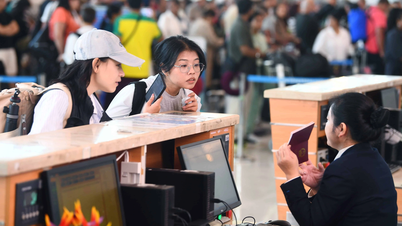
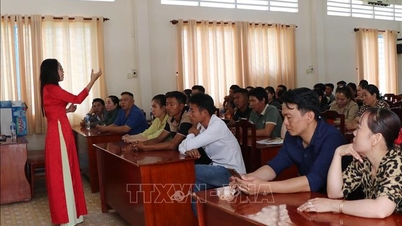
The reason why "brokers for paperwork" still thrive in some localities recently is partly due to people's reluctance to deal with government agencies, their unfamiliarity with procedures, and their desire for quick administrative procedures without sufficient time. Along with the rest of the country, An Giang is promoting the "Digital Literacy Movement"; mobilizing youth union members to assist people in carrying out administrative procedures at commune-level public administrative service centers; and establishing online application support points in residential communities… to help people complete public administrative procedures.
During a conversation with me, an elderly man mentioned that nowadays, smartphones have many installed applications, each with a password that needs to be remembered. He has to write down the passwords for these applications in a notebook so he can access them when needed and complete online administrative procedures. Recently, when applying for a passport renewal, with guidance from officials, he also managed to complete the process on the Ministry of Public Security's Public Service Portal, from uploading his portrait photo and old passport to paying the fees… and then simply waited for the passport to be delivered to his home. This is also seen as a small effort by citizens to implement the policy of building a digital government and digital citizens. According to him, each citizen should research and boldly apply technology; implementing the policy of building a digital government is not only an effort of the government but also requires the participation of the people.
According to Notice No. 408/TB-VPCP announcing the conclusions of the 3rd meeting of the Government Steering Committee on Science, Technology Development, Innovation, Digital Transformation and Project 06, the Steering Committee set the goal that from October 1, 2025, the acceptance of applications will be carried out entirely electronically; and to promote public awareness to encourage people to proactively integrate documents into their electronic identity accounts. The Steering Committee assigned specific tasks to ministries, sectors, and localities, including encouraging people to use 100% electronic environments for 25 full-process online public services. In the short term, the Steering Committee emphasized the need to prioritize the completion of the national population database, ensuring the principles of "accuracy, completeness, cleanliness, viability, and seamless connectivity." Business processes will be reviewed and revised to allow the use of information integrated into the VNeID application to completely replace paper documents.
This requires the active participation of citizens in proactively verifying and integrating documents into electronic identity accounts used when conducting transactions, so that "document brokers" no longer have a place to operate.
LE ANH
Source: https://baoangiang.com.vn/tro-thanh-cong-dan-so-a426282.html




![[Photo] National Assembly Chairman Tran Thanh Man attends the policy seminar to promote Vietnam-Türkiye cooperation.](https://vphoto.vietnam.vn/thumb/1200x675/vietnam/resource/IMAGE/2026/04/16/1776351415367_vna-potal-chu-tich-quoc-hoi-tran-thanh-man-du-toa-dam-chinh-sach-thuc-day-hop-tac-viet-nam-tho-nhi-ky-8705791-jpg.webp)
















































































Comment (0)