

Faced with the problem of online fraud targeting internet and mobile phone users in Vietnam, causing financial and emotional damage to citizens, the National Cybersecurity Association has developed the nTrust application (a tool aimed at preventing online fraud). However, for this tool to work effectively, user participation is essential.
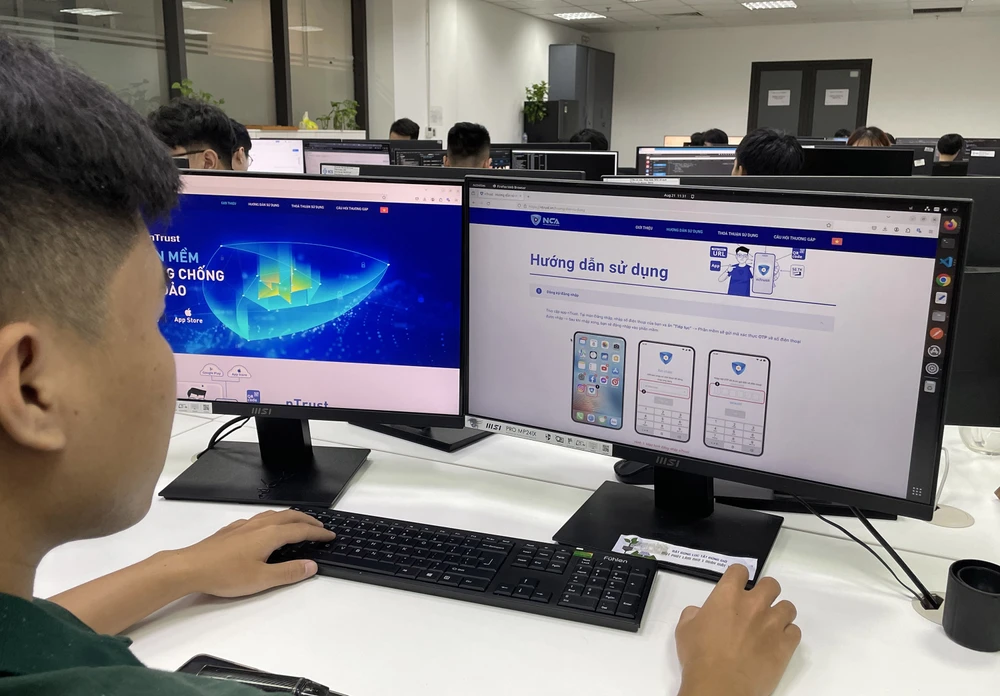
Block scam calls.
The nTrust software, installed on smartphones, was released free of charge to users on July 30th. The application development team researched 24 types of scams and their variations used by fraudsters in Vietnam to create a fundamental understanding of these scams and develop the application's features. Installing the application is also quite easy; simply download it from the CH Play app store for Android users and the App Store for iOS users and follow the activation instructions.
According to the National Cybersecurity Association, the nTrust application contains a database of information on scammers updated from domestic ministries and agencies such as the Ministry of Public Security , the Ministry of Information and Communications, the State Bank of Vietnam, and other relevant parties. The application will also connect with databases of cybersecurity companies that are members of the National Cybersecurity Association, international anti-fraud organizations, etc. However, to fully utilize its features, the application requires user participation in "reporting."
“On the nTrust app, one feature I find useful is the ability to create a “blacklist” of scam or unwanted phone numbers to avoid being bothered. To use this feature, access the “Check Phone Number” section on the app's main interface, then select “Blacklist” from the displayed interface. Here, you press the “Add Phone Number” button and enter the phone numbers you want to block calls from. In this feature, users can also activate the “Send Report” option if they want to send the blocked phone numbers to nTrust's database. With this method, not only scam or bothersome phone numbers, but users can also ask nTrust to block calls from people they don't like to avoid being bothered. This is one of nTrust's mechanisms and thus helps avoid being bothered by spam calls, advertising calls, etc.,” shared Mr. Hai Son, an office worker in Binh Thanh District (Ho Chi Minh City) after using the app. I installed the app and have been using it for the past week.
In addition, nTrust allows users to check if their smartphone has accidentally installed any applications containing malware. Users tap the "Scan for malware" icon in the bottom menu, then tap the "bug" icon that appears on the interface. After the scan is complete, nTrust will inform the user of the number of applications installed on the phone and the amount of malware detected. The application also provides a web address checking function, helping to detect phishing websites, websites containing malware, or fake websites…
Not a "magic wand"
According to statistics from nTrust's management system, after 20 days of launch, there have been approximately 150,000 downloads of nTrust from the Google Play and Apple Store app stores. The number of regular users has exceeded 100,000. Each day, the nTrust app receives 3,000-5,000 reports, mainly related to scam and harassing phone numbers. The data is processed using artificial intelligence (AI), combined with verification through open data sources, and compared and cross-referenced with the existing trust data list. From this, the app updates with approximately 70,000 new records from community reports, primarily reports of scam and harassing phone numbers.
Mr. Vu Ngoc Son, Director of Technology at the National Cyber Security Technology Company (NCS) and chief architect of the nTrust software, stated: “The nTrust software is part of the National Cyber Security Association’s key plan for 2024. Data sharing strictly adheres to the regulations of Decree 13 on personal data protection. Accordingly, nTrust will send the data to be checked in hash code format (standardized, encrypted, and irreversible data) to compare with data in the database of the authorities (which has already been hash-encrypted). The results returned only classify the data as fraud, harassment, etc., and when results are available, nTrust will return the results to the user. This process is completely automated, only comparing encrypted data, is irreversible, and requires no human intervention.”
However, according to the National Cybersecurity Association, software is not a "magic wand"; it's merely a tool to help people detect signs of fraud and proactively prevent it. The final decision still rests with the user's skills and awareness. In this case, the nTrust application will provide maximum support in detecting online fraud and harassment; if the application issues a warning but the user continues with the transaction, the risk of having money stolen from their account still exists. Therefore, to truly prevent fraud, each citizen needs to improve their skills and understanding of common online fraud methods, and especially, build a community focused on fraud prevention.
The current challenge for the nTrust development team is the inability to implement malware scanning on the iOS version. This is due to Apple's developer policy. Apple consistently maintains that no malware can run on iOS (although malware does exist) and does not grant any permissions to applications to develop malware scanning features. Therefore, it is hoped that Apple will adopt more open policies towards software developers in the future. Only then will nTrust be able to scan for malware on iOS devices.
BA TAN
Source: https://www.sggp.org.vn/ung-dung-ntrust-chong-lua-dao-truc-tuyen-tang-hieu-qua-tu-su-tham-gia-cua-nguoi-dung-post755141.html
![[Image] Leaked images ahead of the 2025 Community Action Awards gala.](/_next/image?url=https%3A%2F%2Fvphoto.vietnam.vn%2Fthumb%2F1200x675%2Fvietnam%2Fresource%2FIMAGE%2F2025%2F12%2F16%2F1765882828720_ndo_br_thiet-ke-chua-co-ten-45-png.webp&w=3840&q=75)

![[Photo] Prime Minister Pham Minh Chinh receives the Governor of Tochigi Province (Japan)](/_next/image?url=https%3A%2F%2Fvphoto.vietnam.vn%2Fthumb%2F1200x675%2Fvietnam%2Fresource%2FIMAGE%2F2025%2F12%2F16%2F1765892133176_dsc-8082-6425-jpg.webp&w=3840&q=75)
![[Live] 2025 Community Action Awards Gala](/_next/image?url=https%3A%2F%2Fvphoto.vietnam.vn%2Fthumb%2F1200x675%2Fvietnam%2Fresource%2FIMAGE%2F2025%2F12%2F16%2F1765899631650_ndo_tr_z7334013144784-9f9fe10a6d63584c85aff40f2957c250-jpg.webp&w=3840&q=75)

![[Photo] Prime Minister Pham Minh Chinh receives Lao Minister of Education and Sports Thongsalith Mangnormek](/_next/image?url=https%3A%2F%2Fvphoto.vietnam.vn%2Fthumb%2F1200x675%2Fvietnam%2Fresource%2FIMAGE%2F2025%2F12%2F16%2F1765876834721_dsc-7519-jpg.webp&w=3840&q=75)



























































![[Photo] Prime Minister Pham Minh Chinh attends the Vietnam Economic Forum 2025](https://vphoto.vietnam.vn/thumb/402x226/vietnam/resource/IMAGE/2025/12/16/1765893035503_ndo_br_dsc-8043-jpg.webp)





























Comment (0)