

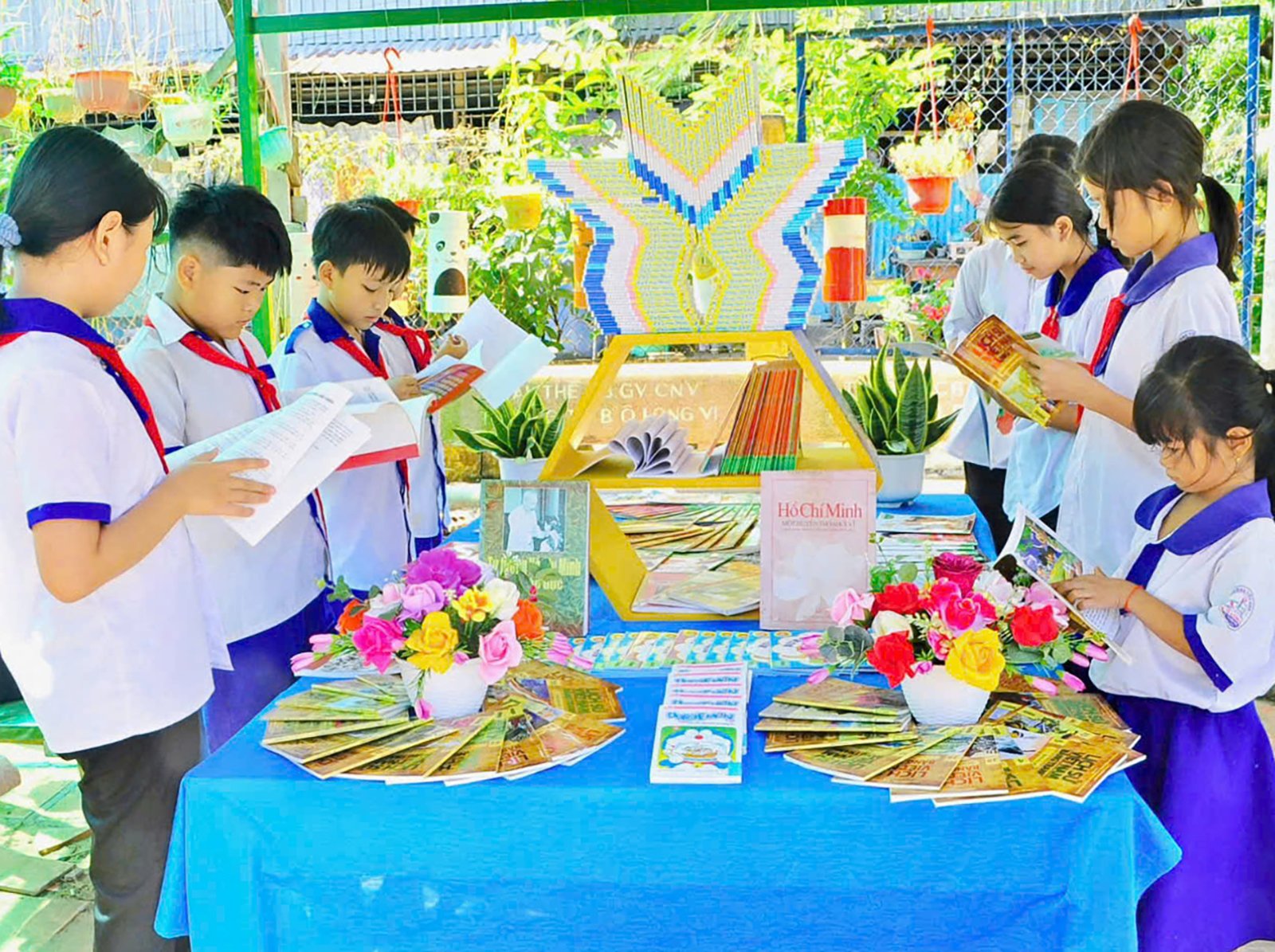
Educating young children helps shape their cultural behavior. Photo: MY LINH
From small actions
Public etiquette reflects each individual's understanding and sense of responsibility towards the community. In today's increasingly interconnected world, each person's behavior needs to be elevated to enhance the environment where they study, work, and live. An act of cultured behavior doesn't necessarily have to be something grand or extraordinary; sometimes, it's simply a few small actions like helping the elderly, children, or assisting people with disabilities cross the street.
Nguyen Chi Thien, a long-distance freight truck driver, shared: “During my trips, I've often witnessed kind acts of kindness from those around me, such as helping people cross the road with packages, giving way to those in urgent situations… Sometimes I also receive support from people when my truck breaks down during a trip, and at those times I feel very warm-hearted and grateful.”
Behavior plays a crucial role in shaping each person's character, especially for young people. Therefore, in recent times, the issue of building and developing culture, including public etiquette, has been given importance by all levels of government, sectors, and localities. Simultaneously, efforts have been intensified to promote and implement this through campaigns, movements, and education in schools, families, and society at large, aiming to cultivate a sense of responsibility among citizens towards the community through behaviors that align with the nation's fine cultural traditions and the trends of social development.
Educating children about proper behavior is a long-term process, in which the role of the family is very important, especially in teaching young children during the formative years of their character. Ms. Nguyen Kim Chi, residing in Long Xuyen ward, shared: “I often teach my children by showing them what they should and shouldn't do in public places. For example, when I see a kind person helping a disabled person cross the road, I tell my child that it's a beautiful act and encourage them to do the same. And when I see someone behaving or speaking inappropriately towards the elderly, I explain to them that it's something to avoid…”
In society, alongside those who behave courteously, there are still many individuals who act uncivilly in public places. These thoughtless behaviors are manifested through pushing and shoving, using foul language, speeding, reckless driving, littering in public, vandalizing walls, dressing inappropriately in sacred places of worship, etc., causing much frustration. Mr. Ngo Van Sai, a resident of Long Xuyen ward, said: “I am very annoyed by the behavior of drivers encroaching on other lanes on the road. In many cases, when it rains and some sections of the road are flooded, many thoughtless people drive through the flooded areas, splashing dirty water onto the clothes and faces of those around them…”
Cultivating a positive public image
Ms. Le Thi My Ngoc, a resident of Long Xuyen ward, said: “For me, proper behavior in public places and how people treat each other is very important. Therefore, when I see groups of people shouting and causing disturbances in restaurants, cafes, or other public places, affecting those around them, I feel very uncomfortable. I think that to build a beautiful lifestyle in public places, each person needs to raise their self-awareness and the role of family and school education for children and students must be promoted from a young age.”
Building a culture of proper conduct in public spaces is essential in the current context to create a healthy cultural environment. Culturally appropriate behavior in public spaces is expressed through respect, care, and helpfulness among people, or through awareness of preserving and protecting the living environment. Therefore, to enhance awareness of culturally appropriate behavior in public spaces, it is necessary to focus on building a culture of conduct for everyone, in every household. Each person needs to be aware, self-aware, and responsible to the community and society in maintaining beautiful, cultured, and civilized behavior towards one another. This can be achieved through campaigns and movements that encourage and spread kind and compassionate actions.
To foster civilized and polite behavior, it is necessary to improve the quality of education in each family, school, and society. At home, adults must be role models for children, educating them about cultured and civilized behavior to shape their character. In school, students must be educated in ethics and equipped with skills and a beautiful way of life.
The dissemination of traditional values, the good lifestyle of the nation, and exemplary lessons, stories, and role models also need to be promoted and popularized. Each individual needs to absorb cultural and civilized aspects within the context of social development to build and develop positive cultural values in life. Strict sanctions are needed to deal with behaviors that violate ethical standards and social rules, creating a strong legal framework to both educate and deter, helping each person to improve their self-awareness and adjust their behavior, contributing to the development of cultural norms of conduct.
Source: https://baoangiang.com.vn/van-hoa-noi-cong-cong-a427735.html

![[Photo] The Politburo, the Secretariat, and the Central Committee are introduced at the Congress.](/_next/image?url=https%3A%2F%2Fvphoto.vietnam.vn%2Fthumb%2F1200x675%2Fvietnam%2Fresource%2FIMAGE%2F2026%2F01%2F23%2F1769156522913_11.jpeg&w=3840&q=75)


![[Photo] Portraits of the 19 members of the Politburo of the 14th Party Congress](/_next/image?url=https%3A%2F%2Fvphoto.vietnam.vn%2Fthumb%2F1200x675%2Fvietnam%2Fresource%2FIMAGE%2F2026%2F01%2F23%2F1769161873355_z7460119485980-304d85fe10d12298f1db614b0d2aa6bc-jpg.webp&w=3840&q=75)


![[E-Magazine]: Fragrances that remain "pristine"...](/_next/image?url=https%3A%2F%2Fvphoto.vietnam.vn%2Fthumb%2F402x226%2Fvietnam%2Fresource%2FIMAGE%2F2026%2F01%2F23%2F1769174174439_e-magazine-huon-w1200t0-di2603d199d5163627t11920l1-hmmtn-018.webp&w=3840&q=75)



Comment (0)