

Whenever someone asks me, "What's the specialty of your hometown?", I answer without hesitation: Thai Binh rice cake.
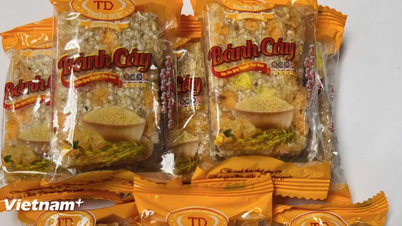
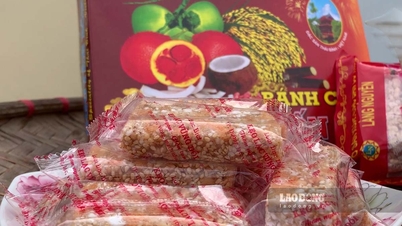
Just those four words, but they were enough to make my heart sink, as if I had just touched a cherished memory. Bánh cáy is not just a dish. It is my homeland, encapsulated in a square, chewy, fragrant, and deeply flavorful piece of cake.
 |
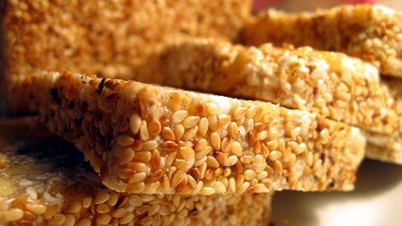
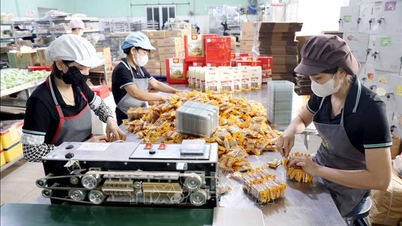
To make a batch of delicious rice cakes, one needs at least half a month of preparation. (Illustrative image: tuoitre.vn) |
I only truly enjoy eating bánh cáy (a type of rice cake) when I go back to my hometown for Tet (Lunar New Year). Throughout the year in the bustling city, I might find bánh cáy somewhere, but the taste isn't the same. Bánh cáy has to be eaten in the countryside, in the crisp chill of the last days of the year when the northeast monsoon winds sweep across the harvested fields, when Tet is still ahead and people's hearts are filled with anticipation. And I want the bánh cáy to be the kind my grandmother buys.
My grandmother said that to make a delicious batch of sticky rice cakes, one needs at least half a month of preparation. Pork fat is thinly sliced and marinated with cane sugar until it's absorbed; the coconut flesh must also be carefully selected and evenly sliced. Sticky rice is the main ingredient, and it must be fragrant, carefully roasted to be crispy without burning. Gac fruit provides a warm red color; gardenia fruit dyes the cake a bright yellow; sesame seeds and peanuts are roasted until golden and fragrant. Each ingredient cannot be prepared hastily.
Listening to her tell the story of how to make bánh cáy (a type of Vietnamese rice cake) felt like hearing about a long harvest season. From simple ingredients, familiar to rural life, through the skillful hands of the baker, everything is harmoniously combined to create a soft, fragrant cake with a special flavor. She said that each bánh cáy is the result of a diligent and meticulous process, containing the love of the craft and the love of the homeland of the people of Nguyen village, Thai Binh province (formerly).
She also taught me how to eat sticky rice cakes. When eating, you shouldn't bite quickly, but eat slowly, savoring each small piece with a warm cup of tea. Then, the delicate sweetness of the sugarcane will gradually spread across your tongue; followed by the mild spiciness of the ginger, the crispness of the roasted sticky rice, the chewiness of the glutinous rice and young rice flakes. On Tet afternoons, I would sit beside her, listening to the wind blowing outside, listening to her tell old stories, holding a piece of sticky rice cake in my hand, and feel time slow down. Then I realized that Tet only needs to be filled with family love.
Growing up, I left my hometown, carrying with me memories of Tet holidays filled with rice cakes and my grandmother. When I shared this treat with friends, my heart swelled with pride as I said, "This is Thai Binh rice cake from my hometown." Rice cake is a local specialty, a way for me to call my roots amidst so many other places.
Then my grandmother grew old, and there were Tet holidays when she no longer had the strength to go to the market to buy the cakes. The rice cakes were still placed in the same spot in the house. I ate them, still with their delicate sweetness and mild ginger flavor, but with an added gentle nostalgia. There was no one to remind me to eat slowly, no more conversations with my grandmother while savoring the familiar taste of the cakes.
Now, every time I go back to my hometown for Tet (Lunar New Year), the first thing I look for is the "banh cay" (rice cake). Taking a bite, I feel like I'm reliving the old days, seeing the old house, seeing the winter in my hometown that has never changed. Perhaps every region has a special treat that makes those far away remember it fondly. For me, that's the "banh cay" from Thai Binh – a small cake that encapsulates the love for my homeland and the pride of those who live far away. And as long as there are "banh cay" available every Tet, I know I still have a place to remember and return to.
Source: https://www.qdnd.vn/van-hoa/doi-song/vi-banh-cay-ngay-tet-1025691

![[Photo] General Secretary and President To Lam presides over a working session with the Central Policy and Strategy Committee on the development of the materials industry.](https://vphoto.vietnam.vn/thumb/1200x675/vietnam/resource/IMAGE/2026/05/21/1779359935432_a3-bnd-3129-1412-jpg.webp)
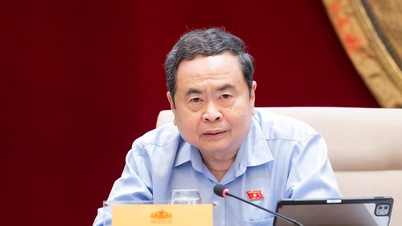
![[Photo] National Assembly Chairman Tran Thanh Man working with the Standing Committee of the Law and Justice Committee](https://vphoto.vietnam.vn/thumb/1200x675/vietnam/resource/IMAGE/2026/05/21/1779378929214_ndo_br_1-4610-jpg.webp)




































































Comment (0)