

Nipah virus outbreak recurs in India, with 6 cases and 2 deaths.
According to Dr. Nguyen Minh Tien, Deputy Director of the Children's Hospital of Ho Chi Minh City, Nipah virus is a zoonotic infectious virus. Malaysia and Singapore were the first two countries to record outbreaks of Nipah virus in 1998-1999 in humans and pigs. This was followed by outbreaks in Bangladesh and West Bengal (India) in 2001, the Philippines in 2014, Kerala (India) in 2018, and the current resurgence.
Over the past week, a Nipah virus outbreak in the southern Indian state of Kerala has resulted in six confirmed cases, including two deaths and one patient, a 9-year-old boy, requiring a ventilator. More than 700 people, including healthcare workers, have been tested. Consequently, the Indian state authorities have taken emergency steps to curb the spread of the Nipah virus, such as closing some schools, offices, and public transport networks.
Rapid rate of spread
According to Dr. Tien, based on epidemiological history, the disease caused encephalitis symptoms in pig farmers in Nipah village, Malaysia, hence the virus's name. Initially, Malaysian health authorities mistook it for Japanese encephalitis; however, epidemiological records among those infected showed that many had been vaccinated against Japanese encephalitis. Furthermore, the disease exhibited some symptoms unlike Japanese encephalitis, often affecting adults and forming clusters of cases in the same household or farm, leading authorities to suspect a different virus transmitted from pigs.
Based on urine isolation results, antibodies against Nipal virus were found in bat species in Bangladesh, the east coast of Malaysia, and other regions.
This antibody was subsequently found in the blood of 23 species of bats living in Yunnan and Hainan Island (China), Cambodia, Thailand, Indonesia, Madagascar, and Ghana in West Africa.
"Nipah virus belongs to the Paramyxoviridae family, similar to Henipavirus, and has an RNA nucleus, therefore it spreads faster than viruses with a DNA nucleus," Dr. Tien shared.
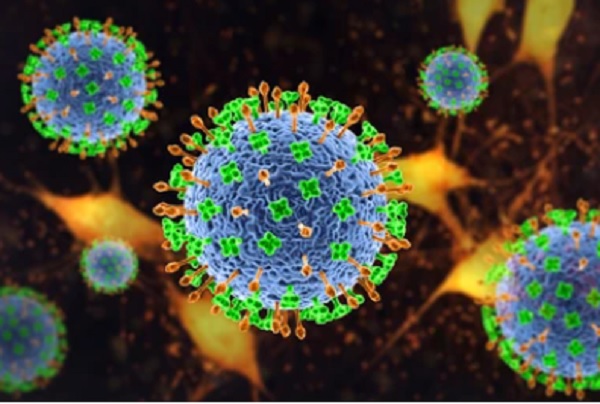
Nipah virus belongs to the Paramyxoviridae family.
The incubation period ranges from 7 to 40 days, with a mortality rate of 40-70%.
Nipah virus can be transmitted through three routes: directly from bats to humans, or indirectly through bat food, from bats to other animals and then to humans, or from infected people to people through urine, saliva, nasopharyngeal secretions, droplets, or directly or indirectly through contact during care, contaminated objects, etc.
People infected with the Nipah virus primarily exhibit symptoms affecting the nervous and respiratory systems. Some patients are asymptomatic. The incubation period ranges from 7 to 40 days, making it easy to miss cases during surveillance.
"The initial symptoms usually include sudden fever, headache, muscle pain, nausea, vomiting, neurological signs such as stiff neck, photophobia, cough, shortness of breath, chest pain, and lung damage on X-ray. In addition, infected individuals may experience heart damage and changes in myocardial contractility. Approximately 60% experience rapid deterioration, falling into a coma within 5-7 days, and generalized seizures occur in 20% of patients," Dr. Tien shared.
Symptoms indicating worsening condition include muscle tremors in the upper limbs, neck, and diaphragm; cerebellar dysfunction (ataxia, unsteadiness, limb tremor, loss of reflexes, brainstem damage, constricted pupils unresponsive to light, abnormal doll-eye reflex), tachycardia, hypertension, etc.
Some cases initially present with no or mild symptoms, followed by delayed neurological manifestations such as fever, headache, and seizures. Magnetic resonance imaging (MRI) reveals scattered plaque-like lesions throughout the brain, and patients experience prolonged fatigue and sleep disturbances.
Patients infected with the Nipah virus will have bone marrow samples taken for PCR testing to identify the causative agent, and biochemical tests will reveal increased cell count (mostly lymphocytes), increased protein levels, etc.
According to Dr. Vo Thi Huynh Nga, Head of the General Internal Medicine Department at Nam Saigon International General Hospital, the main host carrying the pathogen is a species of fruit bat. The virus from this bat species is then transmitted to other animals such as dogs, cats, pigs, and goats. When we come into direct contact with or consume food contaminated with the bodily fluids of infected animals, there is a high probability of becoming infected with the Nipah virus. Furthermore, the disease can also be transmitted from person to person.
The disease is easily confused with other illnesses due to its atypical symptoms such as sore throat, cough, fever, shortness of breath, headache, and vomiting. In severe cases, patients will experience serious symptoms such as altered consciousness, seizures, coma, respiratory failure, encephalitis, and may die within 24-48 hours.
According to the World Health Organization (WHO), the mortality rate from NiV is 40-75%. This rate can vary depending on the outbreak and the local epidemiological surveillance and clinical management capabilities. Mortality rates recorded in Malaysia are 30-40%, in Bangladesh 70%, and in Kerala in 2018 reached 90%, meaning only 2 out of 23 cases survived.
Currently, there is no vaccine or specific treatment for Nipah virus disease. Therefore, monitoring and preventing the spread of the disease plays a crucial role.
Strengthening surveillance of incoming travelers.
According to the Ho Chi Minh City Center for Disease Control (HCDC), Nipah virus disease has not been recorded in Vietnam. Currently, the Ho Chi Minh City health sector continues to monitor cases returning from affected areas. The health sector is conducting 24/7 monitoring of people entering the country at international border gates (Tan Son Nhat International Airport and Ho Chi Minh City Seaport) to detect early cases of fever or suspected symptoms of dangerous infectious diseases, so that they can be isolated and treated promptly at the border, including increased monitoring of people entering from areas experiencing outbreaks.
HCDC also advises passengers returning from epidemic areas that if they experience suspected symptoms such as fever, headache for 3-14 days along with respiratory signs (cough, sore throat and shortness of breath), they should immediately contact a medical facility for timely advice and treatment.
Source link
![[Live] 2025 Community Action Awards Gala](/_next/image?url=https%3A%2F%2Fvphoto.vietnam.vn%2Fthumb%2F1200x675%2Fvietnam%2Fresource%2FIMAGE%2F2025%2F12%2F16%2F1765899631650_ndo_tr_z7334013144784-9f9fe10a6d63584c85aff40f2957c250-jpg.webp&w=3840&q=75)
![[Photo] Prime Minister Pham Minh Chinh receives Lao Minister of Education and Sports Thongsalith Mangnormek](/_next/image?url=https%3A%2F%2Fvphoto.vietnam.vn%2Fthumb%2F1200x675%2Fvietnam%2Fresource%2FIMAGE%2F2025%2F12%2F16%2F1765876834721_dsc-7519-jpg.webp&w=3840&q=75)
![[Image] Leaked images ahead of the 2025 Community Action Awards gala.](/_next/image?url=https%3A%2F%2Fvphoto.vietnam.vn%2Fthumb%2F1200x675%2Fvietnam%2Fresource%2FIMAGE%2F2025%2F12%2F16%2F1765882828720_ndo_br_thiet-ke-chua-co-ten-45-png.webp&w=3840&q=75)
![[Photo] Prime Minister Pham Minh Chinh receives the Governor of Tochigi Province (Japan)](/_next/image?url=https%3A%2F%2Fvphoto.vietnam.vn%2Fthumb%2F1200x675%2Fvietnam%2Fresource%2FIMAGE%2F2025%2F12%2F16%2F1765892133176_dsc-8082-6425-jpg.webp&w=3840&q=75)

























































![[Photo] Prime Minister Pham Minh Chinh attends the Vietnam Economic Forum 2025](https://vphoto.vietnam.vn/thumb/402x226/vietnam/resource/IMAGE/2025/12/16/1765893035503_ndo_br_dsc-8043-jpg.webp)





































Comment (0)