

THE PLACE WHERE THE PEOPLE ONCE "SHOUTED OUT THE VOICE OF THE PEOPLE"
Tiếng Dân was a large-format Vietnamese-language newspaper, the first independent mouthpiece in Annam (Central Vietnam), founded and edited by Mr. Huỳnh Thúc Kháng (1876 - 1947).
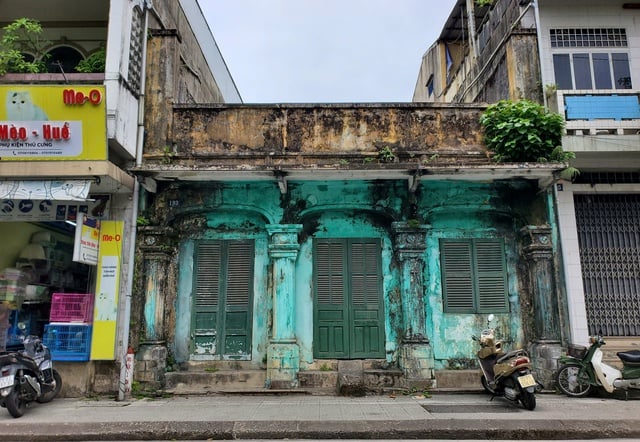
The headquarters of the Tiếng Dân newspaper in Hue, after being recognized as a provincial-level historical site, remains "closed and locked" due to deterioration.
PHOTO: BUI NGOC LONG
According to the book "Huynh Thuc Khang Chronology" (Culture and Information Publishing House - 2000), translated by Anh Minh, in 1926 the French government advocated reforming the Council of Representatives into People's Representatives (Assembly of Representatives) and arranging limited general elections. Mr. Huynh Thuc Khang applied to run for election in the Tam Ky district and became the President of the Assembly of Representatives of Central Vietnam.
After becoming the director, on October 8, 1926, Mr. Huynh submitted a petition to the Governor-General of Indochina, P. Pasquier, requesting permission to publish a newspaper in the Vietnamese Quốc ngữ script , Tiếng Dân (The Voice of the People) , based in Da Nang , to disseminate patriotic and moderate reformist ideas. According to the publication plan, Tiếng Dân would be published twice a week (Wednesday and Saturday), with the ideal of serving the national interest, helping the government understand the aspirations of the people; and supporting moral, intellectual, political , and economic education. Nearly five months later, on February 12, 1927, Governor-General Pasquier finally signed the decision allowing the establishment of the newspaper, but with its headquarters located in Hue.
At this time, Mr. Huynh Thuc Khang assigned Mr. Tran Dinh Phien the task of going to Hue to find and buy a house to serve as both the headquarters and the printing press for the newspaper. After a period of searching, Mr. Phien rented a house at 123 Dong Ba Street, Hang Be Street (now 193 Huynh Thuc Khang Street). Under Mr. Huynh's direction, the printing house and editorial office of the Tieng Dan newspaper quickly took shape.
On August 10, 1927, Tiếng Dân (The People's Voice) published its first issue. From then on, Mr. Huỳnh Thúc Kháng, a prominent intellectual from Quảng province, became a famous figure in Huế, serving as both the President of the Central Annam People's Representative Assembly (1926-1928) and the manager of the Huỳnh Thúc Kháng Printing Company, as well as the editor-in-chief of a major newspaper. Tiếng Dân existed for 16 years (1927-1943), publishing 1,766 issues, before being shut down by the French colonial government on April 24, 1943. Commenting on Tiếng Dân at the National Cultural Conference in July 1948 in the Việt Bắc war zone, General Secretary Trường Chinh assessed it as "Shouting the voice of the people in the imperial city of Huế."
" MUSEUM OF JOURNALISM"
Thanks to his role as a member of parliament, Mr. Huynh Thuc Khang's revolutionary struggle for the country and its people played a crucial role in the formation of the Tieng Dan newspaper, which holds significant historical and cultural value in Hue - Central Vietnam in the early 20th century. On June 4, 2018, the People's Committee of Thua Thien-Hue province (now the People's Committee of Hue City) classified the Tieng Dan newspaper's editorial office as a provincial-level historical relic.
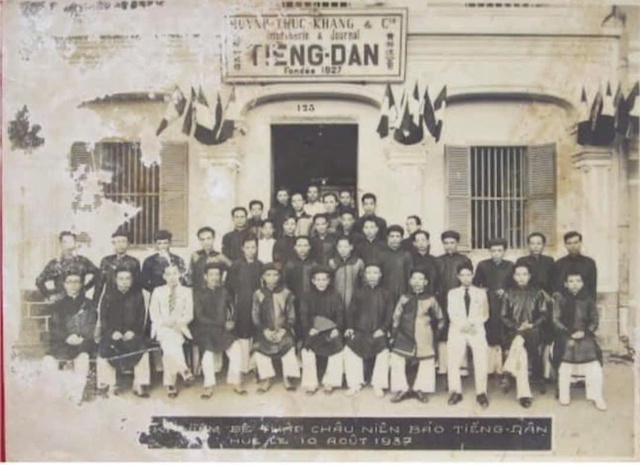
The headquarters of the Tiếng Dân newspaper, founded by Mr. Huỳnh Thúc Kháng.
PHOTO: TL
Mr. Nguyen Duc Loc, Director of the Hue City History Museum, said that the headquarters of the Tieng Dan newspaper was originally a rented building used as an editorial and printing office, which was dissolved in 1946. Afterward, Mr. Huynh allowed the Quang Nam Provincial Council to use it as a dormitory for Quang Nam students studying in Hue. After 1975, this building was allocated to some staff of Hue University of Medicine (now Hue University of Medicine and Pharmacy) and became a residential complex with 6 households. Those living there renovated the building, built a staircase on Phan Dang Luu Street, and constructed some partitions to create separate living and dining rooms for each family. During the management process, the Provincial Land Development Center (now Hue City) repaired and re-roofed the houses, and repainted them.
After the site was classified as a historical monument, in 2021, the Thua Thien-Hue Provincial History Museum (now Hue City Museum) submitted a proposal for approval of the investment plan to restore and renovate the site, in accordance with the directives of the Provincial People's Committee. "However, to date, the project has not been allocated funding for implementation. Currently, the site is in a state of serious deterioration. The deterioration and safety issues of the site have been inspected by the Inspection Sub-Department (Department of Construction) and reported to the museum. To ensure the safety of residents and tourists, the site is currently closed," Mr. Loc said.
Journalist Duong Phuoc Thu, former Standing Vice Chairman of the Thua Thien-Hue Provincial Journalists Association, believes that with its special historical value, the Tieng Dan newspaper headquarters should be preserved and developed into a journalism museum. "With a budget of around 2 billion VND to renovate the building and turn it into a museum, it's not difficult for Hue City. In my opinion, if the leaders of Hue City pay attention, the establishment of this museum is entirely possible, because currently, sources of information about Mr. Huynh Thuc Khang and the Tieng Dan newspaper are not difficult to find," Mr. Thu said.
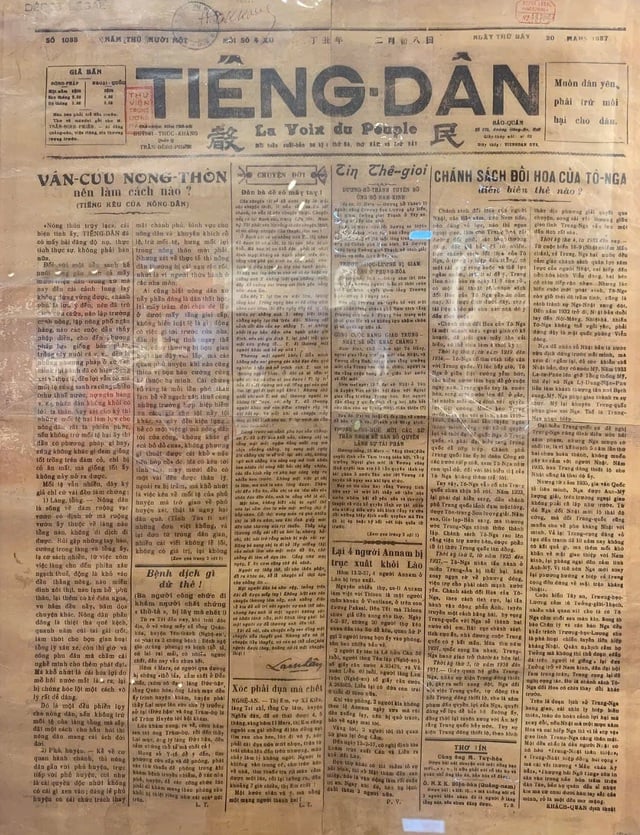
The newspaper Tiếng Dân, issue 1,086
PHOTO: TL
According to Mr. Thu, if invested in, this place could restore the exhibition space for the Tiếng Dân newspaper's editorial office, displaying images, documents, and publications of Tiếng Dân , as well as works published by the Huỳnh Thúc Kháng printing house… With 16 years of existence and 1,766 issues published, Tiếng Dân newspaper is a historical journalistic value of Hue that is not found everywhere. "If Hue can establish this museum, it will become a cultural and historical journalistic landmark worthy of a region with a rich history of Vietnamese journalism in general and the ancient capital of Hue in particular," Mr. Thu suggested.
The doctoral stele at the Temple of Literature (also known as the Hue Temple of Literature) records that Mr. Huynh Thuc Khang was born in the year of the Rat (1876), passed the third-class doctoral examination in the year of the Dragon (1904) at the age of 29, on the same list as his fellow countryman Tran Quy Cap from Quang Nam. According to Dr. Tran Dinh Hang, Director of the Central Vietnam Branch of the Institute of Culture, Arts, Sports and Tourism, although he passed the examination, Mr. Huynh did not enter official service, but stayed at home to focus on reading, supporting the learning of the Vietnamese Quốc ngữ script and participating in the Duy Tan movement. He was arrested and sentenced to death in 1908, but his sentence was commuted and he was exiled to Con Dao Island. In 1921, he was released and continued his activities in the patriotic movement. In 1926, he was elected a representative and became the President of the Central Vietnam People's Assembly. After the August Revolution, Mr. Huynh was invited to serve as Minister of the Interior; when President Ho Chi Minh went to France for negotiations, Mr. Huynh assumed the role of Acting President.
Source: https://thanhnien.vn/bao-ton-hinh-hai-tieng-thet-giua-kinh-thanh-185250616211344091.htm


![[Image] Nearly 125,000 Hanoi students completed the Literature exam for the 10th grade entrance exam.](https://vphoto.vietnam.vn/thumb/1200x675/vietnam/resource/IMAGE/2026/05/30/1780117233041_ndo_br_thiet-ke-chua-co-ten-2-png.webp)

















![[Photo] Admire the coral "masterpiece" amidst the million-year-old heritage of Dak Lak province.](https://vphoto.vietnam.vn/thumb/1200x675/vietnam/resource/IMAGE/2026/05/30/1780107638639_y25-jpg.webp)




























































Comment (0)