

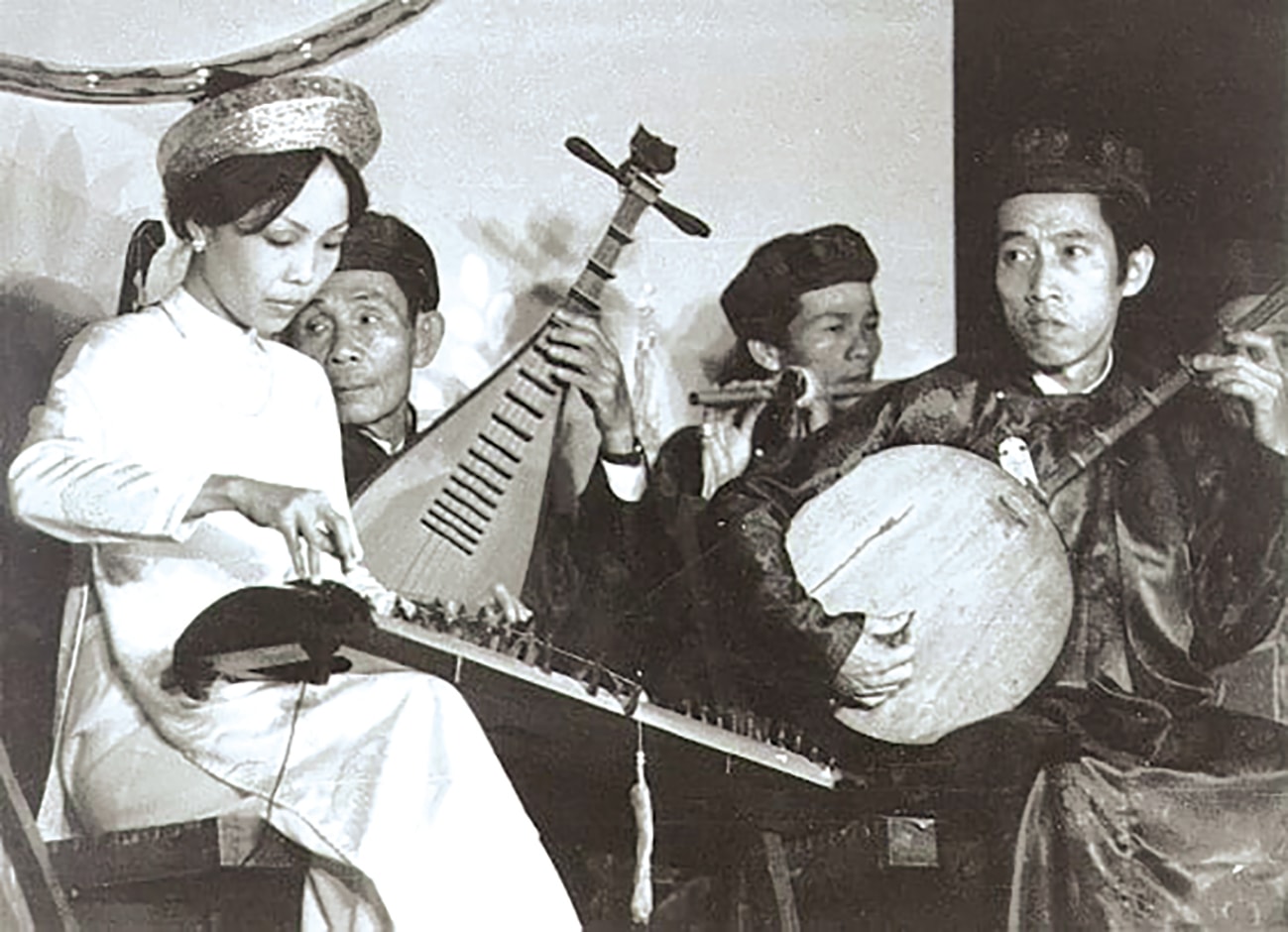
Actually, it should be called Hue music, because this art form encompasses both singing and music. It is a system comprising more than 60 vocal and instrumental works, belonging to two groups: Northern styles and Southern styles.
Following the course of history
Belonging to the Northern style (also known as the Guest style) are musical pieces with cheerful, graceful melodies and fast rhythms, such as Phu Luc, Co Ban, Long Ngam, Long Diep, Luu Thuy, and 10 interconnected pieces: Pham Tuyet, Nguyen Tieu, Ho Quang, Lien Hoan, Binh Ban, Tay Mai, Kim Tien, Xuan Phong, Long Ho, and Tau Ma.
The Nam style includes melancholic melodies with expansive, profound, and lyrical qualities, such as Hành vân, Nam ai, Nam bình, Nam xuân, Quả phụ, Tương tư khúc, Tứ đại cảnh… In addition, there are some slightly modified pieces, meaning the lyrics are modified differently from the usual melody, such as Cổ bản dựng, Nam bình dựng…
No one knows exactly when Hue folk songs originated, but during the reign of Emperor Tu Duc (1848-1883), at least 25 musical pieces circulated in Hue, including 10 with lyrics (9 written in Chinese characters, 1 written in Nom script).
The lyrics in Hue folk songs are very intellectual and scholarly; the language is perfectly refined. This is because Hue folk songs are a type of chamber music for the aristocratic class. They were kings, officials, and scholars with poetic talent and profound learning, so they composed concise and refined lyrics.
Famous poets of the time, such as King Thieu Tri, King Tu Duc, Tung Thien Vuong, Tuy Ly Vuong, and princesses Trong Khanh, Thuc Khanh, and Quy Khanh (daughters of King Minh Mang), all composed lyrics for Hue folk songs.
Hue boasts folk melodies such as "ho mai nhi" and "ho mai day"—slow, expansive, full of compassion and sweetness; unique and creative "ho bai thai" and "ho dua linh" melodies; and fast-paced, exhilarating "ho gia gao," "ho gia lime," and "ho gia cac" (for making Sinh paintings), along with romantic, nostalgic, and sentimental "ly con sao," "ly hoai xuan," "ly hoai nam," and "ly tinh tang" melodies.
Besides this folk music genre, Hue also has a dignified and elegant court music genre. This is Nha Nhac - the ceremonial music of the Nguyen dynasty - majestic and rich, encompassing ceremonial music, temple music, five-character music, grand court music, regular court music, banquet music, sacrificial music, and palace music...
Hue folk music lies somewhere between those two genres. It is neither a version of folk music nor a variant of court music. Hue folk music has its own unique characteristics and spirit, a kind of elegant chamber music, which later spread to the Southern region, developing into Southern amateur music, the precursor to Cai Luong (reformed opera).
The qualities of Hue folk songs
Hue folk songs possess a lyrical and profound quality; a sweet and charming quality that stirs the heart; a sense of sadness and regret; and a bright and joyful quality. The lyrics are insightful, and the rhythm is calm and unhurried, reflecting the rhythm of life of the people of Hue.
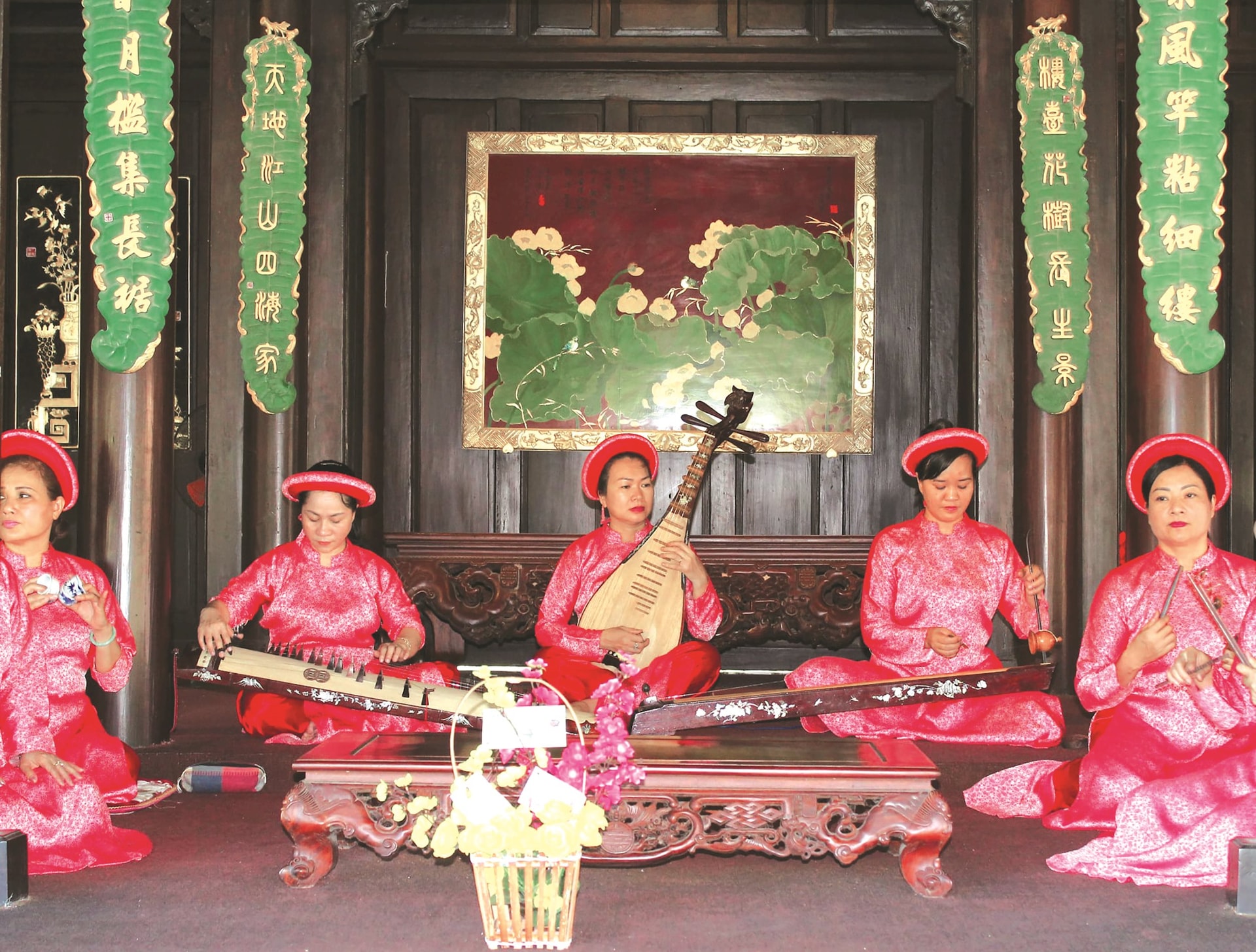
Hue folk singing is not a ostentatious or boisterous form of entertainment. It has a selective audience. A Hue folk singing performance can be held in an elegant, charming auditorium with a band of 5-6 musicians and 4-5 singers, and 5-7 listeners. There are flowers, wine, potted plants, fish tanks, and hearts filled with deep affection for the songs and melodies of the people of Hue.
But the most interesting and captivating experience is listening to Hue folk songs on a moonlit night on the Perfume River. Drifting gently on the vast expanse of water in a beautiful setting, the listener's soul, the singer's voice, the sounds of the zither and flute, and the rhythm of the musicians seem to blend together and soar.
To begin a Hue folk music night, musicians and singers usually perform lively and cheerful Northern-style melodies. This is followed by more solemn and dignified pieces such as Long Ngam and Tu Dai Canh. As the night deepens and the atmosphere becomes quieter and more serene, mournful and evocative Southern melodies like Nam Ai, Nam Binh, Qua Phu, and Tuong Tu Khuc rise up amidst the vast, moonlit night sky.
The Hue folk music orchestra consists of the zither, pipa, moon lute, two-stringed fiddle, and three-stringed lute (known as the five masterpieces). In addition, there is the gourd lute, flute, and a pair of castanets for rhythm. In Hue folk music, musicians pay great attention to exploiting the capabilities of the instruments and elevating them to a high level of skill. Even with the same instrument, there are many different playing techniques that require the musicians to practice diligently and refine their skills.
All of these elements blend together with the flute, clapper, and drum, enriching the expressive power of the lyrics. The sound of the stringed instrument, sometimes slow, sometimes fast, with quarter and eighth notes floating on the familiar pentatonic scale, creates unique rhythms in Hue folk songs, immersing listeners in the music and their own dreams.
Along with the exquisite skill of the musicians comes the richness of the lyrical expression. Depending on their feelings and inspiration, singers use various vocal embellishments to convey emotions through rhythm and melody. Rhythms include regular, arranged, erect, fast, and slow. Melodies include erect, spring, sorrow, lament, reversal, and meditation, each expressing a different emotional nuance, style, and musical scene.
Previously, Hue folk singing was a form of chamber music performance, presented by groups of artists and friends. Today, Hue folk singing has become a widely disseminated performing art, recognized as an intangible cultural heritage of Hue, a "spiritual specialty" that tourists love and choose to enjoy when visiting the land of the Perfume River and Ngu Mountain. Thanks to this, Hue folk singing has earned its rightful place in community performances in this region, which is honored as a "heritage land" of Vietnam and the world .
Source: https://baoquangnam.vn/ca-hue-am-nhac-chon-kinh-ky-3154019.html


































































Comment (0)