

This European Union law, which came into effect on March 7th, requires tech giants to take measures to make it easier for users to switch to other companies' products and services, such as social networks, internet browsers, and app stores, while also protecting users' personal data.
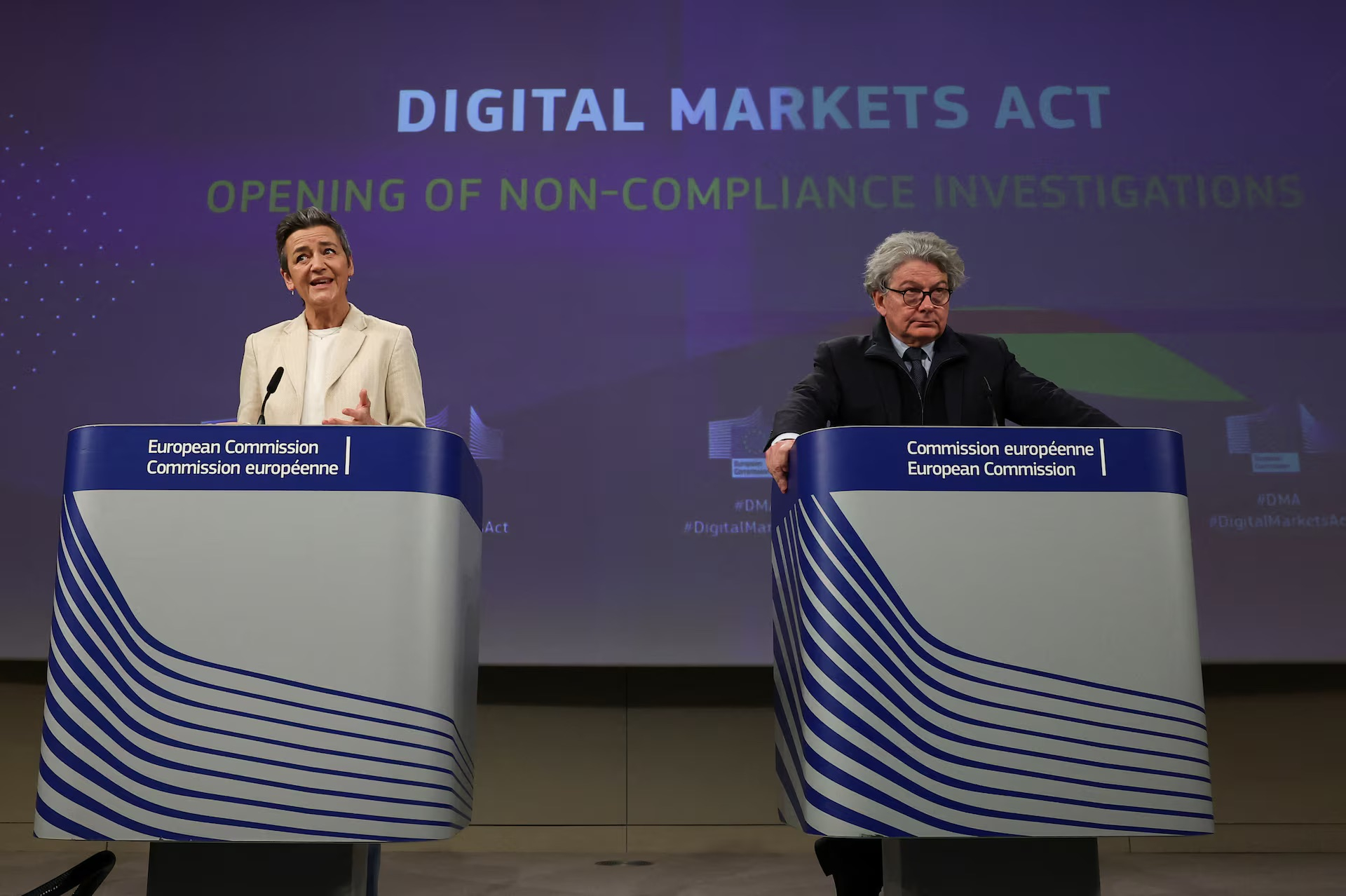
EU antitrust chief Margrethe Vestager and European Commissioner for the Internal Market Thierry Breton hold a press conference in Brussels, Belgium on March 25, 2024. Photo: REUTERS
Violations may result in fines of up to 10% of the company's global annual revenue.
Although somewhat unclear, the DMA's regulations aim to establish a "fairer" and "more competitive" digital market by breaking down closed technology ecosystems that tie consumers to the products or services of a single company.
Six major technology companies, known as the "gatekeepers"—Alphabet, Apple, Meta, Microsoft, Amazon, and ByteDance—have said they have deployed thousands of engineers to meet the requirements of the Digital Markets Act.
But the European Commission said on Monday it doubted that the measures taken were effective enough to comply with the DMA.
Therefore, the investigation aims to assess whether tech giants are complying with DMA regulations that require tech companies to allow app developers to direct users to software or applications available outside of their app store platforms.
Google's chief competition officer, Oliver Bethell, said the company has made significant changes to how it operates its digital services in Europe and will continue to defend its approach in the future.
Apple, however, stated that the company is fully compliant with the new law. "We are confident in our plan to comply with the DMA and will continue to cooperate constructively with the European Commission as they investigate," said Julien Trosdorf, an Apple spokesperson.
Meanwhile, Meta spokesperson Matt Pollard asserted that the subscription model, replacing advertising, is a long-standing business model in many different industries. "We will continue to work constructively with the Commission," he said.
The EU's executive body aims to conclude the investigations within one year, the timeframe stipulated in the DMA.
The EU investigations come amid growing criticism from app developers and business users about shortcomings in the compliance efforts of major tech companies.
Mai Anh (according to Reuters)
Source





![[Photo] General Secretary and President To Lam receives Amazon's Senior Vice President David Zapolsky](https://vphoto.vietnam.vn/thumb/1200x675/vietnam/resource/IMAGE/2026/05/22/1779466547770_a1-bnd-3513-6601-jpg.webp)


































































































Comment (0)