

After more than six years of implementing the Law on Prevention and Combat of Corruption, significant progress has been made in the fight against corruption. Corruption has been curbed and gradually prevented. The detection and handling of corruption cases have been directed and implemented systematically, synchronously, decisively, and effectively, creating a breakthrough in the fight against corruption.
Besides the achievements, the Inspector General of the Government noted that some of the Party's guidelines and policies on preventing and combating corruption have not been promptly institutionalized into law. The legal mechanisms and policies are still inconsistent and do not thoroughly address the practical issues. Some legal provisions have not kept pace with social development and have been exploited by individuals to commit acts of corruption, conceal, transform, and transfer corrupt assets, hindering the detection, handling, and recovery of corrupt assets.
Furthermore, regulations on asset and income declaration are incomplete, and regulations on asset and income control are subject to various interpretations and inconsistent implementation, leading to confusion and numerous obstacles, resulting in low effectiveness. Inspection, supervision, auditing, investigation, prosecution, and trial of corruption in some areas and localities have not been highly effective; the handling of some corruption cases has been untimely and not sufficiently rigorous, and the recovery of assets obtained through corruption remains limited. This reality necessitates amendments to the Law on Prevention and Combat of Corruption to improve the mechanism for preventing, detecting, and promptly addressing acts of corruption.
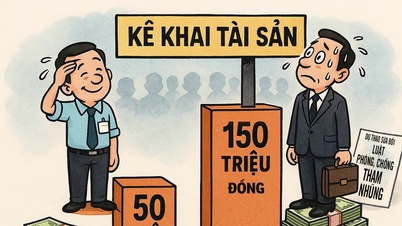
To improve the effectiveness of prevention work in line with current practical conditions, this draft Law also raises the value of assets that must be declared, including precious metals, gemstones, money, valuable papers, and other assets where each type of asset has a value of 150 million VND or more, whereas according to the current Law, assets with a value of 50 million VND or more are already required to be declared.
Furthermore, the draft Law also stipulates that asset and income control agencies have the right to request individuals obligated to declare assets and income to provide or supplement relevant information and explanations when there is an increase of 400 million VND or more during the year to facilitate asset verification (whereas the current Law stipulates only 300 million VND). This new regulation aims to ensure consistency and uniformity with other legal documents on anti-money laundering, including the 2022 Law on Anti-Money Laundering.
The asset and income control agency monitors changes in the assets and income of those obligated to declare them through analysis and evaluation of information from declarations or other sources. If a change in assets or income of 400 million VND or more is detected during the year and the person obligated to declare has failed to declare it, the declaration management agency will request the declarant to provide or supplement relevant information; if there is a change in assets, the declarant must explain the origin of the assets and income.
For individuals who make dishonest declarations or explanations regarding the origin of their assets and income, the draft Law stipulates that, depending on the nature and severity of the violation, they will be subject to disciplinary action. This amendment aims to ensure compliance with the provisions of the Law on Cadres and Civil Servants of 2025 and Decree 172/2015/ND-CP on the handling of cadres and civil servants (adding the disciplinary measure of reprimand, removing the disciplinary measures of demotion and salary reduction).
Increasing the threshold for declaring fluctuating assets and income is necessary, but many argue that the proposed threshold of 400 million VND for annual fluctuating assets and income is too low and inappropriate given current prices and socio- economic conditions. Some also argue that basing it on anti-money laundering regulations is unsuitable, as this is only a single transaction requiring monitoring (a suspicious transaction). A person could conduct multiple transactions of 400 million VND or more within a year. Perhaps the draft law should stipulate a threshold of 1 billion VND or more for fluctuating assets and income within a year to better reflect current realities.
Improving the mechanism for preventing corruption is an urgent requirement to enhance the effectiveness of anti-corruption efforts. Therefore, the drafting agency needs to carefully consider and create a robust legal framework to prevent dishonest declarations and explanations of assets and income. Doing this well will prevent corrupt acts early on.
Source: https://daibieunhandan.vn/co-che-nao-phong-ngua-tham-nhung-10387327.html




![[Photo] General Secretary and President To Lam presides over the meeting to approve the draft report on the results of the second inspection by the Politburo of the Standing Committee of the Hanoi City Party Committee.](https://vphoto.vietnam.vn/thumb/1200x675/vietnam/resource/IMAGE/2026/05/26/1779789811432_a2-bnd-4430-9620-jpg.webp)





















































































Comment (0)