


 |
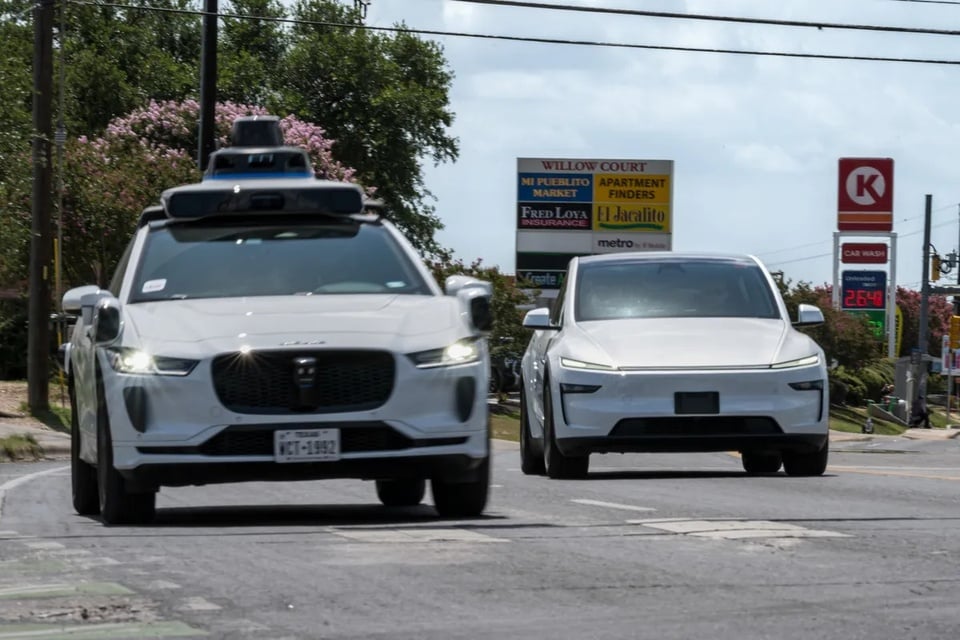
Tesla's electric vehicles compete with rival Waymo. Photo: Bloomberg . |
At a time when Tesla is clearly declining, the launch of self-driving cars is a positive sign that can revive public interest. The event of some Model Y cars beginning to carry passengers for a fee on June 22nd in Texas is a memorable milestone for the company.
The potential of the self-driving car market is enormous, driving Tesla's stock price higher. Many investors expect that in the coming years, Tesla will become a leader in this field. But with last week's launch of its robotaxi, the company revealed several minor flaws, contrary to Elon Musk's marketing claims.
Potential comes with risk.
The launch of such an advanced model has the potential to become a burden. According to Bloomberg's observations, these self-driving vehicles are characterized by clear limitations, such as operating only in confined areas, serving private guests, and each vehicle requiring a safety supervisor inside.
Meanwhile, Tesla promotes its vehicles as being equipped with the hardware to become robotaxis, and its self-driving software, trained by test users, can handle almost any situation. However, the widespread promise of robotaxis, coupled with only a few vehicles carrying passengers, doesn't inspire confidence in Tesla.
Furthermore, the tech giant is suspected of overhyping expectations for its robotaxi, while in reality, there are very few and many limitations. According to Bloomberg , Tesla's core electric vehicle business accounts for 75% of its gross profit, but sales are declining. In reality, its value could only be estimated at around $50 per share, or only 15% of its current value.
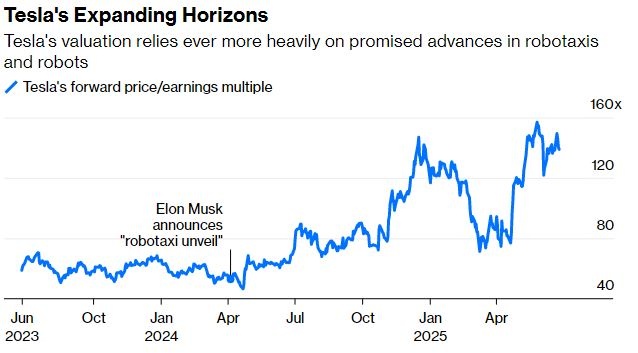 |
Fluctuations in Tesla's projected P/E valuation ratio. Photo: Bloomberg. |
The majority of the remainder (85%) comes from belief in the future of robotaxi and self-driving software. RBC Capital Securities estimates that 59% of Tesla's stock price ( $181 ) comes from robotaxi expectations, with an additional $53 from monetization of self-driving software.
In total, the stock is valued at $815 billion , based on double-digit profit multipliers, but applied to hypothetical revenue, not actual profits. This figure is only achievable in 10 to 15 years, as these are currently still nearly unprofitable business segments.
Over the past two years, Tesla's electric vehicle segment has stagnated. The promised affordable models remain uncertain, and profits have declined. However, since Elon Musk's aggressive shift toward robotaxis and robotics in early 2024, Tesla's valuation has doubled.
Valuation ratios reflect investor confidence. With a global market of 2 billion personal vehicles, the potential for robotaxis is enormous. While it's unclear exactly when, many believe Elon Musk and Tesla will be the leaders.
The trust problem for Renault
For now, that belief doesn't quite match reality. After initially ridiculing Waymo, Alphabet's self-driving car rival, for its cautious, city-by-city approach, Tesla began deploying its service in a similar manner.
To date, only one incident related to Tesla robotaxis safety has been reported on the city of Austin's online portal. However, federal authorities have begun investigating several instances of Tesla robotaxis allegedly violating traffic laws, as captured on video .
According to Bloomberg , the launch of the robotaxi means Tesla has begun its time trial. The key issue lies in expanding the vehicle line and proving the soundness of this strategy. A projected valuation of $800 billion leaves little room for such initial setbacks.
For example, one of Tesla's arguably biggest advantages is its "less-sensor" approach, eliminating systems like LiDAR, which makes its robotaxi cheaper than Waymo's heavily technology-packed vehicles. However, this competitor can pass on that expensive cost across the more than 250,000 rides per week it provides. Meanwhile, other competitors, such as Amazon's Zoox, are also consolidating their market position.
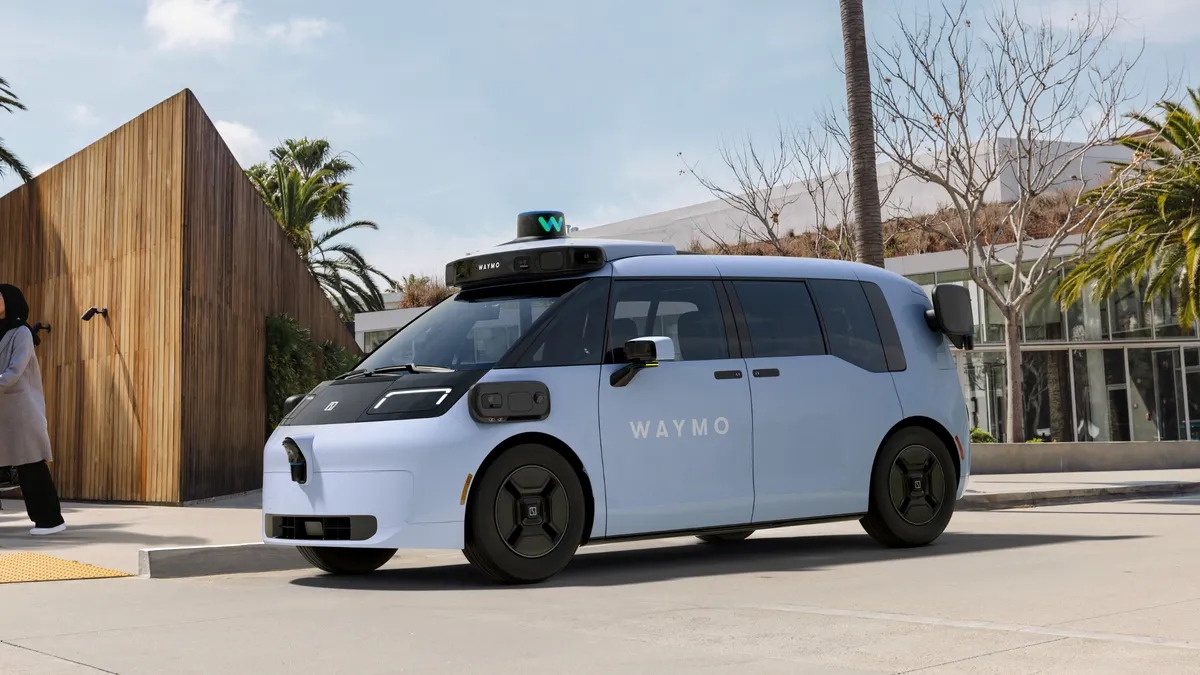 |
Waymo has just reached an agreement to supply self-driving software to Toyota. Photo: Waymo. |
With such a new and volatile market, the final outcome can be very difficult to predict. A recent analysis report from Goldman Sachs, simulating various scales and profit margins for Tesla's hypothetical robotaxi fleets in 2040, projected a range of valuations from $2.50 to $81.75 per share.
Previously, Elon Musk asserted that all Tesla vehicles sold since 2016 already had the necessary hardware and only required a software update to become robotaxies in the future. However, Business Insider reports that the company is adding new hardware to vehicles intended for robotaxies, such as sound sensors, camera protection, and a second telecommunications device.
In the race to license robotaxi technology to other automakers, Waymo is leading the way, having recently reached a preliminary cooperation agreement with Toyota Motor. Shares of Mobileye Global, a company that provides driver assistance and autonomous driving technology to many automakers, have also risen 25% this week.
A year from now, users might be surprised by Tesla's pace of progress, but with what has just been released, Tesla hasn't yet lived up to those expectations. Most importantly, Elon Musk's company now has no room for delay.
Source: https://znews.vn/con-dao-hai-luoi-voi-tesla-post1564393.html












































































Comment (0)