

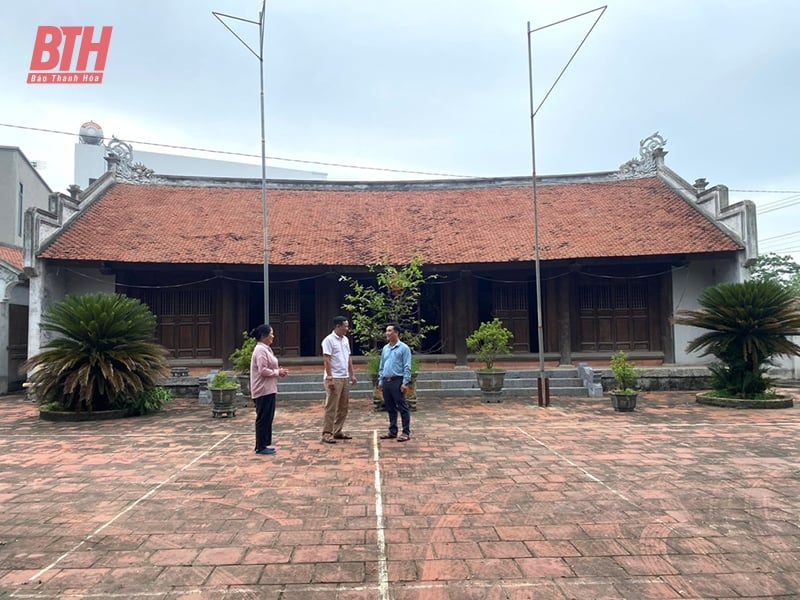
The remains of the Là Thôn village communal house in Định Long district. Photo: Khánh Lộc
The ancient land of Định Long belonged to Quân An district. During the Nguyễn dynasty, it was part of Đa Lộc commune, and from 1953 onwards it was named Định Long. Located on the right bank of the Mã River – not far southwest of Định Long, at Nuông Mountain and Quân Yên Mountain (also known as Quan Yên), archaeologists have discovered many artifacts from the early Paleolithic period.
“In the Yên Định region, on the right bank of the Mã River, there are the oldest traces of prehistoric people from the dawn of human history. During the Bronze Age and the Đông Sơn culture, equivalent to the period when the Hùng Kings founded the nation, the Yên Định region was explored and expanded by humans... gradually conquering the plains. From then until the first centuries AD, many settlements were formed in Yên Định, these were ancient villages with names like “Kẻ” such as Kẻ Đanh, Kẻ Lào; Kẻ Hổ; Kẻ Dền; Kẻ Bộc... Kẻ Lở (now in Định Long)... These are ancient Vietnamese villages formed from prehistoric tribes.”
Based on the historical evidence, the people of Định Long believe that about 2,000 years ago, the first inhabitants came to live in Kẻ Lở. Later, generations of people in Kẻ Lở worked together to build their villages. Today, Định Long has three traditional villages: Là Thôn, Tân Ngữ, and Phúc Thôn (also known as Huê Thôn village).
In the past, La Thon village was known as La Ap. In the old days, La Thon was divided into alleys and lanes, such as Cong Alley, Da Alley, Dinh Alley, etc. The Trinh, Hoang, Le, and Nguyen families were among the most numerous clans in La Thon.
Phuc Thon village is also known as Hue Thon (Hoa Thon). In the past, Phuc Thon had many large rice paddies whose names are still used today by the villagers, such as Dong Chum, Hoc Giac, Sau Chua, Bai Ca, and Dong Lang. Compared to La Thon and Tan Ngu villages, Phuc Thon has a rather unique shape: "The village's shape resembles a boat, bulging in the middle, narrowing at both ends, and higher at the stern and bow. The village has 12 roads running across it from front to back, dividing it into hamlets like the compartments of a boat."
Tan Ngu village is located in the heart of the old Ke Lo. It was known as Chan Lu hamlet, then Chan Ngu. After the August Revolution, it was renamed Tan Ngu. Like Phuc Thon, Tan Ngu also has many large fields, such as Doc Dau, Con Thuyen, and Dong Chong, formed by the alluvial deposits of the Ma River. And the old Ke Lo – present-day Dinh Long – was a prosperous rural area with fertile fields, bustling villages, and many outstanding historical figures.
Historically, Định Long is also known for its tradition of academic excellence, with many people passing the imperial examinations. Notably, in the 16th century, two brothers from the An (Yên) family, An Đôn Phác and An Đôn Lễ, both passed the doctoral examinations. According to their family genealogy, their father fled from Nghệ An during a time of turmoil and was taken in and sheltered by a family in Phúc Thôn, who also married their daughter to him. When the two brothers were born, they adopted a character from the name of Quân Yên (Yên - An) district as their surname. “The elder brother, An Don Phac, passed the doctoral examination in the year Tan Suu 1541, the first year of the Quang Hoa era of Mac Phuc Hai's reign. He served as a high-ranking official, reaching the position of Minister, and was granted the title of Ninh Khe Marquis. The younger brother, An Don Le, passed the doctoral examination in the year Nham Thin, the third year of the Dai Chinh era (1532) of Mac Dang Dung's reign. He served as a high-ranking official, reaching the position of Minister of War, and was granted the title of Marquis. He died at the age of 63 and was granted the title of Khuong Quan Duke by the court. The tombs of the two brothers are still located in the village. It is not uncommon for two brothers in one family to pass the imperial examinations, but for both brothers to serve as high-ranking officials, reaching the position of Minister, is a source of pride and honor not only for the family.”
Generations of people in Dinh Long, striving to make a living, have continuously nurtured their cultural and spiritual lives with the presence of cultural and religious structures such as communal houses, temples, shrines, and pagodas. In particular, each village has its own communal house and the custom of worshipping the village's tutelary deity. Sadly, due to various reasons, some architectural structures in Dinh Long now only remain as traces.
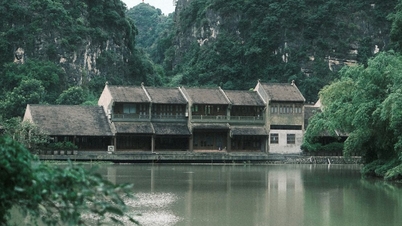
Among the remaining architectural structures in Dinh Long, the La Thon communal house is quite spacious and imposing. The communal house consists of five bays, with a "stacked beam and bracket" structure and many exquisite wood carvings. Despite numerous renovations, the La Thon communal house still retains many of its original beauty, serving as a sacred space and a highlight in the peaceful and beautiful rural landscape.
Mr. Le Van Lac, Head of La Thon village, said: "At La Thon communal house, two major festivals take place annually. The commemoration ceremony for the village's tutelary deity is held on the 13th of November (lunar calendar), and the Ky Phuc Festival takes place on the 12th and 13th of March (lunar calendar). In the past, the Ky Phuc Festival included not only solemn rituals but also traditional opera performances. The communal house is particularly notable for its large gong, which resonates throughout the region when struck, hence the folk saying: 'The gong of La Thon village / The cassia of Ai village'."
In Tan Ngu village, there used to be a rice cooking competition on the 12th day of the first lunar month. Contestants had to cook while walking, using torches. When the rice was almost cooked, they had to use banana leaves to prop up the pot. The higher they propped up the pot and the more evenly the rice cooked, the more likely they were to win. Hence the folk song: "Chieng games, Boc wrestling, Si puppetry / Ke Lo rice potting, Quan Lao rice competition."
Over time, the area of Ke Lo on the Ma River, now Dinh Long, has undergone significant development and transformation. However, alongside the vibrancy of modern life, the ancient land still preserves many traditional cultural features. The imposing village gates, the majestic communal house, the preserved customs... all blend together to create the beauty of the land and people of Dinh Long.
Khanh Loc
(This article references and uses content from the book "History of the Party Committee of Dinh Long Commune").
Source: https://baothanhhoa.vn/dat-co-ke-lo-250394.htm
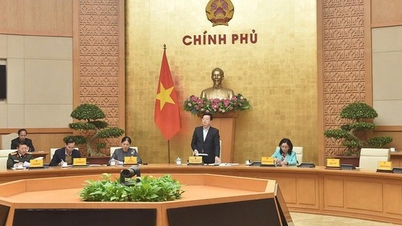
![[Photo] Prime Minister Pham Minh Chinh presides over the first meeting of the Steering Committee for the International Financial Center in Vietnam.](/_next/image?url=https%3A%2F%2Fvphoto.vietnam.vn%2Fthumb%2F1200x675%2Fvietnam%2Fresource%2FIMAGE%2F2026%2F01%2F16%2F1768578920498_ndo_br_dsc-7344-jpg.webp&w=3840&q=75)
![[Image] Political and artistic program "Forever Faithful to the Party"](/_next/image?url=https%3A%2F%2Fvphoto.vietnam.vn%2Fthumb%2F1200x675%2Fvietnam%2Fresource%2FIMAGE%2F2026%2F01%2F16%2F1768579223844_img-2191-2578-jpg.webp&w=3840&q=75)






![[Image] Ho Chi Minh City simultaneously commences construction and breaks ground on 4 key projects.](https://vphoto.vietnam.vn/thumb/340x192/vietnam/resource/IMAGE/2026/01/15/1768472922847_image.jpeg)

![[E-Magazine]: Late winter, another deep sleep...](https://vphoto.vietnam.vn/thumb/402x226/vietnam/resource/IMAGE/2026/01/16/1768567523535_e-magazine-cuoi-w1200t0-di2602d199d5165817t11920l1-cn-011.webp)
![[Photo] Tran Cam Tu, Standing Member of the Party Central Committee Secretariat, attends the launch ceremony of the Propaganda and Mass Mobilization Mobile Application.](/_next/image?url=https%3A%2F%2Fvphoto.vietnam.vn%2Fthumb%2F1200x675%2Fvietnam%2Fresource%2FIMAGE%2F2026%2F01%2F16%2F1768537813342_ndo_br_bnd-4664-jpg.webp&w=3840&q=75)






































Comment (0)