

 |
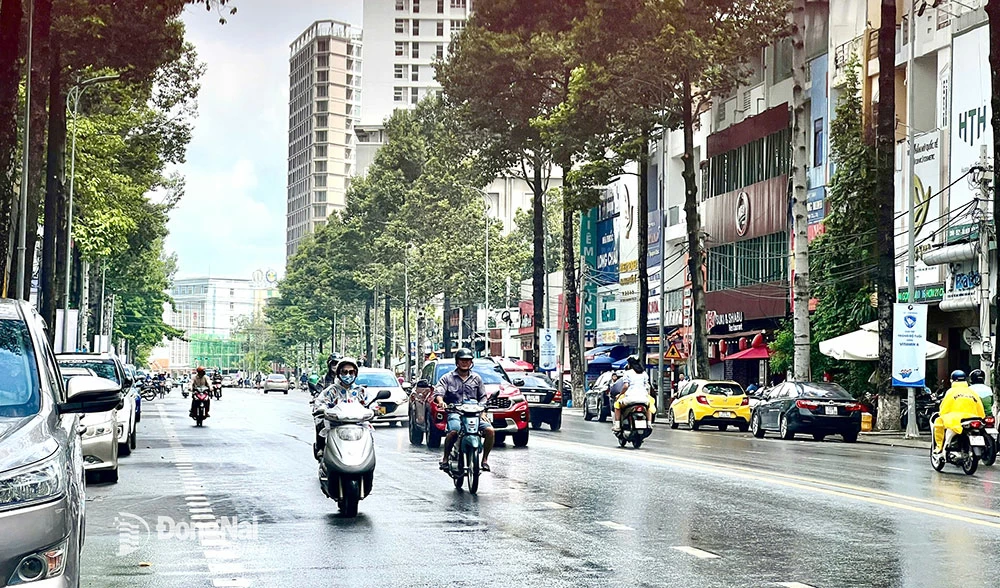
| The Dong Nai Meteorological and Hydrological Station forecasts that from June 23rd to 25th, the province will experience intermittent sunshine during the day, with heavy to very heavy rain and thunderstorms in the evening and at night. (In the photo: People traveling on Vo Thi Sau Street (Bien Hoa City) after the rain. Photo: K. Lieu) |
The peak of the flood is likely to occur in July and August.
According to Nguyen Phuoc Huy, Director of the Dong Nai Provincial Meteorological and Hydrological Station, from now until the end of 2025, thunderstorms, tornadoes, lightning, localized heavy rain, and unusually heavy rainfall are likely to continue to occur frequently in the province. The average temperature from now until the end of 2025 will be approximately to higher than the multi-year average. The total rainfall in July and August 2025 will be less than or approximately equal to the multi-year average, generally ranging from 250-350mm. In September 2025, the total monthly rainfall will be approximately to higher than the multi-year average, generally ranging from 310-400mm.
Water levels on the Dong Nai River system at Ta Lai Station are expected to gradually rise in the coming period. The highest flood peak of the year is likely to occur in July and August 2025, exceeding alarm level 2 (112.5m); at Tri An Reservoir, the lowest water level is expected to occur in July, then gradually rise, remaining lower than the multi-year average. In the lower reaches of the Dong Nai River, at Bien Hoa Station, the highest tide level is approximately at alarm level 2 (2m), occurring in September, higher than the multi-year average; the low tide level is gradually rising, remaining lower than the multi-year average.
Water levels on the La Nga river system at Phu Hiep are gradually rising. The highest flood peak of the year is likely to occur in August, reaching approximately level 2 (105.5m).
It is necessary to proactively prevent dangerous hydrological phenomena such as: rapid and sudden flooding on major rivers when there is heavy rain upstream due to the influence of storms, tropical depressions, or the release of water from upstream reservoirs. Be prepared for localized flooding in urban areas and low-lying areas; flash floods in small rivers and streams; and landslides in hilly and mountainous areas when there is heavy rain. Floods, inundation, flash floods, and landslides pose a risk to human lives and property, cause traffic congestion, and negatively impact the socio -economic situation.
More than 9 storms/tropical depressions have appeared in the South China Sea.
The Dong Nai Provincial Meteorological and Hydrological Station forecasts that from now until the end of 2025, there is a high possibility of many typhoons or tropical depressions in the East Sea affecting Vietnam and potentially making landfall. From now until September 2025, it is predicted that 5-7 typhoons or tropical depressions will occur in the East Sea affecting Vietnam, with 2-3 possibly making landfall. Along with this, thunderstorms, tornadoes, lightning, hail, and strong gusts of wind will continue to occur over a wide area. In Dong Nai, there is a possibility of continued localized heavy rainfall and unusually heavy rainfall.
From October to December 2025, there is a possibility of 4-6 typhoons or tropical depressions forming in the East Sea, of which about 2-3 will make landfall in Vietnam, indirectly affecting the weather in the province. There is also a possibility of unusually heavy rainfall in October. “Typhoons and tropical depressions operating in the East Sea usually do not directly affect the weather in the province. However, the circulation of these typhoons and tropical depressions, combined with atmospheric disturbances, can strengthen the Southwest monsoon, causing heavy rain in the province,” said Mr. Nguyen Phuoc Huy.
Forecasts indicate that water levels in the upper reaches of the Dong Nai River at the Ta Lai station will change slowly in October; gradually decreasing in November and December; and continuing to rise in Tri An reservoir. In the lower reaches of the Dong Nai River, at the Bien Hoa station, the highest tide level of the year is likely to occur in October 2025, exceeding alarm level 2 (2m), higher than the multi-year average; the low tide will tend to decrease again, lower than the multi-year average.
Water levels on the La Nga river system at Phu Hiep changed slowly in October; they gradually decreased in November and December.
From October 2025, water levels in rivers and streams will gradually decrease, but will remain high. Localized flooding in urban areas and low-lying regions during heavy rains is still a concern. Flash floods in small rivers and streams, landslides in hilly areas, and localized flooding during heavy rains can affect socio-economic activities, people's lives, and the growth of crops and livestock.
| Director of the Dong Nai Provincial Meteorological and Hydrological Station, Nguyen Phuoc Huy, warned the public and relevant authorities to proactively prepare for extreme weather phenomena that could impact the environment, living conditions, infrastructure, and socio-economic activities, such as storms, tropical depressions, thunderstorms, tornadoes, lightning, hail, and heavy rain. These events could endanger people, cause property damage, and create difficulties for daily life, agricultural production, and aquaculture. |
Kim Lieu
Source: https://baodongnai.com.vn/ban-doc/202506/de-phong-thoi-tiet-cuc-doan-tu-nay-den-cuoi-nam-2025-d860b75/



































































































Comment (0)