

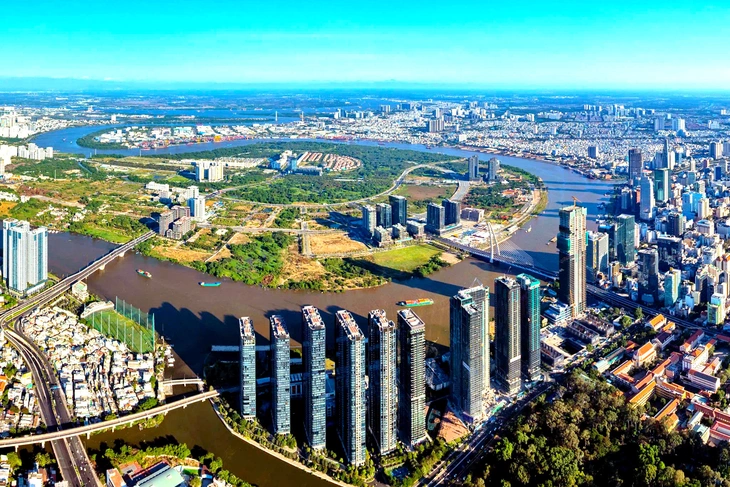
Ho Chi Minh City needs to continue improving the business environment, promoting the development of new technologies and innovation to create strong development momentum - Photo: VAN TRUNG
Speaking with Tuoi Tre , Dr. Nguyen Quoc Viet - former Deputy Director of the Institute for Economic and Policy Research, lecturer at the University of Economics, Vietnam National University, Hanoi - said:
- Resolution 306 on adjusting the national master plan was issued in the context of our determination to transform the growth model, striving to achieve high and sustainable growth. In addition, the Central Government has implemented reforms to streamline the state apparatus and organize two-level local governments.
Therefore, it is necessary to reorganize the development space to suit the trend of renewing the growth model and organizing a new administrative apparatus after merging ministries, provinces and cities and operating two-level local governments. The ultimate goal is to create a new growth and development space, simplify procedures and increase management efficiency.
* So how will clearly identifying the country's growth drivers and growth poles in the next five years promote the overall growth of the economy?

Dr. Nguyen Quoc Viet
- With the characteristics of Vietnam's economy, the new growth space must emphasize two factors, firstly promoting the role of urban cores.
For example, Hanoi and Ho Chi Minh City are core growth areas, promoting the development of new technologies, innovation, new technology development trends, and cutting-edge technologies.
Can Tho City will be a center for modern, ecological, high-quality agricultural processing combined with tourism.
The two dynamic regions of North Central and Central Vietnam need to promote the development of clean industry, energy, tourism, and coastal logistics.
In addition, identifying growth driver regions is a major orientation for connecting intra-regional space, linking regions with new economic development strategies, especially economic development based on science and technology, innovation, digital transformation, and green economy.
Finally, dynamic regional development will create better efficiency for the development of high-tech industrial parks and clusters, towards the global value chain.
This will promote the improvement of labor productivity as well as the contribution rate of total factor productivity (TFP) to the economy's GDP (the target by 2030 must reach 55%).
Vietnam is in the transition period from an extensive growth model (based on resource-intensive, cheap labor) to an intensive growth model (based on improving labor productivity, innovation, application of science and technology, and digital transformation as a foundation).
Therefore, promoting dynamic regions with growth poles being large cities - centers attracting investment resources in high technology, especially in the processing, manufacturing and service industries to reduce business costs and logistics costs is very important.
The growth poles of Hanoi and Ho Chi Minh City play a decisive role in the development of the two most important dynamic regions in the North and the South. These are the two largest growth poles in the country, where all the conditions of finance, human resources, open mechanisms, and experimental policies converge to attract projects, creative ideas, and attract private investment and FDI capital.
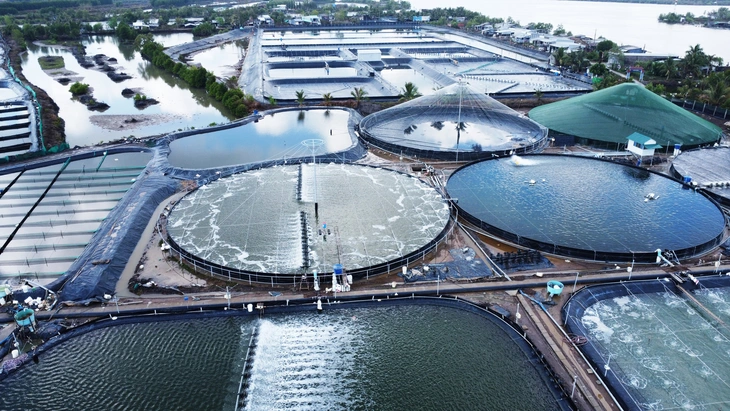
The merger of Ca Mau and Bac Lieu has created a great position in developing the marine economy and fisheries economy - Photo: THANH HUYEN
* In your opinion, what can Vietnam learn from the regional development experiences of leading countries such as Japan and France to promote economic growth?
- In the process of rearranging the country's development space in recent times, we have learned and absorbed the experiences of many countries in the world. Accordingly, the merger of provinces and cities, the re-division of socio-economic regions has not simply been a matter of adding up mechanical administrative space. The process of reorganizing the development space has been based on development corridors and comparative advantages that can support each other.
Regional connectivity based on comparative advantages has received more attention. For example, connecting Ha Long Bay (Quang Ninh) with Lan Ha Bay (Hai Phong) to exploit the maximum efficiency of the natural landscape ecosystem of the two bays.
Second, the connection between urban centers with production infrastructure and logistics services is more focused. In many Asian countries, large urban centers often account for 1/3, even 1/2 of the capital region's population. Obviously, solving urban problems and improving the operational efficiency of large cities such as Hanoi and Ho Chi Minh City as regional growth poles is a story that we must consider.
Third, Vietnam has a long coastline, many comparative advantages in developing a marine-oriented economy. Experience from some Asian countries shows that to achieve high growth and become a developed country, the first thing is to develop growth drivers associated with marine economic advantages. This is what Vietnam must learn and strive for in the coming time.
Identify 5 growth drivers
The Northern growth dynamic region includes: Hanoi and areas associated with the capital's beltways 4 and 5, National Highway 18, expressways CT01, CT04, CT05, CT07, CT09 through Hai Phong city, the provinces of Bac Ninh, Thai Nguyen, Phu Tho, Ninh Binh, Hung Yen, Quang Ninh.
The Southern growth dynamic region includes localities along National Highway 22, National Highway 13, National Highway 1, National Highway 51, the North-South Expressway in the West, and Ring Road 4 through Ho Chi Minh City, Dong Nai, and Tay Ninh.
The Central region's growth engine includes coastal areas of the provinces and cities: Hue, Da Nang, Quang Ngai, Gia Lai.
The Mekong Delta growth dynamic zone includes the areas of Can Tho city and the provinces of An Giang, Vinh Long, Dong Thap associated with the connecting areas of the North-South expressway in the east, the North-South expressway in the west, the An Huu - Cao Lanh - Rach Soi expressway, the Chau Doc - Can Tho - Soc Trang expressway, the Ha Tien - Rach Gia - Bac Lieu expressway and the Phu Quoc special economic zone.
The North Central dynamic region includes the area along the eastern North-South expressway, coastal roads, National Highway 1 connecting with provincial central urban areas, coastal tourist areas of the three provinces of Thanh Hoa, Nghe An, and Ha Tinh.
Mr. Nguyen Huu Thong (Deputy Head of the National Assembly Delegation of Lam Dong province):
Prioritize the development of coastal economic zones
In practice, the Central region has established and developed many coastal economic zones that act as a driving force for local and regional growth. For example, Chu Lai Economic Zone (Da Nang) and Van Phong Economic Zone (Khanh Hoa).
At the same time, many provinces in the region currently have full potential and advantages to continue forming and developing coastal economic zones such as Lam Dong, Gia Lai, Dak Lak, etc. to effectively exploit marine space, promote industry, services, logistics, tourism and comprehensive marine economy.
Therefore, if the organization of regional development space is not linked, it will be difficult to exploit large-scale inter-regional and inter-sectoral projects, especially strategic infrastructure projects, coastal industry and seaport services.
At the same time, it is necessary to define the sea and coastal areas of the Central region from Thanh Hoa to Lam Dong, which will help improve the efficiency of coastal economic zone development. Continue to form and develop the system of coastal urban areas and seaport services, especially specialized seaports associated with economic zones and industrial parks.
Source: https://tuoitre.vn/dinh-danh-cac-cuc-tang-truong-cua-dat-nuoc-20251201082803845.htm


![[Photo] Prime Minister Pham Minh Chinh receives President of Cuba's Latin American News Agency](/_next/image?url=https%3A%2F%2Fvphoto.vietnam.vn%2Fthumb%2F1200x675%2Fvietnam%2Fresource%2FIMAGE%2F2025%2F12%2F01%2F1764569497815_dsc-2890-jpg.webp&w=3840&q=75)








































































Comment (0)