

A launching pad from a consolidation strategy and public investment.
Following their historic administrative merger, Ho Chi Minh City and Dong Nai have demonstrated positive development potential in the Southeast region of Vietnam.
The formation of the new Ho Chi Minh City (comprising Ho Chi Minh City, Ba Ria - Vung Tau , and Binh Duong) and the new Dong Nai (comprising Dong Nai and Binh Phuoc) is not simply an expansion of administrative boundaries, but a consolidation of strengths to create a key economic region.
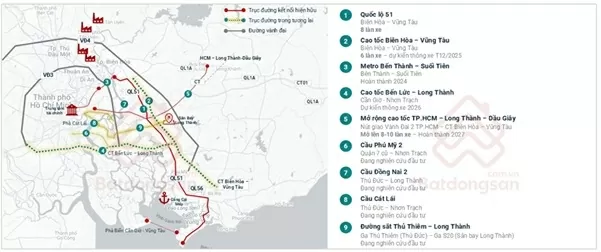 |
| Infrastructure is the driving force behind Dong Nai 's development. (Source: Batdongsan.com.vn) |
After the merger, Ho Chi Minh City's GRDP reached over 2.7 trillion VND (in 2024), leading the country; while Dong Nai ranked 4th with over 609 trillion VND.
The border area between Dong Nai and Ho Chi Minh City has a low population density, abundant land resources, and low land prices, creating significant potential for urbanization. In addition, increased public investment is driving economic development. As of the end of September 2025, Ho Chi Minh City had disbursed 50% of its public investment capital, while Dong Nai had reached 35%.
Dong Nai holds a strategic position within the expanding urban and port-airport logistics landscape east of Ho Chi Minh City. A series of key infrastructure projects are gradually transforming the eastern region, including: Long Thanh International Airport, Cai Mep - Thi Vai Port, Bien Hoa - Vung Tau Expressway, Ho Chi Minh City - Long Thanh - Dau Giay Expressway, Cat Lai Bridge, Phu My 2 Bridge, Dong Nai 2 Bridge, and the Thu Thiem - Long Thanh railway line…
Dong Nai - the new focal point for investment flows from the East.
The synergy between regional planning, infrastructure, and the pace of urbanization is driving a shift in investment flows towards the East.
According to data from Batdongsan.com.vn , as of September 2025, interest in real estate in Dong Nai increased by 21%, double that of the eastern area of Ho Chi Minh City and far surpassing other areas.
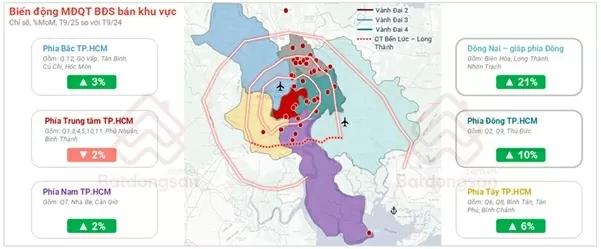 |
Real estate in the eastern region is experiencing increased interest, especially in Dong Nai. (Source: Batdongsan.com.vn) |
Another bright spot in the real estate market bordering the eastern part of Ho Chi Minh City lies in the rental yield of apartments. While District 2 achieved 2.1%, District 9 around 2.7%, and Thu Duc 3.3%, Bien Hoa rose to the top with 4.4%, followed by Nhon Trach at 3.2%.
This demonstrates the real profit potential of the Bien Hoa, Dong Nai market, not only for long-term investment and holding, but also for generating short-term cash flow through rentals, a factor attracting investor attention in a market seeking high liquidity.
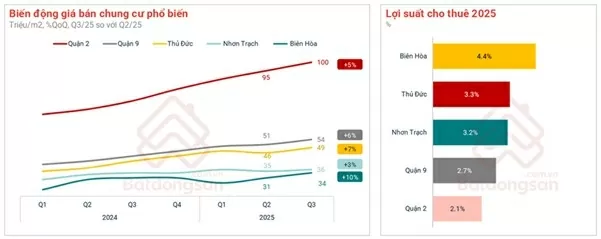 |
Bien Hoa leads in rental yields in the eastern area. (Source: Batdongsan.com.vn) |
In the land plot segment, the market in the East of Ho Chi Minh City is also recovering. Interest in this area increased by 6% in September 2025 compared to April 2025, higher than the West (+3%) and the North (+5%), contrary to the downward trend in the South.
Specifically in Bien Hoa and Long Thanh, the common asking price in Q3 2025 ranged from 16-23 million VND/m2, an increase of 5-7% compared to Q1 2025. Compared to the average price of 130 million VND/m2 in the center of Ho Chi Minh City, this difference shows that there is still significant room for growth.
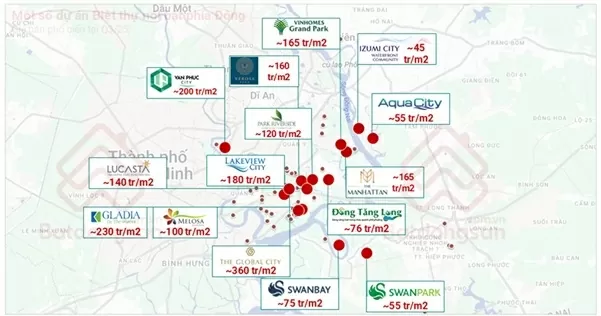 |
Price levels for projects in the eastern part of Ho Chi Minh City, Dong Nai province. (Source: Batdongsan.com.vn) |
Interest in low-rise properties within urban areas in Bien Hoa – an area bordering the eastern part of Ho Chi Minh City – increased by 58% in Q3 2025 compared to the previous quarter.
The price level for this type of property in the central area of Ho Chi Minh City is slightly decreasing and remains at 248 million VND/m2. Meanwhile, the price level for low-rise properties in the Dong Nai area – bordering the eastern part of Ho Chi Minh City – fluctuates around 55 million VND/m2 and is still up 6% compared to Q1/2023.
Some urban areas still have attractive prices, for example, Izumi City (Long Hung, Dong Nai) with a scale of nearly 170 hectares, currently priced at around 45 million VND/m2.
According to Mr. Nguyen Quoc Anh, Deputy General Director of Batdongsan.com.vn , in the short term, investors should prioritize areas that have already formed distinct urban areas, with the potential for rental income or to meet actual housing needs. In the long term, infrastructure progress and urbanization rate will be the decisive factors in determining the real value of the eastern region in the next development cycle.
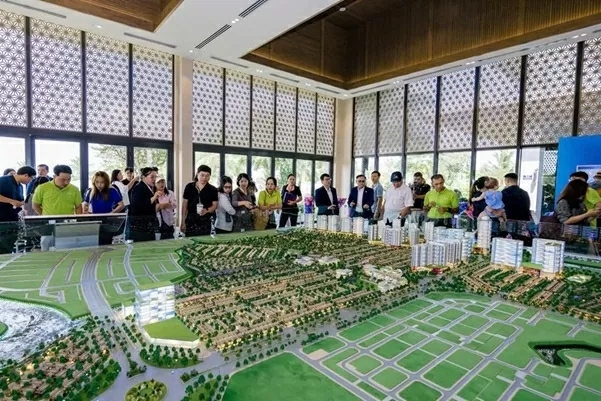 |
| Customers visit a project on the eastern border of Ho Chi Minh City. (Source: Batdongsan.com.vn) |
“In reality, as land prices in the center of Ho Chi Minh City continue to rise and land becomes increasingly limited, the trend of population decentralization and investment expansion to suburban areas is inevitable. Dong Nai, with its position as a gateway connecting the Southeast region, possesses a 'three-in-one' advantage: low land prices, rapidly developing infrastructure, and high rental yields,” Mr. Quoc Anh commented.
Source: https://baoquocte.vn/dong-luc-tang-truong-cua-vung-do-thi-ve-tinh-phia-dong-tp-ho-chi-minh-334656.html

![[Photo] Prime Minister Pham Minh Chinh receives the Governor of Tochigi Province (Japan)](/_next/image?url=https%3A%2F%2Fvphoto.vietnam.vn%2Fthumb%2F1200x675%2Fvietnam%2Fresource%2FIMAGE%2F2025%2F12%2F16%2F1765892133176_dsc-8082-6425-jpg.webp&w=3840&q=75)
![[Live] 2025 Community Action Awards Gala](/_next/image?url=https%3A%2F%2Fvphoto.vietnam.vn%2Fthumb%2F1200x675%2Fvietnam%2Fresource%2FIMAGE%2F2025%2F12%2F16%2F1765899631650_ndo_tr_z7334013144784-9f9fe10a6d63584c85aff40f2957c250-jpg.webp&w=3840&q=75)
![[Image] Leaked images ahead of the 2025 Community Action Awards gala.](/_next/image?url=https%3A%2F%2Fvphoto.vietnam.vn%2Fthumb%2F1200x675%2Fvietnam%2Fresource%2FIMAGE%2F2025%2F12%2F16%2F1765882828720_ndo_br_thiet-ke-chua-co-ten-45-png.webp&w=3840&q=75)

![[Photo] Prime Minister Pham Minh Chinh receives Lao Minister of Education and Sports Thongsalith Mangnormek](/_next/image?url=https%3A%2F%2Fvphoto.vietnam.vn%2Fthumb%2F1200x675%2Fvietnam%2Fresource%2FIMAGE%2F2025%2F12%2F16%2F1765876834721_dsc-7519-jpg.webp&w=3840&q=75)




































![[Photo] Prime Minister Pham Minh Chinh attends the Vietnam Economic Forum 2025](https://vphoto.vietnam.vn/thumb/402x226/vietnam/resource/IMAGE/2025/12/16/1765893035503_ndo_br_dsc-8043-jpg.webp)




















Comment (0)