

Vietnam could welcome up to 12 million tourists.
In the draft law amending and supplementing several articles of the Law on Exit and Entry of Vietnamese Citizens and the Law on Entry, Exit, Transit, and Residence of Foreigners in Vietnam, which the Government has submitted to the National Assembly, there are two provisions that directly impact the tourism industry. These are the proposal to extend the validity period of electronic visas from no more than 30 days to no more than 3 months, and the proposal to extend the validity period of temporary residence certificates at border gates for those entering under the unilateral visa exemption scheme from no more than 15 days to no more than 45 days.
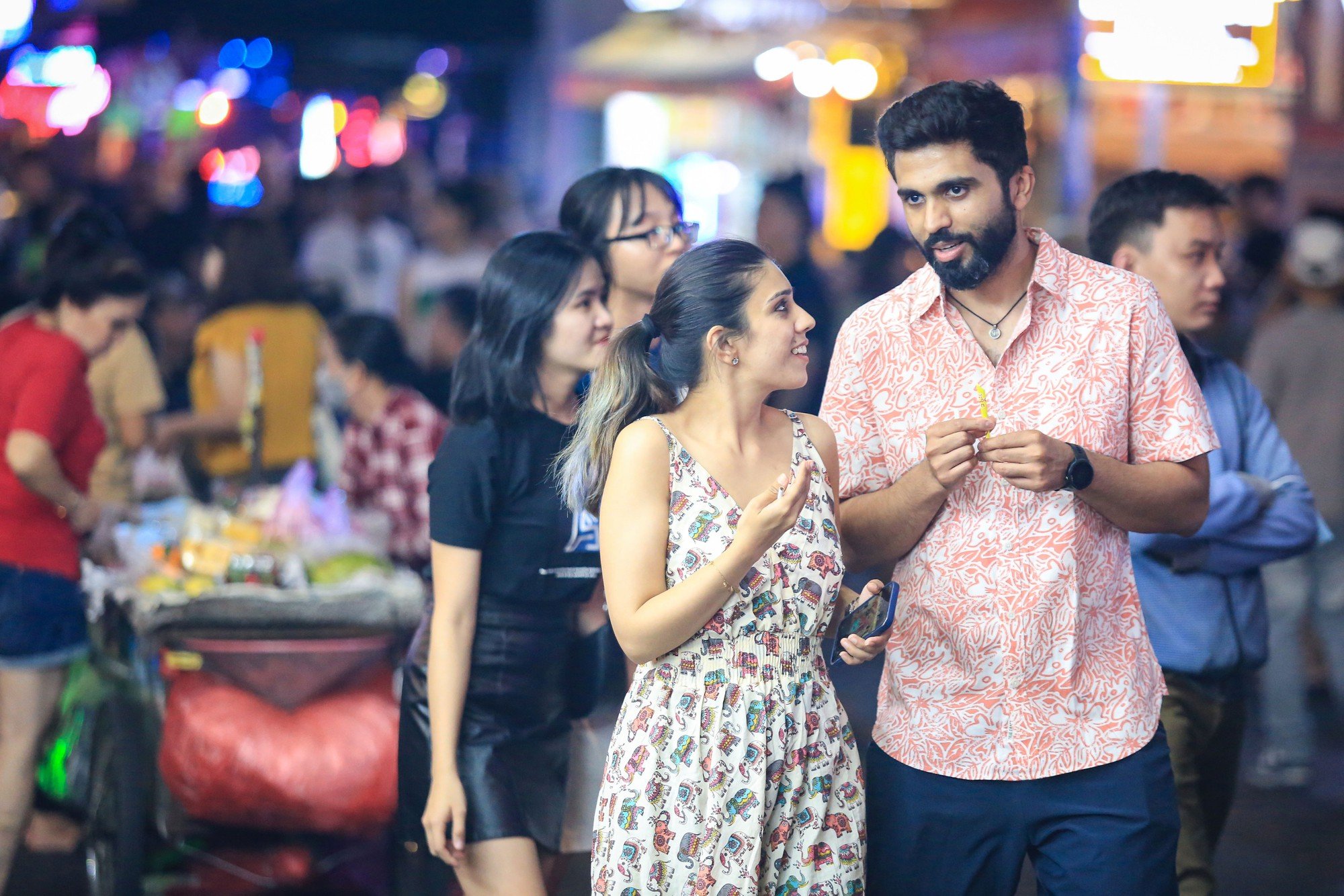
Foreign tourists at Bui Vien Walking Street (District 1, Ho Chi Minh City)
"If the above proposals are approved by the National Assembly and implemented starting this May, along with a further expansion of the visa-exempt list, the tourism industry will not have to worry about reaching the target of 8 million international visitors, but could welcome around 12 million," confidently predicted Dr. Luong Hoai Nam, a member of the Vietnam Tourism Advisory Board (TAB).
Mr. Nam analyzed: Firstly, increasing the validity period of the e-visa from 30 days to 3 months means increased flexibility for tourists when planning their trips. Tourists can depart on any day, at any time within the 3-month period. Also, because it's 90 days, tourists can enter and exit the country multiple times, not just once as before, and they don't need to reapply for a visa upon arrival or departure. This will create opportunities to diversify tourist experiences. For example, tourists can visit Vietnam for a while, then go to Thailand, Laos, Cambodia, or even return to their home country and then come back to Vietnam to continue their experiences. The idea of "One visa - Many destinations" in the CLMV sub-region (Cambodia - Laos - Myanmar - Vietnam), in which our country plays an important role, will soon have the opportunity to become a reality.
Furthermore, this regulation is also suitable for certain groups that Vietnamese tourism has previously struggled to reach, such as retirees. In developed countries, many elderly retirees have ample time to organize long trips. There is even a growing trend of retirees renting out their homes and then traveling for extended periods in other countries. A visa validity of up to 90 days is ideal for tapping into the leisure tourism segment for retirees, allowing them to enjoy their entire winter or summer vacation.
Furthermore, after Covid-19, a new type of "homeless" traveler has emerged – meaning many businesses have adopted the habit of not requiring employees to come to the office and instead allowing them to work online. These individuals then bring their laptops along, combining travel with remote work. Some countries have implemented separate visa programs for this type of traveler, and with the new regulations, Vietnam will also become a potential destination.
Furthermore, foreign investors in Vietnamese real estate are also eagerly awaiting the opening of this visa. It will make it more convenient for them to visit their second home, bring family and friends for vacations, and explore Vietnam. The resort real estate market – currently the biggest "iceberg" in the real estate industry – will soon be revitalized.
"In the current challenging and fiercely competitive market, the more we expand our target customer base, the sooner tourism will recover, and the more industries will benefit from it," this expert affirmed.
In fact, before Vietnam, many countries had already used visa extension policies as a "magnet" to rapidly attract tourists. For example, after the pandemic, Thailand quickly implemented a visa fee waiver policy to attract international tourists, while also extending tourist visas to a maximum of 45 days to encourage longer stays. As a result, the Land of Smiles impressively welcomed 11.8 million international tourists in less than a year after officially reopening and continues to aim for 25 million international tourists in 2023, based on extending the 45-day visa policy for visa-exempt markets.
The longer tourists stay, the more money the tourism industry makes.
According to travel companies, a 15-day trip is too short for tourists from distant markets such as Europe and North America. As a company that has been attracting many wealthy groups from India to Vietnam for lavish weddings and events, Mr. Than Huynh Vinh Thuy, Business Director of Yen Tu Tung Lam Company, said that high-end Indian clients coming to Vietnam for events or weddings are willing to spend a lot of money and have a need for extended stays. Before the main event, they will visit resorts and vacation areas for a long time to conduct thorough surveys before bringing the bride and groom's families to stay. Afterwards, most groups often take advantage of their trip to Vietnam to visit many more places. For example, if they hold a wedding in Yen Tu, they will create a tour program to Ha Long Bay, Hanoi, or Sa Pa. Each such group currently spends several billion VND on a single event.
"If visa procedures were more streamlined and convenient, Vietnam would have great potential to attract high-end tourists from the Indian market. The more opportunities we create for them to stay longer, the more money they will spend, and the entire tourism industry will benefit," Mr. Thuy said.
Analyzing the issue from a product perspective, Chairman of Vietravel Corporation Nguyen Quoc Ky assessed: "The chronic problem" of Vietnam's tourism industry is that tourists stay for only a few days, spend little, and don't return, largely due to inadequate regulations. Visa validity limits and restrictions on the length of stay prevent travel companies from diversifying and enriching their product offerings. Historically, companies have only built product packages in a stick-like format, focusing on prominent destinations in the North and South, such as Hanoi to Da Nang, Hue, Hoi An, Quy Nhon, then back to Ho Chi Minh City, and the Mekong Delta. These cross-Vietnam tours are typically limited to 10-15 days, monotonous, and discourage tourists from returning once, believing they've explored enough of Vietnam. Because of this stick-like, slide-like approach, the impact of tourism on the economy is minimal and lacks a strong ripple effect. All tourism companies want to shift their product model to a herringbone or deer antler shape, meaning expanding horizontally and attracting tourists to areas with tourism development potential. This will create a ripple effect, broaden the list of tourism-developing localities, and encourage tourists to stay longer, wanting to return to explore Vietnam again after completing their tours."
"Extending the length of stay is a prerequisite for transitioning to these types of product models. The tourism industry must always clearly define how to encourage tourists to stay as long as possible, travel on longer routes, not only to major tourist centers but also to areas with potential to attract visitors. The longer tourists stay and the more they travel, the more they spend, and the more tourism and the economy benefit," Mr. Nguyen Quoc Ky commented.
Besides easing visa extensions and increasing the length of stay for tourists, the list of visa-exempt countries also needs to be quickly submitted to the National Assembly for approval. This is an essential requirement in terms of destination competitiveness. Vietnam will not be able to compete with a list of 26 visa-exempt countries, while Malaysia and Singapore have visa-exempt countries for 162, the Philippines for 157, and Thailand for 64 countries… If approved by the National Assembly, removing the visa bottleneck will be a boost for Vietnamese tourism to accelerate from the autumn-winter tourist season at the end of this year.
Mr. Nguyen Quoc Ky (Chairman of the Board of Directors of Vietravel Corporation)
Source link


![[Photo] Portraits of the 19 members of the Politburo of the 14th Party Congress](/_next/image?url=https%3A%2F%2Fvphoto.vietnam.vn%2Fthumb%2F1200x675%2Fvietnam%2Fresource%2FIMAGE%2F2026%2F01%2F23%2F1769161873355_z7460119485980-304d85fe10d12298f1db614b0d2aa6bc-jpg.webp&w=3840&q=75)


![[Photo] Special art program 'Under the glorious banner of the Party'](/_next/image?url=https%3A%2F%2Fvphoto.vietnam.vn%2Fthumb%2F402x226%2Fvietnam%2Fresource%2FIMAGE%2F2026%2F01%2F24%2F1769217384206_image_20260124072702.jpeg&w=3840&q=75)



Comment (0)