

Ganymede, Jupiter's largest moon and also the largest moon in the solar system, may function as a giant dark matter detector. Physicists believe that large dark matter particles, if they exist, could create unusual impact craters on Ganymede's icy surface.
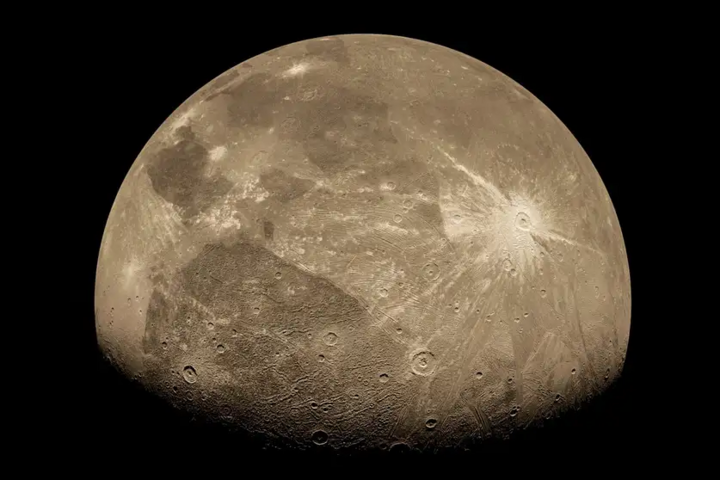
A view of Ganymede from NASA's Juno spacecraft. (Source: NASA)
Typically, scientists search for dark matter as ultralight particles that interact very weakly with ordinary matter. However, another hypothesis suggests that dark matter may exist as very large particles – ranging in size from a basketball to an asteroid – but which are extremely rare and difficult to detect.
Because of the rarity of large dark matter particles, detecting them requires a detector of enormous size – like a moon or planet. Ganymede, with its ancient and relatively unaltered icy surface, is an ideal candidate to preserve the traces of these rare collisions.
Future space exploration missions could help detect unique impact craters caused by dark matter. If found, this would be crucial evidence for the existence of a new type of dark matter and open up entirely new avenues of research in astrophysics.
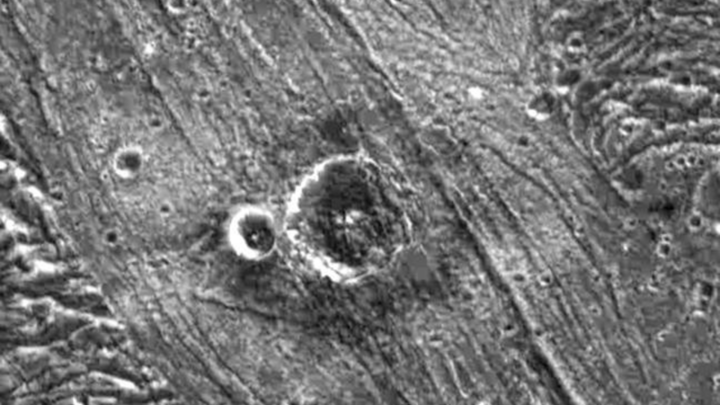
The distinctive impact crater on Ganymede. (Source: NASA)
Dark matter is a form of matter that does not emit light or any other type of radiation that can be detected by telescopes. Although it cannot be seen directly, scientists believe it exists because of its gravitational influence on galaxies and objects in the universe.
Galaxies rotate faster than their visible mass can explain. This suggests there's a large amount of "hidden" matter holding them together by gravity. Dark matter accounts for about 85% of the total mass in the universe, but we only understand a small fraction of it.
Dark matter is extremely important in the universe – not because we understand it well, but because it governs how the universe works.
If we relied solely on the mass of the stars and planets we see, galaxies would disintegrate as they rotate. But in reality, they remain stable – suggesting there's an additional gravitational force from dark matter holding them together.
Immediately after the Big Bang, dark matter helped form galaxy clusters, galaxies, and other large structures. Without dark matter, the universe would not be in its current form – it would likely be just a thin cloud of gas.
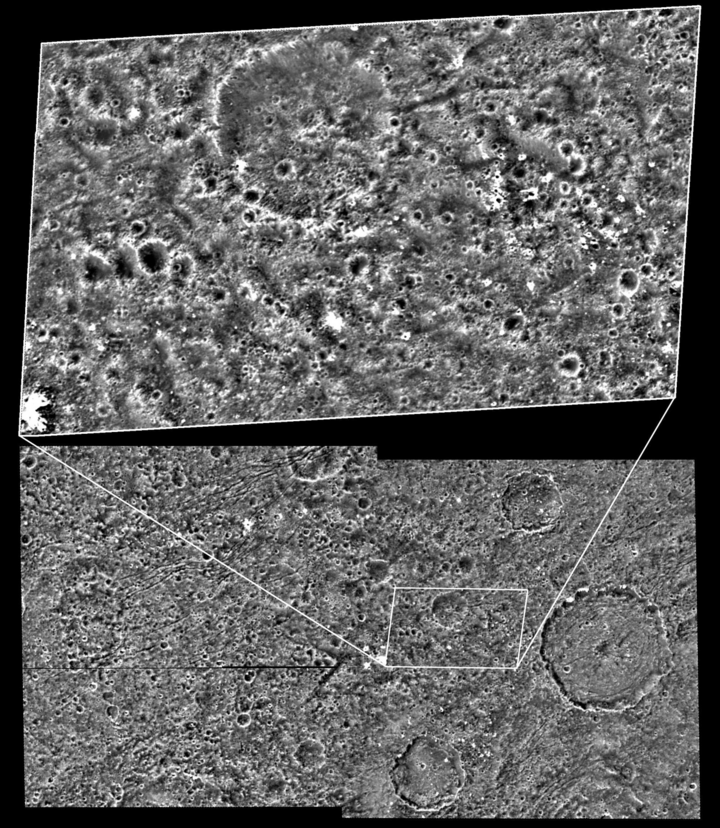
Ganymede's dark surface – a repository of impact history. (Source: NASA)
Because dark matter doesn't interact with light, yet exerts a strong gravitational influence, it could help us test and expand existing physics theories like relativity or the Standard Model of particle physics. The discovery of dark matter could lead to the discovery of new fundamental particles, or even other dimensions. It's a gateway to expanding our understanding of the nature of the universe.
Missions like NASA's Ganymede probe are searching for traces of massive dark matter – particles that could create the distinctive impact craters on this moon's icy surface. If discovered, it would be a major breakthrough in astronomy.
Source: https://vtcnews.vn/ganymede-thiet-bi-do-vat-chat-toi-tu-nhien-ar960424.html
![[Photo] Admire the coral "masterpiece" amidst the million-year-old heritage of Dak Lak province.](https://vphoto.vietnam.vn/thumb/1200x675/vietnam/resource/IMAGE/2026/05/30/1780107638639_y25-jpg.webp)









![[GALLERY] The million-dollar 007 blockbuster is causing a sensation on Steam, is it worth buying?](https://vphoto.vietnam.vn/thumb/402x226/vietnam/resource/IMAGE/2026/05/29/1780064112088_ta-2-png.webp)































































































Comment (0)